Simons Maison
Mango-Wood Serving Spoon
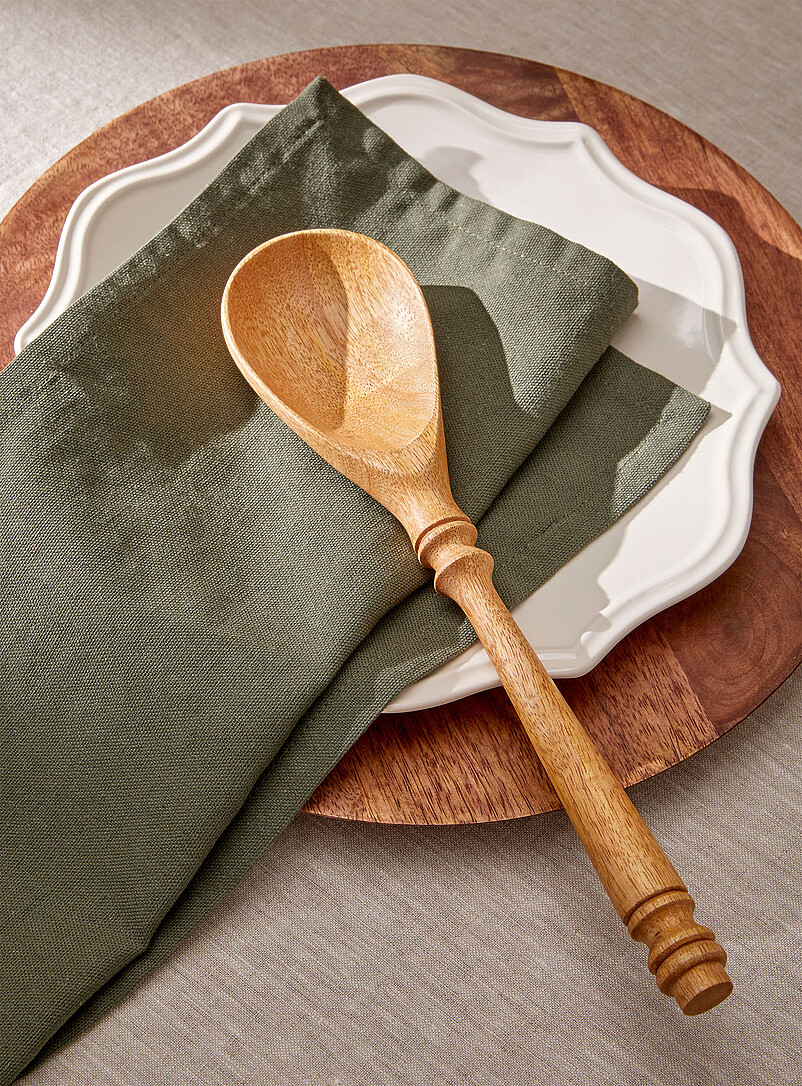
This serving spoon is crafted from a single piece of mango wood, featuring an oval shallow bowl and a turned cylindrical handle with decorative rings. It measures 12.5 inches (31.5 cm) in length and 2.75 inches (7 cm) in width, making it suitable for serving salads, sides, or other dishes. Care instructions: wipe with a dry cloth only and avoid contact with liquids; matching serving pieces are sold separately.
- Category
- Home & Garden > Kitchen & Dining > Kitchen Tools & Utensils
Specifications
- Material
- 100% mango wood
- Gender
- unisex
- Age Group
- adult
- Condition
- new
- Category
- Home & Garden > Kitchen & Dining > Kitchen Tools & Utensils
Product Insights
A hand-carved, single-piece mango wood spoon from retired orchard trees that sequesters carbon and is fully biodegradable at disposal because it lacks synthetic coatings, priced at $8.99–12 CAD—less than oil-finished alternatives—with unique grain and gentle non-stick safety, but its lower hardness means visible scratches develop with use and requires dry-cloth care, optional mineral oil altering the surface.
Verified claims
- Value
- At $8.99–12 CAD, costs less than oil-finished wood spoons due to no finishing.
- Durability
- Single-piece mango wood, half the hardness of olive wood; scratches faster but no glue seams.
- Biodegradability
- Fully biodegradable at disposal because it has no synthetic coatings.
- Sourcing
- Mango wood from retired orchard trees turns agricultural waste into a carbon-sequestering $8.99 spoon.
- Patina
- Mango wood's lower hardness means the spoon develops a visible patina of scratches with use.
- Natural variation
- Sold as 'Assorted' so each spoon has unique grain; the entire matching collection uses the same 100% mango wood.
- Non-stick safe
- Mango wood is gentle on non-stick cookware surfaces.
- Artisanal
- Hand-carved from a single piece; each spoon has unique grain.
- Material
- Mango wood is salvaged from fruit trees that have stopped bearing.
- Single-piece construction
- Hand-carved from a single piece of mango wood with no glued joints.
- Aesthetic variation
- Natural grain variation gives each piece a distinct, artisanal look.
- Non-stick & flavor
- Safe for non-stick pans; any natural mango-wood scent is too faint to transfer to food, and no noticeable taste is left behind.
- Care
- Dry-cloth-only care; food-grade mineral oil may be applied monthly when the wood looks dry, but it can alter the surface.
- Carbon storage
- As a solid mango-wood object, the spoon sequesters carbon absorbed during tree growth for decades.
- Water exposure
- If the spoon gets wet, its unfinished mango wood can absorb moisture unevenly and warp or split along the grain.
- Finish
- The spoon ships without oil or sealant, leaving the mango wood surface unfinished.
- Matching collection
- Matching Simons Maison serveware pieces are also 100% mango wood with assorted natural grain variation, so a set keeps a warm, organic look.
- Durability perception
- Buyers describe the spoon as sturdy and nicely made.
- Sourcing
- The spoon's mango wood comes from orchard trees removed after fruit-bearing years decline around age 15-20, so it uses a waste stream without clearing natural forests.
Product record
- Title
- Mango-Wood Serving Spoon
- Brand
- Simons Maison
- Price
- 12 CAD
- Availability
- In stock
Buying Guide
1 comparison · 3 sourcesUses
Serving dishes at dinner parties
Bring this mango-wood serving spoon out when hosting dinner parties. Reviews analysis describes the wood as sturdy and visually appealing, with a rustic-chic look that guests have complimented, blending form with function for serving dishes.[1]
Serving hearty dishes at everyday family meals
Scoop and serve hearty family dishes with a spoon reviewers describe as solid enough not to flex, with a well-balanced shape that makes it easy to handle for daily serving. Per reviewer feedback, it holds up to everyday use, though the manufacturer recommends wiping it clean with a dry cloth only and avoiding liquids.[1]
A color caution for bright or minimalist table settings
If you're aiming for a carefully coordinated, light-toned table, reviewers' feedback (summarized in a reviews analysis) suggests checking expectations: the wood on this serving spoon comes across as darker and grey-toned than the name might suggest. That deeper color can clash with lighter ceramics and linens, potentially working against a bright or minimalist aesthetic.[1]
Not the pick if you want a lightweight, slender serving spoon
Per a review analysis, this mango-wood serving spoon is thicker and heavier than many serving spoons, which some reviewers found substantial. Shoppers who prefer a delicate, lightweight utensil — including those with smaller hands or serving for longer stretches — may find the added heft bulky or unwieldy, especially if expecting a sleeker profile.[1]
Product comparison
Compared within this brand.
| Mango-Wood Serving Spoon: Choose this if you want a carved, one-piece 100% mango wood serving spoon for dinner parties or everyday family meals—review analysis describes it as sturdy enough for scooping hearty dishes without flexing, with an eye-catching grain and a rustic-chic look guests compliment. Be aware the wood often appears darker and greyer than online images, which can clash with lighter ceramics and minimalist table settings, and its thicker-than-average build may feel bulky if you prefer lightweight utensils. Care is dry-cloth only, with any contact with liquids to be avoided.[1] | Acacia Wood Salad Utensils 2-Piece Set: Choose this if you want a compact 2-piece wooden serving set for preparing and serving salads: one slotted three-tine fork and one flat paddle, each about 7.5 by 3.5 inches, in warm acacia wood with a smooth satin finish and visible two-tone grain. Note that these are hand-wash only, and matching pieces are sold separately.[2,3] |
Image Analysis
1 images- 01
Product
Single carved wooden serving spoon shown diagonally with an oval shallow bowl and a turned cylindrical handle featuring decorative rings; visible smooth finish and pronounced straight and flecked wood grain across bowl and handle.
- Overall geometryOne-piece carved spoon with an oval, shallow bowl transitioning into a long, round turned handle; spoon lies diagonally from upper-left toward lower-right of the image.
1 region
x 0.18 · y 0.06 · w 0.64 · h 0.84 (high) - Bowl shape and finishOval, shallow concave bowl with smoothly sanded interior and a subtle satin sheen; interior shows visible open wood pores and streaked grain patterns.
1 region
x 0.20 · y 0.06 · w 0.32 · h 0.26 (high) - Handle turning detailCylindrical turned handle with multiple decorative rings and a stepped end profile; turning details are clearly visible near the joint with the bowl and at the butt end.
1 region
x 0.42 · y 0.28 · w 0.40 · h 0.58 (high) - Surface textureSmooth, lightly polished wood surface with visible linear grain and small darker streaks and flecks running along the length of the spoon.
1 region
x 0.20 · y 0.06 · w 0.62 · h 0.80 (high) - Join and carvingSeamless carved transition from bowl to handle indicating single-piece carving; no visible adhesives or joints on the visible side.
Other
Styled tabletop shot showing spoon on a folded green cloth napkin atop a white decorative plate and a round wooden charger, with neutral textured tablecloth background and soft directional lighting casting clear shadows.
- Napkin propLarge folded olive-green textured cloth napkin placed beneath the spoon, covering most of the plate surface.
1 region
x 0.06 · y 0.12 · w 0.66 · h 0.60 (high) - Plate and chargerWhite scalloped-edge decorative plate centered under the napkin, itself sitting on a round medium-brown wooden charger with visible wood grain.
2 regions
x 0.18 · y 0.02 · w 0.64 · h 0.46 (high); x 0.10 · y 0.22 · w 0.80 · h 0.58 (high) - Lighting and shadowSoft directional light from upper-left producing distinct soft shadow of the spoon and napkin toward lower-right; highlights on spoon bowl show light angle.
- Background surfaceNeutral beige textured tablecloth visible around the plate and under the charger.
1 region
x 0.00 · y 0.56 · w 0.48 · h 0.44 (high) - Image crop and focusProduct is fully in frame and in sharp focus; edges of the plate and charger approach the image borders but are not fully cropped.
Colors
honey mango wood· spoon bowl and handle#C4BAADnone· nonePackaging- Overall geometryOne-piece carved spoon with an oval, shallow bowl transitioning into a long, round turned handle; spoon lies diagonally from upper-left toward lower-right of the image.
Documents & Data
Customer Reviews
8 total8 reviews · out of 5
Solide, pratique et jolie!
Solide, pratique et jolie!
Well made.
Nicely made but the colour of the wood is much darker and grey than I expected. Also much thicker than expected.
Big
They are a nice size and shape, but not liking the color
Magnifique!
Magnifique!
An all-go-to cooking spoon
Very sturdy and practical spoon
A-1 quality!
I love these Mango-wood spoons. Great quality and look!
Magnifique
Tout simplement magnifique
Wow
Wow