MESSYWEEKEND
Milo Narrow Rectangular Reading Glasses Blue Light Blocking
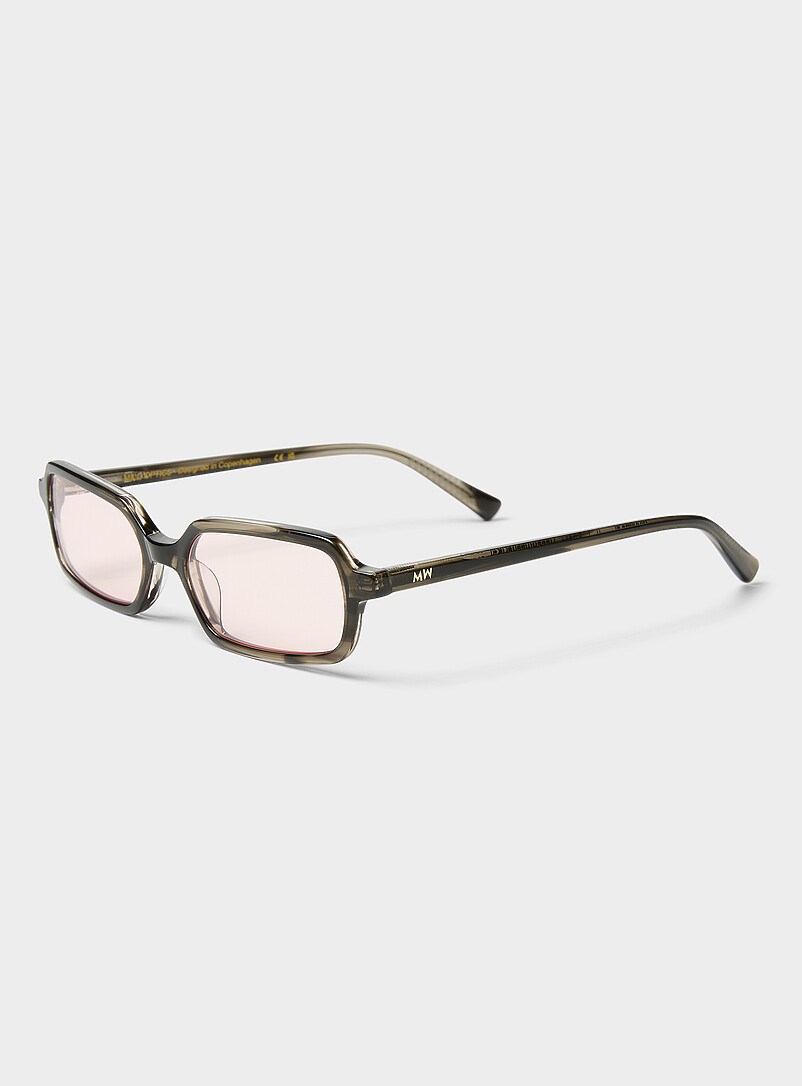
The Milo narrow rectangular reading glasses from MessyWeekend at Simons feature an acetate frame with a translucent brown-olive finish and pale pink-tinted lenses. Their anti-blue light lens coating makes them ideal for screen use. Key measurements include 52 mm eye width, 17 mm bridge, and 145 mm temple length; a box and soft designer case are included.
- Material
- Acetate
- Gender
- unisex
- Category
- Apparel & Accessories > Clothing Accessories > Sunglasses
Color
Size
Specifications
Narrow rectangular reading glasses with blue light blocking coating, acetate frame, includes case.
Anti-blue light lens coating, acetate frame, includes box and soft case.
- Material
- Acetate
- Gender
- unisex
- Age Group
- adult
- Condition
- new
- Category
- Apparel & Accessories > Clothing Accessories > Sunglasses
Additional Attributes
- Acetate frame
- Anti-blue light lens coating
- Ideal for screen use
- Includes box and soft designer case
- Eye width: 52 mm
- Bridge: 17 mm
- Temple: 145 mm
- Narrow rectangular shape
- MessyWeekend collection
Product Insights
MESSYWEEKEND's Milo narrow rectangular reading glasses are a Copenhagen-designed, Kickstarter-launched acetate frame that filters blue light with a clear, non-tinted coating, priced at $150 CAD (often $79.95 on sale, roughly 40% less than readers at Warby Parker or LensCrafters). They suit round faces, are hypoallergenic and phthalate-free, and with case storage and gentle care can last 5–10 years; they can be heat-adjusted by an optician for fit, but warp above 60°C and are permanently damaged by alcohol, acetone, or paper towels. The main tradeoffs: they are non-prescription with no diopter options, and the clear coating blocks only about 10–25% of blue light without a tint or color shift. Each purchase also funds 2 kg of plastic removal from the Colombian Pacific.
Verified claims
- Value
- At its 79.95 CAD sale, about 40% less than Warby Parker/LensCrafters readers
- Rival comparison
- Same-price rival Nooz Optics Milo uses featherlight TR90 with multi-distance lenses
- Blue-light lens
- Non-prescription blue-light reader; clear coating blocks 10-25% of blue light without a tint
- Frame longevity
- Acetate frame lasts 5–10 years with case storage and gentle care
- Lens coating
- Anti-blue-light lens blocks 10–25% of blue light, with anti-scratch coating
- Magnification
- Non-prescription reading glasses; no diopter strength options
- Blue light coating
- Milo's clear coating cuts roughly 15–30% of high-energy blue light.
- Durability
- Milo's acetate frame and anti-scratch blue-light lenses typically last 5-10 years with care.
- Brand heritage
- Launched via a $40k+ Kickstarter in 2018 and designed in Copenhagen.
- Environmental mission
- Every purchase funds 2 kg of plastic removal from the Colombian Pacific.
- Face shape suitability
- Narrow rectangular shape suits round faces, adding contrast and length.
- Fit adjustability
- Acetate frame can be heat-adjusted by an optician for a custom fit.
- Comfort
- Acetate frame distributes weight evenly and is hypoallergenic for comfortable wear.
- Material
- Acetate frame is hypoallergenic, phthalate-free, and lasts 5–10 years with proper care.
- Heat
- Acetate warps above 60°C yet can be reshaped by an optician.
- Cleaning
- Clean with mild soap and water only; alcohol, acetone, and paper towels cause permanent damage.
- Storage
- Store in the included case; perching on your head stretches the temples.
- Blue light filtering
- Clear coating filters roughly 10-25% of blue light with no color shift
- Care
- Acetate warps above 60°C and solvents permanently cloud it
Product record
- Title
- Milo Narrow Rectangular Reading Glasses Blue Light Blocking
- Brand
- MESSYWEEKEND
- Price
- 150 CAD
- Availability
- In stock
Deep Research
How the Milo compares in price and quality to similar reading glasses
- The Milo is part of MessyWeekend's Core Collection, originally priced at €85 (600 DKK) on the brand's store, sitting between the €55 TR90 Essential line and the €100 Premium acetate line; at its current 79.95 CAD sale price (~€53), it effectively costs less than the Essential Collection while retaining the Core's 100% acetate construction and classic rectangular silhouette, making it the brand's best-value entry into an acetate frame.
- In a 2024 cross-brand reader comparison, Warby Parker's reading glasses were priced at $95 USD and LensCrafters at $89 USD, while the Milo's sale price of 79.95 CAD (about $58 USD) is roughly 40% less; this allows a buyer to secure a 100% acetate, anti-blue light reader with a designer provenance for the cost of a basic reader from a mainstream optical chain, shifting the value decision toward style-led direct-to-consumer brands.
- At £69.90 (~C$120), Nooz Optics' own Milo (a coincidentally named round model) takes the same "reading glasses" category in a completely different direction: it swaps acetate for featherlight Swiss TR90 and embeds Multi-Distance lens technology that provides clear vision from near to 3 meters; for a buyer comparing prices, the MessyWeekend Milo prioritizes classic acetate aesthetics and a traditional blue-light filter, while the Nooz Milo channels a similar budget toward tech-forward, multi-range functionality — two distinct value propositions at comparable spend.
How to care for acetate frames to keep them looking new
- Acetate softens around 60°C (140°F), so leaving the frames on a hot car dashboard or using a hairdryer up close can permanently warp their alignment — when adjustments are needed, an optician uses controlled heat to safely reshape the material without damage.
- Acetate scratches and dents more easily than metal, so the included box or a dedicated hard case is essential to prevent surface damage when the glasses are stored in a bag or pocket.
- Pushing the glasses up onto the head gradually stretches the temple arms and misaligns the hinges because the top of the head is wider than the face — leaving them in their case instead preserves the original precise fit.
- Acetone, rubbing alcohol, ammonia, and perfumes chemically react with cellulose acetate, stripping its plasticizers and leaving an unfixable cloudy white film — only mild soap and water should touch the frames to maintain their deep gloss.
- To preserve the acetate's high-gloss finish, rinse the Milo frames under lukewarm water with a drop of mild dish soap and dry with the included microfiber cloth — paper towels contain microscopic wood fibers that act like sandpaper, creating micro-scratches that permanently dull the surface.
- Sweat, UV exposure, and harsh chemicals cause plasticizers to migrate to the surface, creating a dull white film over time — regular gentle cleaning and avoiding cosmetic contact slow this oxidation, and professional polishing can restore the original shine if it occurs.
How the narrow rectangular fit suits different face shapes
- Unlike injection-molded plastics, acetate can be carefully warmed and molded by an optician to refine bridge fit or temple bend, so the 17mm bridge and 145mm temples can be individually tuned for a bespoke feel while retaining the taupe translucent sheen that gives the Milo its refined character.
- The narrow rectangular shape embodies the classic styling principle for round faces: angular frames introduce contrast and visually lengthen the face, a recommendation directly echoed in eyewear guides, while the reduced width ensures the angularity stays refined rather than blocky.
MESSYWEEKEND's design approach and where Milo fits
- MESSYWEEKEND's AW26 editorial articulates a design philosophy of 'clean silhouettes, sculpted forms and balanced proportions' — the Milo’s narrow rectangular frame and 52mm eye width in Taupe channel that ethos into a reading glass that reads as purposefully refined rather than basic.
- MessyWeekend launched in 2018 via a $40k+ Kickstarter campaign, a crowdfunded origin that validates the brand’s ability to resonate with a community of early adopters — and underpins the Milo with authentic start-up credibility rather than corporate anonymity.
- Each MessyWeekend purchase funds the removal of 2kg of plastic waste from the Colombian Pacific through a partnership with NGO 4THEPLANET, making the Milo a purchase that doubles as a small environmental contribution.
- The Milo’s $79.95 CAD sale price (down from $150 CAD) mirrors MessyWeekend’s founding mission to slash traditional eyewear markups by selling direct — positioning it as a designer-styled reading glass at a mass-market price point.
Why an acetate frame matters for everyday reading glasses
- Quality acetate frames typically last 5–10 years with proper care — they resist cracking, maintain shape, and do not become brittle with age like injection-molded plastic, which averages only 1–3 years; for reading glasses worn daily at screens, the longer lifespan translates to a better cost-per-wear.
- The taupe hue on the Milio is integrated throughout the acetate material itself, not applied as a surface paint — so the color won't chip, fade, or peel even with daily handling and exposure to sunlight, keeping the frames looking newer far longer than painted plastic alternatives.
- When surface micro-scratches accumulate over years, an optician can polish the acetate frame back to a glossy finish — essentially restoring the ‘new’ look without replacing the glasses, a maintenance advantage that molded plastic frames do not offer.
- Acetate's excellent strength-to-weight ratio distributes the frame weight evenly across the nose and temples, minimizing pressure points and fatigue — important for reading glasses worn during marathon work sessions where heavy frames can dig in after a few hours.
- High-grade cellulose acetate is naturally hypoallergenic and phthalate-free, meaning these frames rest gently against the skin without causing irritation or discoloration — a crucial advantage for all-day screen sessions where sweat and contact can trigger reactions with lesser materials.
What a blue light coating actually changes during screen use
- Clear anti-blue light coatings like the one on the Milo remain practically invisible, avoiding the constant warm cast of yellow/amber lenses that block more blue light but introduce a noticeable tint — a trade-off that keeps the reading glasses looking and feeling like regular eyewear for casual screen sessions.
- The coating intentionally leaves a subtle blue-violet reflection on the lens front, a visible hallmark of the HEV-reflecting layer that also acts as a styling accent — one that pairs with the Milo’s acetate frame and signals the lens is actively filtering blue light.
Image Analysis
1 images- 01
Product
Narrow rectangular reading glasses photographed at a three-quarter front angle showing both lenses, bridge, temples and temple tips. Translucent brown/olive glossy frame with pink-tinted lenses and a small gold 'MW' logo on the right temple.
- Frame shapeNarrow rectangular front frame with slightly rounded corners and a defined bridge between lenses.
1 region
x 0.06 · y 0.54 · w 0.58 · h 0.26 (high) - Frame material and finishTranslucent brown/olive acetate-looking material with a glossy surface and visible internal depth.
1 region
x 0.06 · y 0.52 · w 0.70 · h 0.33 (medium) - Lens colorLenses have a pale pink tint visible across both lenses.
1 region
x 0.08 · y 0.58 · w 0.56 · h 0.22 (high) - Temple constructionSlim temples continuing the same translucent frame material, extending back to slightly curved temple tips.
2 regions
x 0.52 · y 0.58 · w 0.44 · h 0.20 (high); x 0.02 · y 0.58 · w 0.38 · h 0.20 (medium) - Hinge detailVisible hinge area at the outer edge of the lenses where temples attach, with a slight seam and a small metal pin.
1 region
x 0.22 · y 0.62 · w 0.12 · h 0.12 (medium) - Temple logo text“MW”
1 region
x 0.52 · y 0.66 · w 0.08 · h 0.06 (high) - Fine-print inside templeNarrow band of small printed characters along the inner side of the left temple, illegible at this resolution.Partial
1 region
x 0.04 · y 0.54 · w 0.34 · h 0.06 (medium)
Other
Studio product shot on a light neutral background with soft shadow beneath the glasses, photographed at a shallow three-quarter front angle showing the right temple receding into the background.
- Shot compositionThree-quarter front view with the glasses placed on a flat surface and the right temple extending toward the right rear of the frame.
- Background and surfaceEven light grey neutral background and flat surface with a soft shadow cast below the glasses.
- LightingSoft diffuse lighting producing subtle reflections on the glossy frame and gentle shadows under the temples and lenses.
Colors
translucent brown olive· frame and templespale pink· lenses#E4E4E4metallic gold· temple logo- Frame shapeNarrow rectangular front frame with slightly rounded corners and a defined bridge between lenses.
Documents & Data
Customer Reviews
1 total1 reviews · out of 5
Lunettes de lecture vendues sans force
Retournée car il n'y avait pas de force dans les lentilles. Necessite d'en ajouter. Merci à la dame du service à la clientele de Simons qui m'a recommandé de les essayer avant de quitter car il s'agissait d'une commande en ligne. Grace à son bon conseil, cela m'a evité un deplacement car je les ai retourné sur-le-champ. De plus le confort n'y etait pas.
Q&A
3 answered- What percentage of blue light do the MESSYWEEKEND Milo reading glasses block?
- MESSYWEEKEND doesn't publish a specific blue light block percentage for the Milo. The lenses carry an anti-blue light coating made for screen use [1]; for reference, standard AR blue light coatings typically filter roughly 15–30% of high-energy blue light [2].
- What diopter strengths are available for the MESSYWEEKEND Milo reading glasses?
- The Milo is listed in a single ONE SIZE option with no diopter strengths published, so this appears to be a non-prescription blue light reader rather than a magnified reading glass with selectable strengths. If you need a specific magnification, this model doesn't appear to offer that choice.
- What material are the lenses made of and are they scratch-resistant?
- The frame is 100% acetate, and the Milo's lenses are described as high-quality anti-scratch blue light lenses, so a scratch-resistant treatment is included per retailer specs [1]. The specific lens material (e.g., plastic/CR-39) isn't stated in the listing.