Liberty
Pure Silk Lanthe Scarf Made With Liberty Fabric
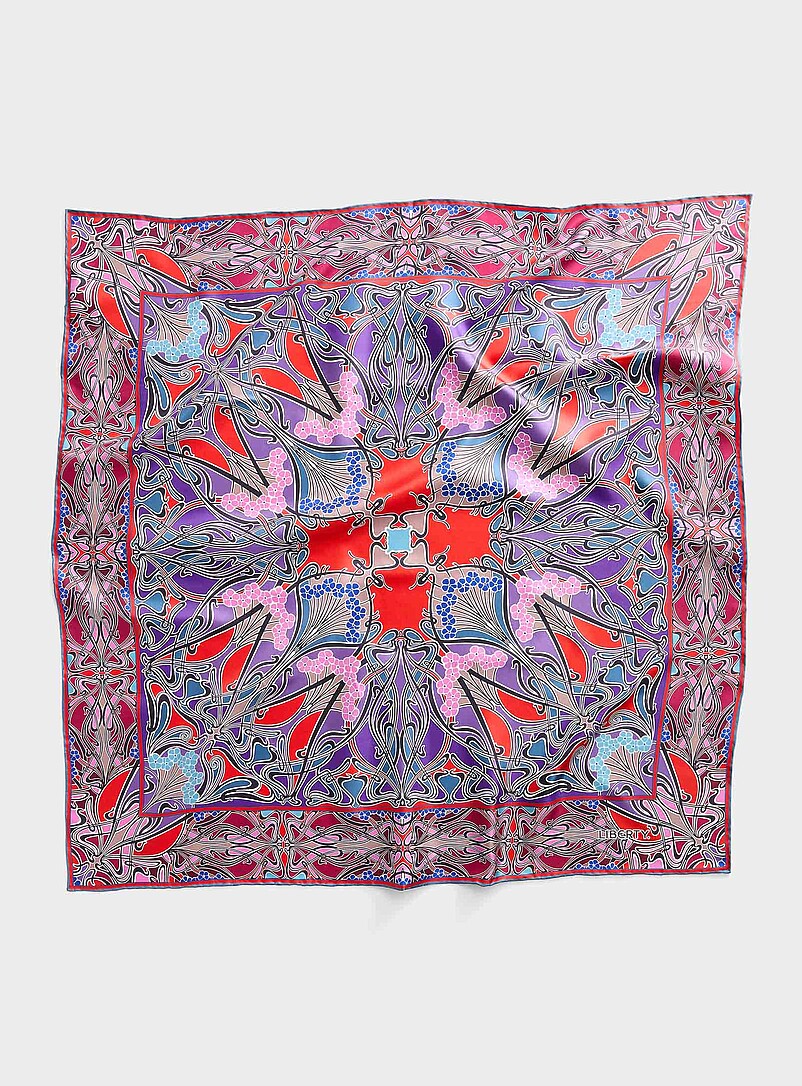
This square silk scarf is made from 100% silk twill and measures 35.5 x 35.5 inches (90 x 90 cm). It is manufactured in Italy and features a kaleidoscopic botanical pattern in red, purple, pink, blue, and black. The scarf can be used as a fashion accessory, such as a neck scarf or headscarf.
- Material
- 100% silk twill
- Gender
- unisex
- Style
- classic, vintage, heritage
- Category
- Apparel & Accessories > Clothing Accessories > Scarves & Shawls > Scarves
Color
Size
Specifications
Luxurious square silk scarf featuring iconic Liberty fabric, crafted in Italy.
100% silk twill, square 35.5-inch design, Liberty print, Italian craftsmanship.
- Material
- 100% silk twill
- Style
- classic, vintage, heritage
- Gender
- unisex
- Age Group
- adult
- Condition
- new
- Category
- Apparel & Accessories > Clothing Accessories > Scarves & Shawls > Scarves
Additional Attributes
- 100% silk twill fabric
- Square shape, 35.5 x 35.5 inches (90 x 90 cm)
- Made in Italy
- Features Liberty of London fabric
- Lanthe print pattern
- Pure silk construction
- Luxurious material
Product Insights
The Liberty Pure Silk Lanthe Scarf, priced at 395 CAD, is a 100% silk twill square made in Como, Italy, featuring the Ianthe pattern—an Art Nouveau design originating as a 1902 French wallpaper and a Liberty Tana Classic since 1986. As a design cornerstone prized by collectors who date colorways, the scarf offers versatility: the 90cm size holds knots securely, drapes softly yet holds crisp folds, withstands repeated handling, and shows vivid, detailed botanical prints. While it undercuts luxury rivals like Hermès and Gucci, its machine-finished edges lie flat when tied—a tradeoff compared to hand-rolled hems. Liberty frames the scarf as artwork on a silk canvas.
Verified claims
- Iconic status
- Ianthe is a quintessential Art Nouveau pattern and a Liberty design cornerstone.
- Collector appeal
- Buyers on collector forums date vintage Ianthe scarves by colorway and debate specific eras.
- Versatility
- The 90cm silk twill square holds knots securely and suits diverse styling from golf to dancing.
- Knot holding
- Knots and wraps stay in place throughout the day.
- Structured drape
- Holds crisp folds yet drapes softly around the neck.
- Print clarity
- Intricate botanical prints appear vivid and detailed.
- Durability
- Wrinkle-resistant and stands up to repeated handling.
- Design history
- The Ianthe pattern, a Liberty Tana Classic since 1986, is colorway-dated by collectors.
- Pricing
- At CAD 395, it undercuts Hermès and Gucci silk scarves.
- Edge finish
- Machine-finished edges lie flat when tied, unlike hand-rolled hems.
- Material quality
- The scarf is 100% silk twill made in Como, Italy, delivering vivid color saturation on a matte surface.
- Styling and artistry
- Brand direction frames the scarf as artwork on silk, styled loose over tailoring or knotted close.
- Heritage
- The Ianthe pattern is a 1902 French wallpaper turned Liberty Tana Classic.
- Artistic framing
- Liberty's senior designer describes the scarf as artwork on a silk canvas.
Product record
- Title
- Pure Silk Lanthe Scarf Made With Liberty Fabric
- Brand
- Liberty
- Price
- 395 CAD
- Availability
- In stock
Deep Research
The Ianthe pattern's design heritage and evolution
- Ianthe was rediscovered in an old design folio in 1966 and redrawn specifically for Liberty's screen-printing process, making this scarf the outcome of a literal archival retrieval that transformed a forgotten wallpaper into a modern fabric icon.
- Ianthe was inducted into Liberty's Tana Classics collection in 1986, a permanent curation of the brand's most historically significant prints, so this scarf belongs to an elite tier of patterns that represent Liberty's core identity rather than a transient seasonal offering.
- First printed by Liberty in 1967 and reimagined by the Haward Studio for the Carnaby Street fashion crowd, the pattern captures the late-1960s Victorian revival that turned Ianthe into a hit amid London's 'youthquake' — so this scarf inherits a countercultural cool that melds historical ornament with Swinging London energy.
- Frequently described as Liberty's most iconic Art Nouveau design, Ianthe's sinuous floral layout embodies the movement's rebellion against the art-craft divide — wearing this scarf acknowledges the aesthetic that gave Liberty its Italian name, 'Stile Liberty', cementing the store's place in design history.
- The Ianthe pattern originated as a wallpaper border designed by French artist René Beauclair around 1902, so this silk scarf wears a direct descendant of early Belle Époque decorative arts that predates Liberty's adoption by over six decades — an independent creative legacy that adds historical depth to the print.
The Liberty scarf as a styling icon
- Illustrator Joyce Denny's 1930s booklet declared that a Liberty scarf could substitute for a new outfit when money was tight and was suitable for everything from golf to dancing — a testimonial that has become a touchstone for the scarf's enduring reputation as a versatile, high-impact wardrobe transformer that blurs the line between necessity and luxury.
- The scarf's Ianthe print began as a wallpaper design by a French artist in 1902, was first translated to Liberty dress fabric in 1967, and was reworked in 2012 to amplify its rich, decorative character — so the scarf carries a century-spanning design lineage that makes it a conversation piece rather than a generic floral.
- Liberty has sold scarves since the store's very first day in 1875, making the category as old as the brand itself — owning one is buying into a specific retail tradition that predates most luxury fashion houses and gives the scarf the weight of a piece of living history rather than a seasonal novelty.
- Liberty senior designer Alexandra Lovatt describes the most exquisite scarf designs as 'conversational, so the scarf becomes a piece of artwork on a canvas, but the canvas just happens to be silk' — telling a buyer that the brand intentionally creates prints meant to be viewed like art, rewarding close looking and making the scarf a wearable investment in design rather than just an accessory.
- Liberty's scarf design has moved from heritage florals through 70s paisley to 80s abstracts and 21st-century digital prints while always staying at the 'avant-garde of print design' — a lineage that assures a buyer the Ianthe print is not a stale reissue but part of a living design tradition that still feels current.
- Liberty's own styling direction advises draping the scarf loosely over breezy tailoring or knotting it close to the neck for a pop of colour — a signal that the 90cm square is sized for both relaxed volume and a neat neckerchief, and that the print is meant to be visible and central to an outfit rather than hidden.
- A Liberty scarf catalogue from the 1950s claimed that 'Smart people say they can never have too many Liberty scarves,' indicating that already by mid-century the accessory was seen as a collectible signifier of taste — the kind of item women wanted multiples of, which supports the scarf's modern-day role as a repeat-purchase heirloom piece that builds a personal archive.
Silk twill feel, durability, and care
- The subtle diagonal texture of silk twill gives the fabric enough grip to hold a knot securely — so styles like a neckerchief, bag tie, or wrapped headband stay put throughout the day, unlike the slip-prone nature of satin weaves. This makes the scarf a practical choice for structured scarf styling without sacrificing the soft hand of 100% silk.
- The scarf's twill weave yields a structured hand that supports crisp folds and sculpted draping, while the longer float pattern inherent to twill gives it enough fluidity to softly swirl around the neck. This duality means the 90 cm square works equally well as a tailored neckerchief or an effortless, drapey shoulder accent.
- The generous 90 cm square gives the wearer multiple styling options — neckerchief, headwrap, handbag accent, halter top — and the silk twill's grip and structured body ensure those styles stay put without constant readjustment. Compared to a lightweight chiffon square of equal size, this twill scarf delivers a more substantial, controlled drape that holds its form.
- Silk twill's superior dye absorption and its low-glare, subtly textured surface allow the intricate Ianthe floral — originally a 1902 Art Nouveau wallpaper by French artist R. Beauclair — to render with exceptional color saturation and fine detail. The result is a scarf where every petal and vine appears crisp and luminous, without the distracting shine that can wash out complex designs on satin.
- Thanks to the twill weave, this scarf resists wrinkles better than lighter silks like charmeuse or chiffon, and its abrasion resistance is rated good for scarf-level wear — so daily knotting, handbag storage, and repeated styling won't quickly degrade the surface or leave it permanently creased, giving it a longer wearable lifespan than a satin counterpart.
How Liberty compares to other luxury scarves
- Constructed in pure silk twill — the same weave category used by Hermès and Gucci for their signature squares — the Ianthe gains the crisp hand, body, and tie-holding structure that elevate a scarf from delicate square to daily-wear accessory, a practical advantage over lighter silk weaves.
- Made and printed in Como, the Ianthe shares its manufacturing region with Ferragamo, Gucci, and other Italian luxury silk names, drawing on the same Lake Como specialist expertise rather than the Lyon tradition of Hermès — a distinction that defines its hand feel and print finish as part of the Italian school.
- The Ianthe design began as a French artist’s wallpaper in 1902, was first printed as a Liberty dress fabric in 1967, and was reworked in 2012 to heighten its decorative richness — a 120-year design arc that gives the scarf an interior-design storytelling edge over the typical fashion-house archive motif.
- At £245, the Ianthe sits significantly below Hermès 90cm carrés (starting above £400) and slightly undercuts Gucci’s printed silk carrés at $540, making it an accessible entry point into design-collector scarves without sacrificing Italian silk twill or an in-house archival print.
- The Ianthe’s machine-finished edges place it among the mid-tier luxury scarves that prioritise print and fabric over artisanal finishing; Hermès carrés command a higher price partly through hand-rolled hems executed at 7 stitches per centimetre, a labor-intensive detail Liberty does not attempt at this price point.
- Liberty’s reputation for intricate, densely patterned prints is a core competitive asset; the Ianthe’s reworked decorative motif delivers a level of visual density that matches the archival ambition of fashion-house carrés, yet carries an unmistakable English-heritage character that editors single out as uniquely Liberty.
Ianthe pattern collectibility and vintage appeal
- The pattern entered the Tana Classics collection in 1986, marking it as a permanent Liberty signature that has been continuously produced for nearly four decades — a level of commitment that signals to buyers they are purchasing a design the brand considers timeless, not a trend-driven seasonal release.
- Liberty recently reworked Ianthe into a companion print called Iphis — named after Ianthe's lover in Ovid's Metamorphoses — proving that the design remains an active part of Liberty's creative engine, a factor that tends to sustain and grow collector interest over time as the design universe expands.
- Vintage scarf collectors actively date Ianthe scarves by colorway — an 80s-era palette is recognizable enough to provoke forum debate — confirming that the pattern has sustained a secondary market where specific variations carry period value, which lends the contemporary red version a sense of future collectibility tied to its own era's colorway.
- Liberty's own archive describes Ianthe as 'one of our most enduringly beloved and instantly recognisable artworks' over 120 years — this is not a fringe pattern but a design the company explicitly positions as a cornerstone of its textile identity, which gives any new product bearing it immediate institutional pedigree.
- Originally conceived as a wallpaper border by French artist René Beauclair around 1902, the Ianthe pattern is an authentic Art Nouveau artifact — its sinuous flowers and curling lines embody the movement Liberty was so synonymous with that Italy called Art Nouveau 'Stile Liberty', giving the scarf a genuine early-20th-century design heritage rather than a modern vintage pastiche.
- First printed by Liberty in 1967 as part of the Art Nouveau revival, the pattern was reimagined by the Haward Studio for a Carnaby Street clientele and became an instant hit on fabrics before scaling to scarves — placing this scarf in the direct lineage of the Swinging London fashion moment that defined 1960s British style.
Image Analysis
1 images- 01
Product
Square silk scarf laid flat showing a kaleidoscopic botanical/ornamental pattern with a visible brand wordmark near the lower right corner and small soft wrinkles and shine from the fabric.
- Overall shapeSquare scarf with edges visible on all four sides and slightly undulating hem lines due to fabric drape.
1 region
x 0.03 · y 0.04 · w 0.94 · h 0.92 (high) - Central motifLarge symmetrical central medallion with a bright red core surrounded by radiating purple and red petal-like shapes and dense black linear outlines creating a kaleidoscopic pattern.
1 region
x 0.28 · y 0.25 · w 0.44 · h 0.45 (high) - Pattern elementsIntricate flowing linear motifs in black and dark navy forming repeated organic loops and fine vein-like lines throughout the field, with clusters of small round dots in pink and blue accenting the design.
1 region
x 0.12 · y 0.12 · w 0.76 · h 0.76 (high) - Fabric finishSmooth, lustrous surface with specular highlights and soft wrinkles indicating a lightweight satin-like silk fabric.
1 region
x 0.34 · y 0.18 · w 0.32 · h 0.16 (high) - Hem detailNarrow rolled hem visible along the outer edge with a thin darker outermost trim.
1 region
x 0.02 · y 0.02 · w 0.96 · h 0.96 (medium) - Brand wordmark“LIBERTY”
1 region
x 0.83 · y 0.76 · w 0.12 · h 0.08 (high)
Other
Product photographed flat on a uniform light gray background with even diffuse lighting; slight shadow and fabric creases visible at the bottom edge.
- BackgroundUniform light gray studio background filling the frame around the scarf.
1 region
x 0.00 · y 0.00 · w 1.00 · h 1.00 (high) - Lighting and reflectionsEven diffuse lighting with localized shiny highlights on the silk surface, especially near the upper right quadrant.
1 region
x 0.60 · y 0.18 · w 0.24 · h 0.18 (high) - Fabric creasesSmall soft folds and a shallow central crease toward the bottom edge creating slight shadowing.
1 region
x 0.40 · y 0.86 · w 0.20 · h 0.10 (high) - Shot compositionScarf centered in frame, photographed from above showing the full front face.
Colors
bright red· central red field#FC3B34vivid purple· surrounding purple motifspale pink· pink dot clustersbright sky blue· blue accentsblack· linework and outlines- Overall shapeSquare scarf with edges visible on all four sides and slightly undulating hem lines due to fabric drape.
Documents & Data
Q&A
1 answered- Are the edges of this scarf hand-rolled or machine-hemmed?
- The edges of the Ianthe Silk Scarf 90 are finished edges, not hand-rolled. Liberty describes them as “finished edges” [1] which is a machine-hemmed finish rather than the hand-rolled hem seen on some other Liberty scarves.