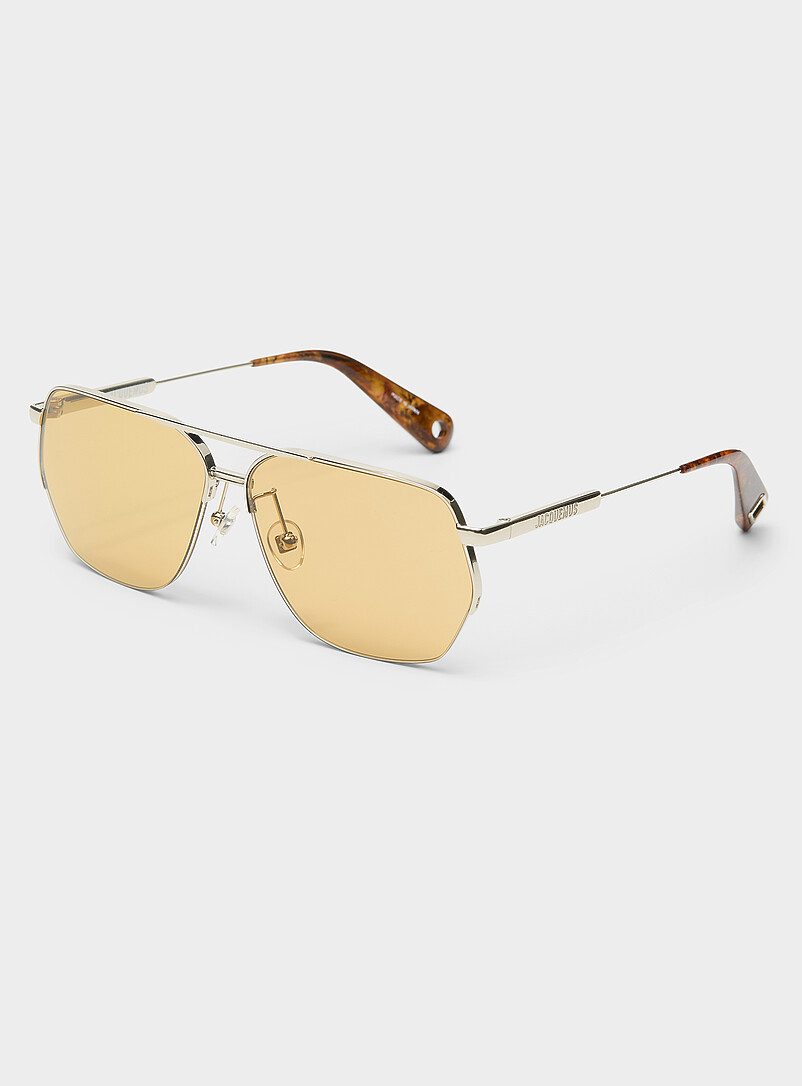
Yellow lens aviator sunglasses product image (primary)
Front three-quarter view of aviator-style sunglasses with pale yellow lenses, thin gold metal frame, clear nose pads, and tortoiseshell acetate temple tips; brand name engraved on right temple.

Jacquemus

Yellow Lens Aviator Sunglasses

CA$650.00CAD
In Stock

Jacquemus aviator sunglasses feature pale yellow lenses, a gold stainless steel frame, and tortoiseshell acetate temple tips. They provide 100% UV protection and are made in Japan. Key measurements are 63 mm eye width, 15 mm bridge, and 145 mm temple length, with a designer case and cleaning cloth included.

Color
Yellow Lens
Material
Stainless steel frame
Gender
unisex
Style
futuristic, minimal, modern
Category
Apparel & Accessories > Clothing Accessories > Sunglasses

Color

Silver

Size

ONE SIZE

Specifications

Futuristic geometric aviator sunglasses with yellow lenses and stainless steel frame, offering UV protection and sculptural elegance.

100% UV protection, lightweight stainless steel frame, includes designer case and cleaning cloth.

Color
Yellow Lens · yellow
Material
Stainless steel frame
Style
futuristic, minimal, modern
Occasion
vacation, casual
Gender
unisex
Age Group
adult
Condition
new
Category
Apparel & Accessories > Clothing Accessories > Sunglasses

Additional Attributes

  • Geometric futuristic aviator shape
  • Light and comfortable stainless steel frame
  • 100% UV protection lenses
  • Yellow-tinted lenses
  • Includes soft designer case
  • Includes cleaning cloth
  • Presented in designer box
  • Made in Japan
  • Eye width 63mm, bridge 15mm, temple 145mm
  • Sculptural elegance from Jacquemus

Product Insights

Jacquemus’s Yellow Lens Aviator Sunglasses rework the classic aviator with a flat-top double bridge and geometric lines, paired with yellow lenses that filter blue light to cut haze and boost contrast in overcast or twilight conditions, handcrafted in Sabae, Japan from 316L surgical-grade stainless steel with laser-welded seams and sub-millimeter tolerances, weighing about 25g for lasting comfort; however, at CAD 650, the tailored fit suits average to smaller faces, with fixed nose pads that may not accommodate low bridges and angles that offset roundness but can exaggerate square faces, positioning the sunglasses as a fashion-literacy symbol from Jacquemus’s viral runway history, competing with Tom Ford and Gucci on Japanese craftsmanship and brand cachet.

Verified claims

Design
Flat-top double bridge and straight lines sculpt the classic teardrop into a geometric statement.
Lens
Yellow lens channels Y2K revival and enhances contrast for everyday wear.
Vision performance
Yellow lens filters blue light to cut haze, preserve brightness, and boost contrast in overcast or twilight light.
Style
Yellow tint is a deliberate color statement with a futuristic aesthetic.
Build quality
Laser-welded, hand-polished, and inspected to sub-millimeter tolerances.
Origin
Handcrafted in Sabae, Japan, by family-run workshops with generations of expertise.
Material
316L surgical-grade stainless steel with self-healing passive layer.
Construction
Crafted in Japan with laser-welded seams and zero-defect quality inspection.
Comfort and fit
Resists bending and weighs about 25g for lasting comfort.
Maintenance
Wipe with microfiber after wear to prevent milky film that dulls luster.
Sizing
Fits average to smaller faces; larger faces may feel snug.
Nose pad fit
Fixed nose pads may not suit low nose bridges.
Face shape
Geometric angles offset roundness but may exaggerate square faces.
Cleaning
Clean using only mild soap and the included microfiber cloth.
Storage
Store in the supplied soft case to protect the yellow tint from UV and oxygen.
Pricing
At CAD 650, prices against Tom Ford and Gucci; value is in Japanese craftsmanship and brand cachet.
Brand story
Part of Jacquemus's viral runway history, a fashion-literacy symbol.
Market positioning
At CAD 650, directly competing with Tom Ford and Gucci aviator models.

Product record

Title
Yellow Lens Aviator Sunglasses
Brand
Jacquemus
Price
650 CAD
Availability
In stock

Deep Research

What yellow lenses actually do for your vision

  • By attenuating high-energy visible blue light, the tint reduces the harsh glare that typically causes squinting and ocular fatigue during long days under open sky — a subtle ergonomic benefit that complements the 100% UV protection and makes extended outdoor use more comfortable.
  • Yellow lenses are a staple in precision sports optics — from ski goggles to ballistic eyewear — precisely because they reveal terrain contour in flat light; this pair inherits that visual DNA, meaning the geometric aviator shape isn't just futuristic design but also brings a proven contrast-boosting tool to everyday wear.
  • Unlike dark grey lenses that dim the entire scene by up to 90%, a yellow tint preserves nearly all ambient brightness while still cutting blue light, so the wearer gets enhanced definition without sacrificing visibility in shade or on cloudy days — a genuine functional advantage for a sunglass that's as much about indoor-to-outdoor transition as it is about sun protection.
  • The yellow lens absorbs a large portion of the blue light spectrum (centered around 450 nm), effectively acting as a high-pass filter that cuts through atmospheric Rayleigh scattering — the fog, haze, and glare caused by short-wavelength light — delivering noticeably sharper contrast and depth perception in overcast or twilight conditions.

Keeping yellow lenses and stainless steel pristine

  • Isopropyl alcohol, ammonia-based sprays, and even paper towel fibers will micro-scratch and chemically degrade the anti-UV yellow lenses; only a dedicated eyewear spray or lukewarm water with a drop of mild soap, wiped with the supplied cloth, is safe for daily debris removal.
  • Perspiration, skin oils, and cologne settle invisibly on the frame and, over weeks, can create a milky film that dulls the metallic luster; rubbing the frame down with the included microfiber cloth after each wear removes this film before it etches the surface.
  • The soft case is not just a carrier; it cuts ambient UV and oxygen, which are the primary catalysts for polymer breakdown in the lens — a lens left on a tabletop in indirect daylight will slowly shift its yellow hue toward muddy amber, while a cased lens retains its intended bright yellow for years.

The significance of being made in Japan

  • High-end Japanese eyewear typically employs laser welding instead of traditional soldering to fuse temples, bridge, and rim joints, creating seamless bonds that are both stronger and visually cleaner on the frame's sculptural lines and reducing the risk of breakage at stress points.
  • The sharp, angular silhouette of this geometric aviator demands sub-millimeter accuracy in bending and welding to maintain perfect symmetry; Japanese workshops are renowned for hitting these tolerances through a blend of CNC cutting and manual assembly, ensuring the bold shape reads consistently from every angle.
  • Japanese artisans often hand-polish metal frames through multiple abrasive stages, a labor-intensive process that eliminates micro-burrs and produces a smooth, mirror-like surface on stainless steel — so the frame feels soft against the skin and resists snagging on clothing or hair far better than machine-finished alternatives.
  • Japan's eyewear industry is concentrated in Sabae city, where over 90% of domestic frames are produced and metal-frame craftsmanship has been evolving since the early 1900s; a 'Made in Japan' Jacquemus aviator almost certainly originates from this ecosystem, inheriting a legacy of micro-precision that generic outsourced manufacturing cannot replicate.
  • Japanese eyewear production embeds multiple inline inspection checkpoints — a practical expression of the monozukuri manufacturing philosophy that aims for zero defects — checking alignment, finish consistency, and temple tension on every frame, so the buyer can reasonably expect a frame free of the subtle asymmetries common in mass-produced luxury eyewear.
  • Many of Japan's metal-frame workshops are small, family-run operations where expertise in titanium and stainless steel fabrication is passed down through generations, meaning each Jacquemus aviator carries the accumulated mastery of a niche craft rather than the hallmarks of a high-volume assembly line.

How this price compares to the luxury market

  • The 'Made in Japan' stamp is uncommon among European luxury fashion sunglasses, where Italian or French production dominates; Japanese eyewear manufacturing is renowned for precision engineering and hand-finished components, an attribute that places these Jacquemus aviators closer in spirit to collectible high-craft brands like Dita or Matsuda than to mass-luxury lines, and helps justify the CAD 650 price beyond the brand name alone.
  • Simon Porte Jacquemus built the brand from viral runway moments—a show in a lavender field, another against the white salt flats of Camargue—into a cultural force whose accessories now carry the same cachet as heritage houses; the price premium for these sunglasses reflects that current cultural heat, making them a wearable signal of fashion-literacy rather than just eyewear.
  • Tom Ford's metal-frame aviator models, such as the TF1084, typically retail between CAD 600 and CAD 700, and Gucci's GG0061S aviator sits near CAD 700; the Jacquemus pair, at CAD 650, prices itself directly against these established luxury houses rather than undercutting them, signaling that Jacquemus intends to be perceived as a full-fledged participant in the high-end eyewear market, not a budget alternative.
  • A lightweight stainless steel frame and 100% UV protection are baseline expectations at this price tier—Gucci, Prada, and Tom Ford all offer equivalent specs—so the CAD 650 tag is driven not by material innovation but by the convergence of Japanese manufacturing rigor, sculptural design, and brand elevation.

Stainless steel in eyewear—real-world durability

  • Premium Japanese eyewear relies on 316L stainless steel, an alloy with 16–18% chromium and 2–3% molybdenum that forms a self-healing passive layer to resist sweat and saltwater corrosion, while its composition meets hypoallergenic thresholds so even those with nickel sensitivities can wear them without reaction.
  • Although stainless steel (7.8 g/cm³) is denser than acetate, its high specific strength permits the ultra-thin wireframe that keeps total weight around 25 grams — lighter than most acetate aviators that need thicker arms for equivalent rigidity, and without the premium markup of featherweight titanium.
  • With a modulus of elasticity around 193 GPa — roughly twice that of titanium — stainless steel frames resist unintentional bending and hold optician adjustments more faithfully, so the precise 63mm lens alignment and bridge curvature remain consistent through years of daily use.
  • The 'Made in Japan' imprint on these frames traces back to Sabae city in Fukui prefecture, the epicenter of Japanese eyewear craft since 1905, where artisans work with domestic high-purity stainless steel to achieve the slim, durable wire profiles seen in these sculptural aviators.

How the geometric shape reworks the classic aviator

  • Where a curved aviator tends to echo facial contours, the geometric frame’s straight lines and defined angles introduce structure that can offset roundness, effectively acting as a contouring tool and aligning with Jacquemus’s broader fascination with silhouette and proportion.
  • The entire Jacquemus visual lexicon—from the micro Le Chiquito bag to the wide-brimmed straw hats—is built on exaggerated, architectural silhouettes, so this geometric aviator is a direct extension of the house’s sculptural identity rather than a one-off experiment, making it an authentic piece of the brand’s design universe.
  • The aviator’s functional double bridge is repurposed here as a graphic element spanning a flat-top brow bar, transforming a utilitarian relic into an architectural detail that challenges the classic pilot silhouette and shifts the frame into contemporary design territory.
  • Manufactured in Japan, the stainless steel frame benefits from a supply chain renowned for exacting craftsmanship, allowing the sharp geometric lines to be rendered with clean, lightweight precision—critical for a design where angularity is the entire point.
  • The yellow tint draws from Y2K revival and utilitarian workwear codes, turning the lens from a purely protective element into a deliberate color statement that reads as curated and futuristic even from a distance, reinforcing the frame’s overall avant-garde mood.
  • Since the late 2010s, high-fashion eyewear has migrated from soft teardrop aviators to sharp-lined geometric and shield shapes, with houses like Prada, Loewe, and Balenciaga spotlighting angular metal frames—this pair plugs into that editorial movement, giving it credibility that a classic aviator would lack.

Image Analysis

1 images
Yellow lens aviator sunglasses product image (primary)
01

Product

Front three-quarter view of aviator-style sunglasses with pale yellow lenses, thin gold metal frame, clear nose pads, and tortoiseshell acetate temple tips; brand name engraved on right temple.

  • Lens shape and tintPaired large aviator-style lenses with a subtle geometric (slightly hexagonal/rounded-hex) outline and uniform pale yellow tint filling each lens.
    1 regionx 0.08 · y 0.44 · w 0.66 · h 0.30 (high)
  • Frame material and finishThin metal frame surrounding the lenses and bridge with a reflective warm gold finish visible on rim, top bar, bridge, and temples.
    1 regionx 0.06 · y 0.42 · w 0.88 · h 0.34 (high)
  • Nose pads and mountClear molded nose pads attached to small metal pad arms mounted on the bridge, visible between the lenses.
    1 regionx 0.38 · y 0.53 · w 0.10 · h 0.10 (high)
  • Temple constructionVery thin round metal temples extending from the hinges toward the ear with a narrow top bar continuing into the temples.
    1 regionx 0.02 · y 0.40 · w 0.96 · h 0.38 (medium)
  • Temple tipsAcetate tortoiseshell-patterned temple tips with a glossy finish and a rounded end; right tip shows a small rectangular metal accent at the edge.
    2 regionsx 0.34 · y 0.17 · w 0.18 · h 0.12 (medium); x 0.78 · y 0.34 · w 0.12 · h 0.12 (high)
  • Brand engraving on templeJACQUEMUS
    1 regionx 0.57 · y 0.50 · w 0.18 · h 0.08 (high)

Other

Studio product shot on a light neutral gray background with soft diffuse lighting and a faint drop shadow; image shows sunglasses centered in a front three-quarter perspective, slight perspective foreshortening of temples.

  • Shot compositionFront three-quarter perspective with left lens slightly closer to camera and temples angled back, product positioned near the lower center of the frame.
  • Background and lightingEven light neutral gray background with soft diffuse lighting and a subtle soft shadow beneath and slightly behind the sunglasses.
  • Image qualityHigh-resolution studio image with sharp focus on frame and lenses and shallow visible noise; no visible hands or props.

Colors

pale yellow· lenses#E3C38Cwarm gold· metal frame and temples#E3C38Ctortoiseshell brown· temple tips

Q&A

2 answered
What is the UV protection rating? Is it UV400 or another standard?
The product listing states '100% UV protection,' which typically means they block 99-100% of UVA and UVB rays, equivalent to UV400-rated lenses.
Does the frame have adjustable nose pads, and how does the one-size fit various face shapes, especially for larger faces?
The product does not specify adjustable nose pads. The one-size frame has measurements of eye width 63mm, bridge 15mm, and temple 145mm. This may fit average to smaller faces, and larger faces might find it snug.

Provenance

Merchant Link
https://www.simons.ca/en/men-designer/accessories/sunglasses/yellow-lens-aviator-sunglasses--21831-158030?colourId=0
Updated