Simons Maison
Acacia Wood Salad Utensils 2-Piece Set
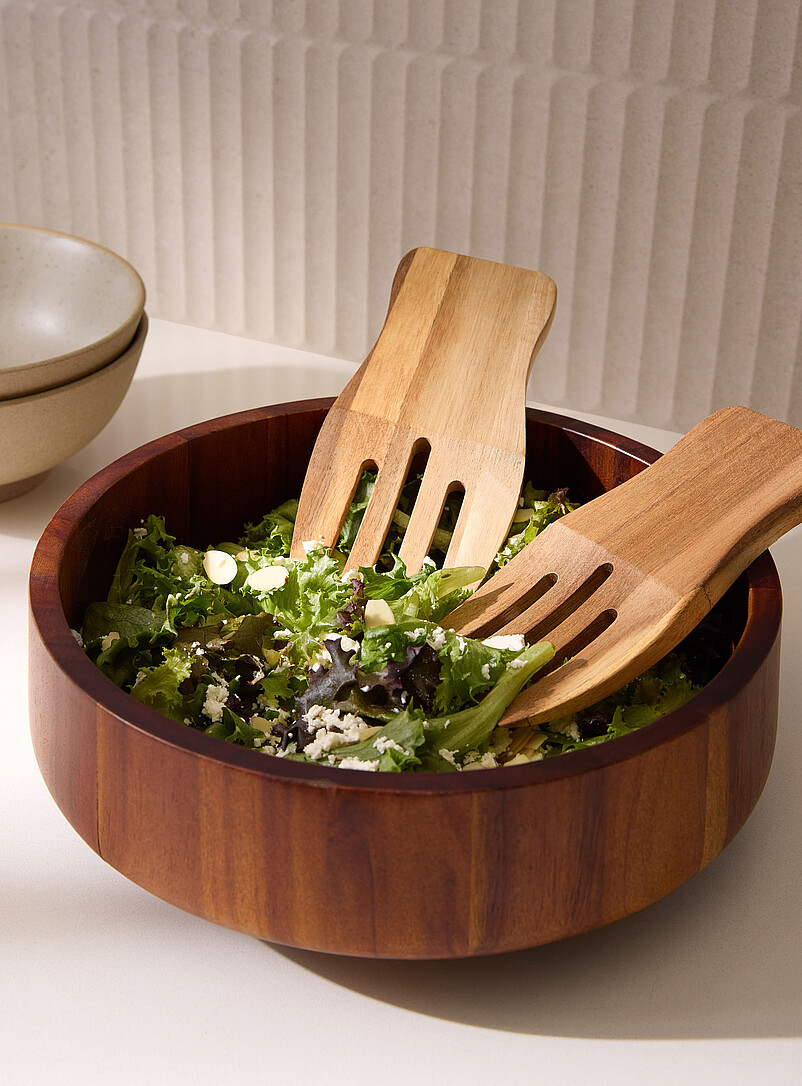
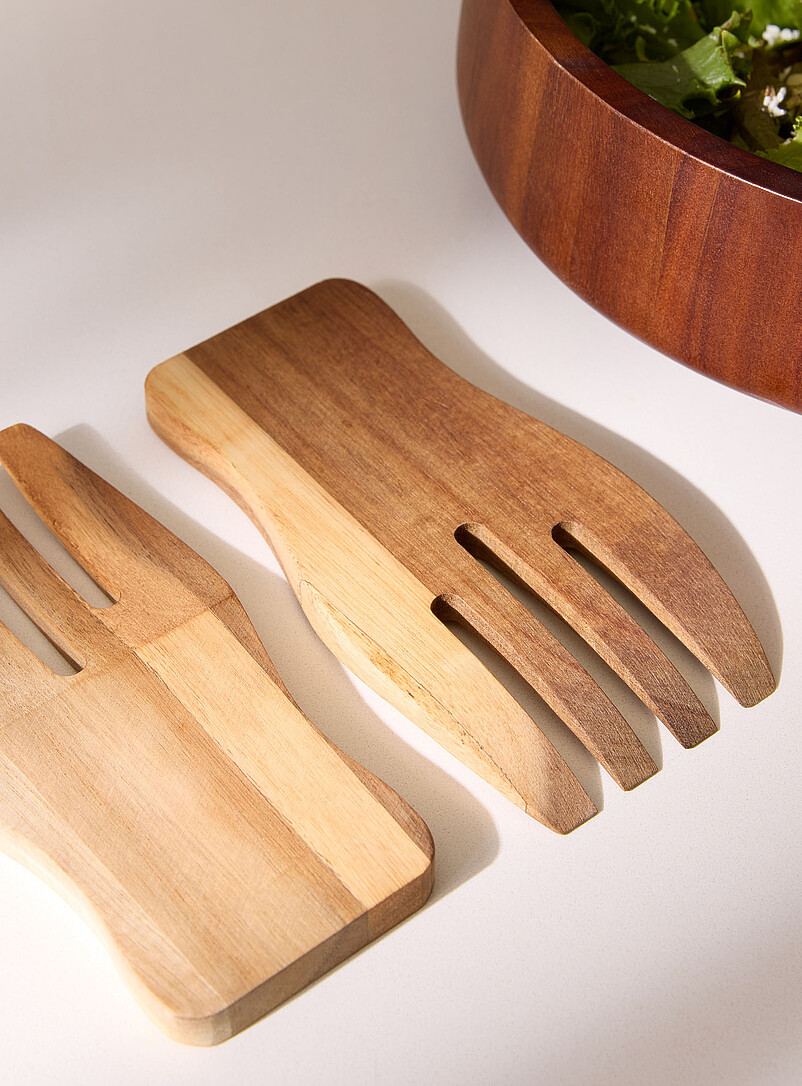
This 2-piece set includes acacia wood salad utensils: a slotted serving fork with three tines and a flat paddle serving piece. The utensils measure 7.5 x 3.5 inches (19 x 9 cm) and feature a smooth, satin finish with visible wood grain. Hand-wash only; matching pieces sold separately.
- Color
- warm acacia wood
- Material
- acacia wood
- Category
- Home & Garden > Kitchen & Dining > Kitchen Tools & Utensils > Kitchen Utensil Sets
Specifications
Set of two warm acacia wood salad utensils, hand-wash only.
Warm acacia wood, designed for salads, matching pieces available separately.
- Color
- warm acacia wood · brown
- Material
- acacia wood
- Gender
- unisex
- Age Group
- adult
- Condition
- new
- Category
- Home & Garden > Kitchen & Dining > Kitchen Tools & Utensils > Kitchen Utensil Sets
Additional Attributes
- warm acacia wood
- hand-wash only
- set of 2
- matching pieces sold separately
- 7.5 x 3.5 inches
Product Insights
This acacia wood salad utensil set offers a Janka hardness of 1750—harder than bamboo, teak, or cherry—ensuring resistance to denting and flexing while remaining soft enough to avoid scratching non-stick surfaces. At $18 CAD, it provides a harder alternative to bamboo and a visual match to olivewood at a lower price. The 7.5-inch length and 3.5-inch head enable precise one-pass scoops in individual bowls, and the two-piece set minimizes kitchen clutter. However, longevity requires hand washing and monthly oiling to prevent cracking, with each piece featuring unique grain due to natural variation in the assorted color option.
Verified claims
- Hardness
- Acacia rates around 1750 Janka hardness, harder than bamboo, teak, or cherry.
- Value
- At $18 CAD, this set is harder than bamboo and visually similar to olivewood, which costs $30-50.
- Non-stick safety
- Hard enough to resist denting but softer than metal, so it won't scratch non-stick surfaces.
- Serving ergonomics
- 7.5-inch length, 3.5-inch head, and stiff acacia enable precise one-pass scoops.
- Set design
- Two-piece set reduces clutter by focusing on salad-serving essentials only.
- Durability
- Acacia resists denting and flexing, and won't scratch non-stick pans.
- Size
- 7.5-inch by 3.5-inch head sized for individual bowls.
- Care
- Hand wash, dry immediately, and oil monthly to prevent warping or cracking; do not soak or put in the dishwasher.
- Natural variation
- Assorted color option yields unique grain in each piece.
- Visual comparison to olivewood
- The deep brown color and swirling grain pattern of acacia often make this set look like olivewood on the table, at a lower total price than typical olivewood servers.
- Grain variation
- Each piece can have unique grain patterns and color variations because the utensils are made from natural acacia wood.
- Comparative water resistance
- Acacia offers higher water resistance than bamboo, making this set a more permanent step-up from bamboo utensils.
Product record
- Title
- Acacia Wood Salad Utensils 2-Piece Set
- Brand
- Simons Maison
- Price
- 18 CAD
- Availability
- In stock
Buying Guide
1 comparison · 4 sourcesUses
Tossing and serving salads with a natural wood look
This two-piece acacia wood set is meant for preparing and accompanying meals, such as tossing salad in a bowl and serving it at the table. The set includes a slotted fork-style utensil and a flat paddle-shaped serving piece, with a warm wood grain finish. Note that the utensils are hand-wash only.[1,2,3]
Product comparison
Compared within this brand.
| Acacia Wood Salad Utensils 2-Piece Set: Choose this if you want a two-piece salad-serving set in warm acacia wood, with a wide slotted fork with three rounded tines paired with a flat paddle serving piece, each about 7.5 inches by 3.5 inches (19 x 9 cm) with smooth, rounded edges and a light satin finish showing two-tone striped grain. It suits shoppers preparing and serving salads in style who prefer natural wood over metal or plastic. Note the utensils are hand-wash only, and matching pieces are sold separately.[1,3] | Mango-Wood Serving Spoon: Choose this if you want a sturdy, all-wood serving spoon for heavy, everyday serving or dinner-party dishes — reviewers describe it as solid enough to scoop hearty food without flexing, with an eye-catching natural grain. It measures 12.5 inches long and 2.75 inches wide, but note the wood often looks darker and greyer than expected and the thicker-than-average build can feel bulky if you prefer a lightweight utensil. Care is dry-cloth only, with no contact with liquids.[4] |
Image Analysis
2 images- 01
Product
Two flat acacia wood salad utensils (wide paddles with three long fork slots) are shown resting inside a round wooden salad bowl; utensils have visible alternating light and medium wood grain panels and a smooth satin finish.
- Utensil shapeEach utensil is a flat paddle with a broad, slightly tapered handle that widens into a rectangular head with three long, rounded slots forming fork tines; head edges are gently rounded.
2 regions
x 0.36 · y 0.10 · w 0.28 · h 0.62 (high); x 0.64 · y 0.22 · w 0.30 · h 0.44 (high) - Wood grain and finishUtensils show alternating lighter and slightly darker longitudinal wood panels with visible grain lines and a smooth, low-sheen finish.
2 regions
x 0.36 · y 0.10 · w 0.28 · h 0.62 (high); x 0.64 · y 0.22 · w 0.30 · h 0.44 (high) - Slot detailEach head contains three elongated, rounded rectangular slots cut through the wood, aligned parallel to the handle.
2 regions
x 0.44 · y 0.38 · w 0.18 · h 0.18 (high); x 0.72 · y 0.44 · w 0.14 · h 0.16 (high) - Handle profileHandles are flat with a subtle upward curve near the head and squared ends with softened corners.
2 regions
x 0.38 · y 0.06 · w 0.20 · h 0.20 (medium); x 0.68 · y 0.20 · w 0.22 · h 0.20 (medium) - Placement and occlusionBoth utensils are shown inserted into a bowl of salad with their heads partially covered by salad leaves and one utensil overlapping the other near the center.
1 region
x 0.30 · y 0.32 · w 0.60 · h 0.40 (high)
Other
Image shows the utensils staged inside a darker wooden bowl on a light surface with a vertically ribbed neutral backdrop; soft directional lighting from the top left creates subtle shadows and highlights. A stacked ceramic bowl appears at the left edge as a prop.
- Bowl propA round, darker wood salad bowl contains the utensils and salad; bowl rim and interior are visible and the bowl rests on the same surface as the utensils.
1 region
x 0.08 · y 0.36 · w 0.84 · h 0.50 (high) - Background textureVertical soft-ribbed paneling in a light neutral tone fills the background behind the bowl and utensils.
1 region
x 0.00 · y 0.00 · w 1.00 · h 0.42 (high) - Salad contentsMixed leafy greens and crumbled white cheese are visible inside the bowl around the utensils.
1 region
x 0.28 · y 0.42 · w 0.44 · h 0.30 (high) - Shot compositionThree-quarter overhead view with utensils angled toward the viewer and cropped edges of a secondary ceramic bowl visible at the left.
- Lighting and shadowSoft directional light from the top left produces highlights along the utensil edges and a soft shadow on the right side of the bowl on the surface.
Colors
light acacia brown· utensils#D59A64- Utensil shapeEach utensil is a flat paddle with a broad, slightly tapered handle that widens into a rectangular head with three long, rounded slots forming fork tines; head edges are gently rounded.
- 02
Product
Two flat wooden salad utensils shown flat on a light surface: one wide slotted fork with three tines and one flat paddle-like serving piece; both show natural wood grain with two-tone sections and smooth rounded edges.
- Fork shapeFlat wooden fork with three wide, evenly spaced tines that have rounded tips and rectangular cutouts between them; fork body is broad and tapers into a short, slightly flared handle with rounded outer edges.
1 region
x 0.53 · y 0.34 · w 0.39 · h 0.48 (high) - Paddle serving pieceFlat paddle-shaped serving utensil with a wide rectangular blade and a short handle area; blade has gently rounded corners and a smooth flush surface without visible holes or seams.
1 region
x 0.02 · y 0.48 · w 0.48 · h 0.44 (high) - Two-tone wood grainBoth utensils display alternating lighter and darker wood sections along their length, producing a visible two-tone striped grain pattern following the pieces' long axis.
1 region
x 0.02 · y 0.48 · w 0.90 · h 0.44 (high) - Finish and surface textureSmooth, lightly satin-finished wood surface with subtle visible grain and no visible varnish pooling or roughness.
- Edge treatmentUtensil edges are rounded and chamfered rather than sharp; tine edges are smoothly contoured.
1 region
x 0.50 · y 0.54 · w 0.34 · h 0.28 (medium)
Other
Close-up studio-style shot with a partial wooden salad bowl visible at top right; neutral light background and soft shadows cast beneath utensils.
- Partial salad bowlCurved rim of a round wooden bowl appears in the top-right corner, showing darker stained wood and leafy salad contents inside.
1 region
x 0.68 · y 0.00 · w 0.32 · h 0.36 (high) - Background and surfaceMatte, pale cream or off-white flat surface and backdrop with soft studio lighting producing gentle, soft-edged shadows beneath the utensils.
- Lighting and shadowSingle-directional soft light from upper left producing short diffuse shadows cast to the lower right of the utensils.
- Image crop and compositionClose-up crop focusing on utensil heads and short handles; both utensils are partially cropped near the bottom-left and lower edges of the frame.
Colors
light tan· lighter wood sections#F5D3A3warm medium brown· darker wood sections#B47343dark reddish brown· bowl rim#732D1C- Fork shapeFlat wooden fork with three wide, evenly spaced tines that have rounded tips and rectangular cutouts between them; fork body is broad and tapers into a short, slightly flared handle with rounded outer edges.
Documents & Data
Customer Reviews
1 total1 reviews · out of 5
Ustensiles bois d’acadia
Beau produit, fonctionne très bien, je suis vraiment contente!