Opinel
Large Beech Wood Cutting Board
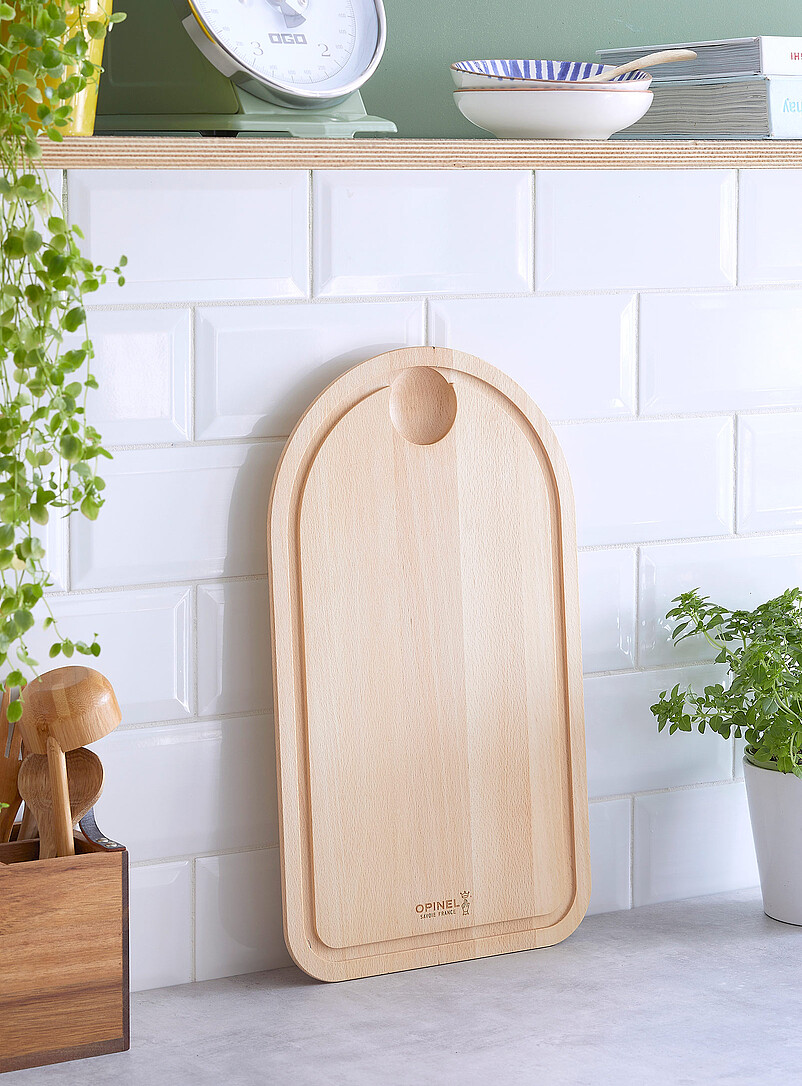
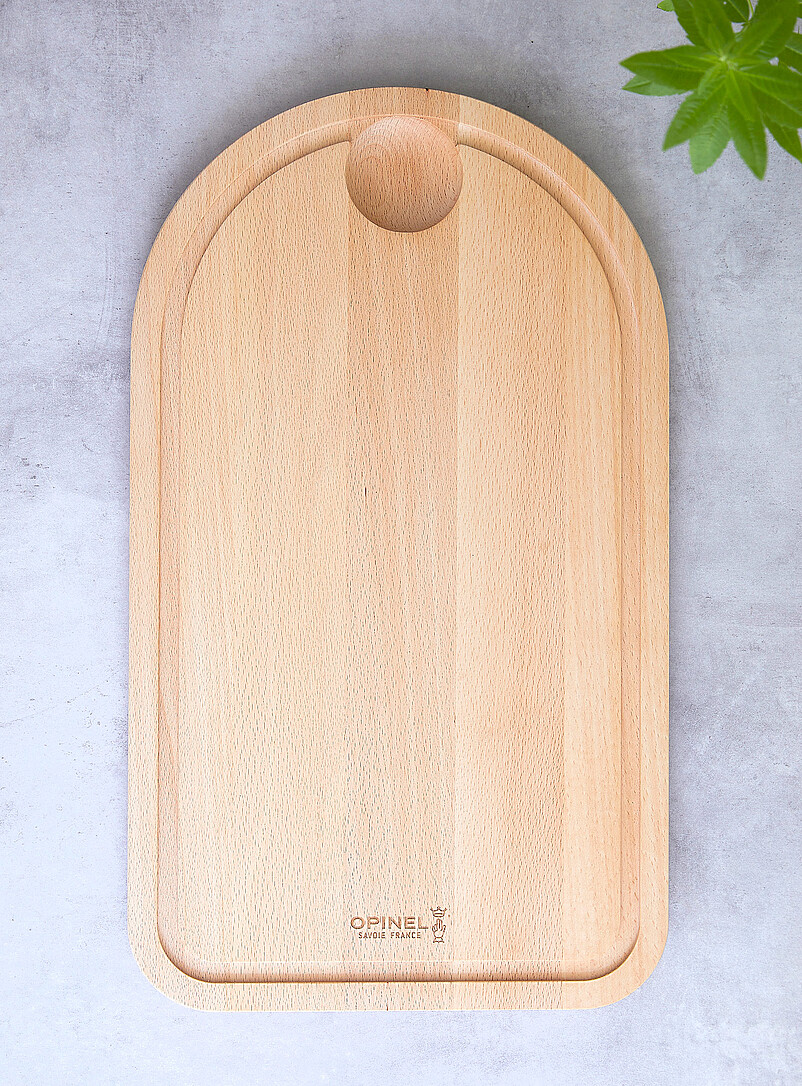
This is a large Opinel cutting board made of beech wood, designed for cutting meats, roasts, and poultry. It features an integrated juice gutter and well to catch liquids, and a circular hanging hole for storage. The board measures 11 x 18.5 inches (27.5 x 47 cm), is made in Italy, and each piece is unique due to natural wood variations.
- Material
- Beech wood
- Category
- Home & Garden > Kitchen & Dining > Kitchen Tools & Utensils > Cutting Boards
Color
Size
Specifications
Large beech wood cutting board with juice well for mess-free cutting of meats and poultry.
Gutter and juice well for mess-free use; Engraved logo; Made of beech wood; Made in Italy; Each piece unique.
- Material
- Beech wood
- Gender
- unisex
- Age Group
- adult
- Condition
- new
- Dimensions
- 11x18.5 in
- Category
- Home & Garden > Kitchen & Dining > Kitchen Tools & Utensils > Cutting Boards
Additional Attributes
- gutter and juice well
- engraved logo
- made in Italy
- natural wood
- unique piece
- large
- mess-free use
- perfect for cutting meats roasts and poultry
- designed for easy use and convenient storage
Product Insights
The Opinel Large Beech Wood Cutting Board offers a dense, closed-grain beech wood surface with Janka ~1300 hardness that resists knife dulling and stain absorption, paired with a deep juice groove and 2.5 cm thickness for stable carving of whole poultry (5–12 lb) and serving 4–6, while requiring pre-oiling before first use and regular hand-washing and re-oiling to maintain its patina and prevent warping; at 120 CAD it reflects Opinel’s 130-year woodworking heritage but is not designed for heavy bone chopping.
Verified claims
- Material
- 100% beech wood: closed grain resists stains and odors, Janka ~1300 hardness protects knife edges.
- Thickness
- 2.5 cm thick board: deep juice groove and enough mass for stable carving without a mat.
- Use cases
- Ideal for carving poultry and doubles as a serving board; not for cleaving bones.
- Maintenance
- Ships untreated; oil before first use with olive or sesame oil.
- Patina
- Engraved with Opinel's Savoie France mark, beech grain matches their knife standards from 1890.
- Finish
- Untreated beech develops patina and must be oiled before first use.
- Juice well
- Juice well captures whole-chicken runoff, resists staining, and keeps knives clear of the groove.
- Carving capacity
- Fits whole 5–12 lb poultry with knife clearance and 7-inch work zone; no heavy bone chopping.
- Stability
- ~5 lb mass keeps board planted during carving, no damp towel needed.
- Serving capacity
- 11-inch width serves as platter for 4–6 people.
- Warp resistance
- Resists warping from moisture and temperature changes over years of use
- Care routine
- Must be pre-oiled before first use, then hand-washed and re-oiled after each cleaning.
- Use limitations
- Not designed for heavy bone chopping or cleaving through joints.
- Cleaning
- Do not put in dishwasher; hand wash and dry thoroughly.
- Oiling
- Must be oiled before first use and re-oiled regularly.
- Serving use
- 11x18.5-inch beech board: carving and serving board for 4-6.
- Initial care
- Board ships un-oiled; oiling before first use enhances wood color and seals it.
- Juice groove
- Full-perimeter juice groove holds runoff from large roasts; board is for slicing, not heavy chopping.
- Price value
- At 120 CAD, offers Opinel's 130-year beech wood heritage at a price competitive with John Boos boards.
- Knife friendliness
- Beech wood's 1300 Janka hardness resists cuts without dulling knives.
Product record
- Title
- Large Beech Wood Cutting Board
- Brand
- Opinel
- Price
- 120 CAD
- Availability
- In stock
Deep Research
Beech wood as a cutting board material
- As a diffuse-porous hardwood with a tight, closed grain similar to maple, beech naturally inhibits moisture and bacteria from penetrating below the surface — translating to better resistance to lingering odors and stains from meat juices compared to open-grained woods like red oak, a clear advantage for a board marketed specifically for carving poultry and roasts.
- Beech registers approximately 1300 on the Janka hardness scale, placing it between walnut (~1010 lbf) and hard maple (~1450 lbf); this provides good resistance to cut marks without being so hard that it prematurely dulls knives, a practical middle ground for those who sharpen their own knives and want to minimize edge degradation.
- Opinel has manufactured its signature folding knives with beech wood handles since the 1890s, giving the brand over 130 years of material expertise; the cutting board therefore extends that legacy into the kitchen, suggesting a deliberate material selection rather than a cost-driven default.
- Untreated beech wood starts as a pale cream and gradually absorbs oils from hands and food, shifting to a warm amber hue; because beech has a subtle, straight grain, the darkening is uniform and visually pleasing, and the transformation is more dramatic than with inherently dark woods — so the board will look markedly different after a year of regular use, a characteristic that makes it feel like a living object in the kitchen.
- With an average density of about 720 kg/m³, beech is a notably heavy European hardwood, and at 18.5 inches long this board possesses enough mass (roughly 5 pounds) to stay firmly planted during carving — the heft largely eliminates the need for a damp towel underneath, yet the board remains easy to flip for double-sided use.
Juice well design for mess-free carving
- The juice well runs along all four edges, so juices are captured regardless of carving direction, meaning you can rotate a roast mid-cut without pausing to reorient the board or worrying about runoff.
- At 2.5 cm thick, the board has enough depth to carve a juice channel that can hold the runoff from a large chicken or roast without filling up mid-task — a common issue with thinner boards whose grooves are often too shallow to contain a full carving's worth of juices.
- Beech's closed-cell structure and ~720 kg/m³ density limit liquid absorption into the groove's walls, so the channel resists odor retention and cleans more readily than grooves in softer woods like pine or bamboo.
- The generous 47 cm length keeps the cutting surface well inside the perimeter groove, preventing the knife from accidentally dipping into the channel and dulling its edge — a practical advantage when carving large items like turkeys or rib roasts.
Board size for roasts and poultry: what fits
- The polished beech surface and restrained 11-inch width make it a handsome serving platter for a cheese spread or charcuterie for four to six people, meaning it earns its storage footprint as more than a single-task tool.
- The 18.5-inch length comfortably fits a whole 5-pound chicken (9–10 inches) or a 12-pound turkey (about 13 inches long), leaving a clear margin at each end so the carving knife stays inside the board's boundaries during the stroke.
- Beech wood's density (roughly 45 lbs per cubic foot) gives this 1-inch-thick board enough mass to stay planted on stone or tile without a damp towel, so you can focus on the carve instead of steadying the board.
- On a standard 25.5-inch-deep countertop, the board's 18.5-inch depth leaves a 7-inch work zone in front for a resting platter or utensils, preventing the carving station from crowding adjacent prep areas.
Opinel's heritage in woodworking and kitchen tools
- Untreated beech — like that on a classic Opinel folding knife — darkens and burnishes with use into a warm, personal patina; this board ships un‑oiled, so it will develop the same individual character over time, shaped by the user’s hands and maintenance routine.
- Opinel has been crafting knife handles from beech wood since Joseph Opinel founded the company in 1890 in Savoie, France — this cutting board shares the same hardwood species and a raw, unvarnished finish, extending over a century of natural woodworking expertise from the pocket into kitchen prep.
- Opinel’s origins in the French Alps fostered a deep understanding of how locally harvested beech responds to moisture and temperature changes; that heritage of working with the material’s natural movement translates into a board dimensionally stable enough for everyday kitchen conditions.
- The company’s knife production demands beech with a tight, straight grain to avoid splitting under force and humidity shifts; applying that same selectivity to their cutting‑board stock yields a board less prone to warping or cracking during daily use.
Value compared to similar beech wood boards
- The Opinel name, trusted on pocket knives since 1890, brings a century‑plus of tool‑making credibility to this board—its engraved logo and French‑designed, Italian‑made provenance make it a collectible kitchen object rather than a replaceable slab.
- At 2.5 cm, this board is significantly more massive than the typical 1.5‑cm‑thick budget beech boards, giving it the stability needed for carving without a non‑slip mat—a feature that alone accounts for a portion of its premium.
- The integrated juice channel is a feature often omitted on generic large beech boards under $80 CAD; paired with beech’s closed‑grain structure (which resists moisture and staining better than more porous woods), it justifies the board’s specialisation as a meat‑carving surface.
- In the premium wood cutting board category, 120 CAD is entry‑level for a thick European‑made board with a juice well—brands like John Boos charge upwards of 100 USD for similar‑sized maple models, while artisan end‑grain boards often exceed 200 CAD; the Opinel offers a middle ground with European pedigree at a modern retail price.
Image Analysis
3 images- 01
Product
A single light beech wood cutting board shown standing upright against a tiled backsplash; board has a rounded top with a circular hanging hole and an inner recessed juice groove. A small branded stamp near the bottom edge reads OPINEL.
- Overall shapeRectangular board with a rounded top and a flat bottom, shown standing upright and leaning against the wall.
1 region
x 0.28 · y 0.18 · w 0.44 · h 0.68 (high) - Hanging holeCircular cutout centered near the top inside the rounded area, recessed into the board.
1 region
x 0.46 · y 0.19 · w 0.08 · h 0.07 (high) - Juice grooveShallow recessed channel following the board perimeter set in from the outer edge, forming an inner rounded-rect border.
1 region
x 0.30 · y 0.22 · w 0.40 · h 0.62 (high) - Surface material and grainLight beech wood surface composed of long vertical strips with subtle color variation and a smooth, matte finish.
1 region
x 0.30 · y 0.22 · w 0.40 · h 0.62 (high) - Brand stamp“OPINEL”
1 region
x 0.46 · y 0.73 · w 0.08 · h 0.05 (medium) - Bottom edge detailRounded outer corners at the bottom with the juice groove terminating near the bottom edge; the board sits flat on the countertop.
1 region
x 0.30 · y 0.74 · w 0.40 · h 0.12 (high)
Other
Kitchen lifestyle scene with white subway tile backsplash, a light wood shelf with scale and bowls above, a wooden utensil holder at lower left, and a potted herb at lower right; soft diffuse lighting and natural shadows.
- Backdrop tilesGlossy white rectangular subway tiles in a running bond pattern covering the wall behind the board.
1 region
x 0.00 · y 0.00 · w 1.00 · h 0.74 (high) - Shelf stagingThin light wood shelf near the top with a pastel green kitchen scale and stacked bowls on top, partially visible.
1 region
x 0.00 · y 0.00 · w 1.00 · h 0.18 (high) - Utensil holderSquare wooden container at lower left holding wooden utensils and a small wooden mallet, cropped by the image edge.
1 region
x 0.00 · y 0.66 · w 0.22 · h 0.26 (high) - Potted herbSmall potted green herb in a white pot located at lower right on the countertop.
1 region
x 0.78 · y 0.64 · w 0.18 · h 0.22 (high) - Lighting and shadowsSoft, diffuse overhead or front lighting producing gentle shadows behind and to the right of the board and soft highlights on glossy tiles.
- Image crop and compositionVertical composition centered on the cutting board with some staging elements intentionally cropped at the image edges.
Colors
light beech· main surface#E3CAB5- Overall shapeRectangular board with a rounded top and a flat bottom, shown standing upright and leaning against the wall.
- 02
Product
Top-down view of a single beech wood cutting board with a rounded arched top, integrated circular finger hole, recessed juice groove near the perimeter, visible vertical wood grain strips, and a burned brand stamp near the bottom center.
- Overall shapeRectangular board with a semicircular arched top and squared bottom corners visible from top-down.
1 region
x 0.07 · y 0.02 · w 0.86 · h 0.96 (high) - Material and finishLight beech wood surface with fine visible vertical grain and a smooth, matte finish.
1 region
x 0.12 · y 0.08 · w 0.76 · h 0.84 (high) - Juice grooveShallow recessed groove running parallel to the board edge, forming a continuous border inset from the outer rim.
1 region
x 0.11 · y 0.07 · w 0.78 · h 0.86 (high) - Finger holeCircular recessed finger hole centered on the top rounded edge, carved into the board with visible inner shadow.
1 region
x 0.43 · y 0.02 · w 0.14 · h 0.12 (high) - Wood panel constructionBoard surface shows narrow vertical strips of wood with subtle color variation indicating joined panels running lengthwise.
1 region
x 0.15 · y 0.12 · w 0.70 · h 0.78 (high) - Brand stampBurned or stamped brand mark near the bottom center of the board above the inner groove.
1 region
x 0.39 · y 0.78 · w 0.22 · h 0.10 (high) - Brand text line 1“OPINEL”
1 region
x 0.43 · y 0.80 · w 0.14 · h 0.03 (high) - Brand text line 2“SAVOIE FRANCE”
1 region
x 0.42 · y 0.83 · w 0.18 · h 0.03 (high) - Small iconSmall vertical icon or emblem to the right of the brand text, burned into the wood (details visible but small).
1 region
x 0.57 · y 0.79 · w 0.04 · h 0.08 (medium)
Other
Top-down styled studio shot on a light gray concrete surface with a green potted plant partially visible in the top-right corner; soft directional lighting from top-left producing subtle shadows and a clear view of texture.
- Background surfaceLight gray textured concrete or cement surface visible around the board.
1 region
x 0.00 · y 0.00 · w 1.00 · h 1.00 (high) - Prop plantGreen leafy plant placed at the top-right corner overlapping the board slightly, used as a styling prop.
1 region
x 0.80 · y 0.00 · w 0.20 · h 0.18 (high) - Shot compositionBoard centered vertically in the frame with even margins left and right; image cropped close to board edges at top and bottom.
- Lighting and shadowSoft, diffuse lighting from upper-left producing subtle shadowing inside the finger hole and faint shadow along the right edge of the board.
Colors
light beech· main surface#EBC4A3warm light brown (recess)· juice groove and finger hole interior#D5AB84burned brown· brand stampnone· nonePackaging- Overall shapeRectangular board with a semicircular arched top and squared bottom corners visible from top-down.
- 03
Product
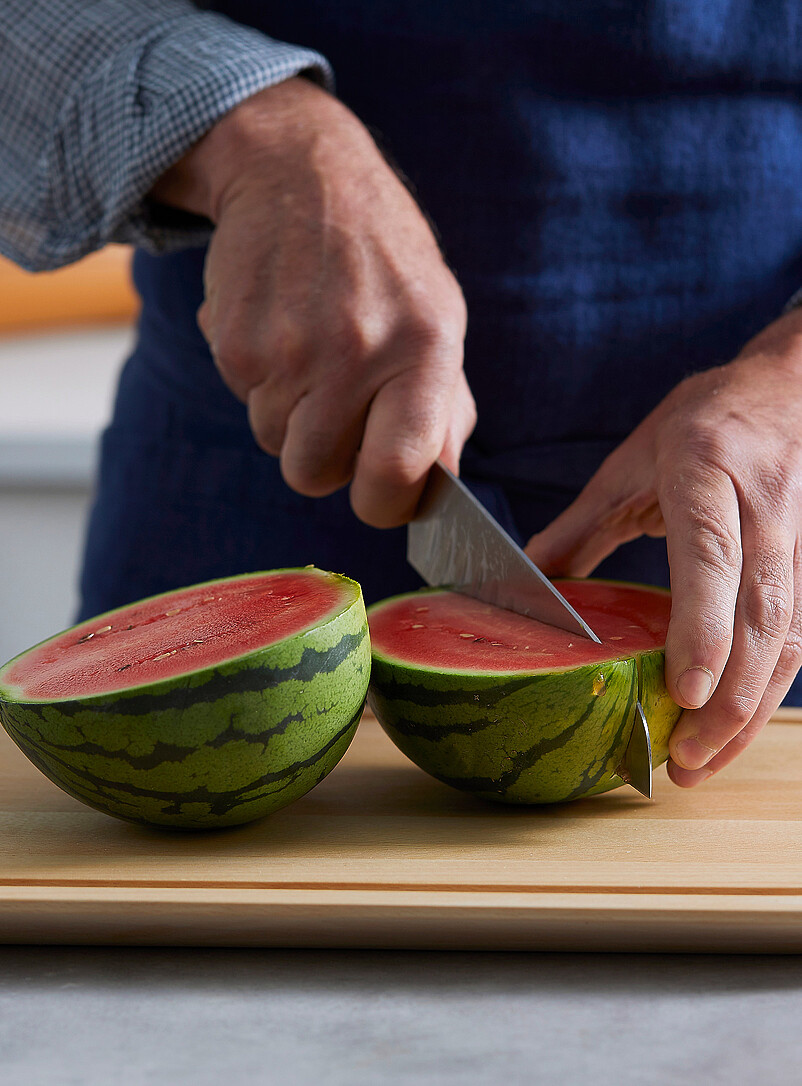
A flat rectangular light-wood cutting board with a smooth planed surface and a narrow recessed channel near its long edge; shown laid flat on a countertop with two watermelon halves on top.
- Overall shapeRectangular flat board with straight long edges and slightly rounded corners visible at the bottom-right corner of the board.
1 region
x 0.03 · y 0.68 · w 0.94 · h 0.26 (high) - Material and finishLight natural beech wood surface with fine linear grain, planed/sanded smooth finish and a matte appearance.
1 region
x 0.08 · y 0.70 · w 0.84 · h 0.20 (high) - Edge detailNarrow darker wood trim or recessed band running along the visible long edge of the board, forming a thin contrasting line between the top surface and the board's face.
1 region
x 0.04 · y 0.88 · w 0.92 · h 0.05 (high) - Juice groove / channelTwo parallel shallow recessed grooves set close to the top long edge of the board, visible as thin lines running along the board's length.
1 region
x 0.09 · y 0.76 · w 0.82 · h 0.03 (high) - Surface conditionClean, unmarked surface with no visible printed text, logos, or stickers on the visible face.
Other
Close-up lifestyle shot showing hands slicing a watermelon on the board; shallow depth of field with a blurred background including a blue apron and checked shirt sleeve.
- Hands and activityTwo adult hands are actively holding and cutting a watermelon with a stainless-steel knife; the right hand holds the fruit while the left hand grips the knife handle.
1 region
x 0.40 · y 0.09 · w 0.53 · h 0.60 (high) - Knife bladeVisible stainless-steel knife blade with a pointed tip slicing into the watermelon flesh.
1 region
x 0.48 · y 0.33 · w 0.28 · h 0.28 (high) - Props and backgroundPerson wearing a dark blue apron and a grey checked long-sleeve shirt; blurred background beyond the subject.
1 region
x 0.05 · y 0.02 · w 0.90 · h 0.48 (medium) - Surface and lightingBoard rests on a light-colored countertop; scene lit with soft directional light from the left producing gentle shadows under hands and fruit.
1 region
x 0.00 · y 0.60 · w 1.00 · h 0.40 (medium) - Shot compositionVertical close-up crop focused on the cutting action and the board, with shallow depth of field isolating foreground elements from a blurred background.
Colors
light beech wood· board surfacemedium warm wood· edge trim#83848B- Overall shapeRectangular flat board with straight long edges and slightly rounded corners visible at the bottom-right corner of the board.
Documents & Data
Q&A
4 answered- What is the thickness of the cutting board?
- The board has a thickness of 2.5 cm (about 1 inch).
- Is the beech wood treated with any food-safe finish or oil?
- The beech wood is untreated; we recommend oiling it before first use with a light natural oil like olive or sesame oil. The board is BPA-free and FDA-approved as noted by retailers.
- What is the recommended cleaning method for this board?
- Do not put the board in the dishwasher. Clean it with a brush and washing-up liquid in lukewarm water, then rinse. For deeper cleaning, rub with salt and white vinegar. Dry thoroughly with a cloth and let it air dry, then nourish the wood with a light cooking oil.
- Is the board suitable for heavy chopping tasks like breaking down poultry or cutting through small bones?
- The board is described as ideal for cutting meats, roasts, and poultry, but as a beech wood board it is not designed for heavy bone chopping or cleaving through joints. For heavy-duty tasks like breaking down poultry or cutting small bones, a thicker end-grain board would be more suitable.