Hazaki Knives
Santoku Walnut Knife
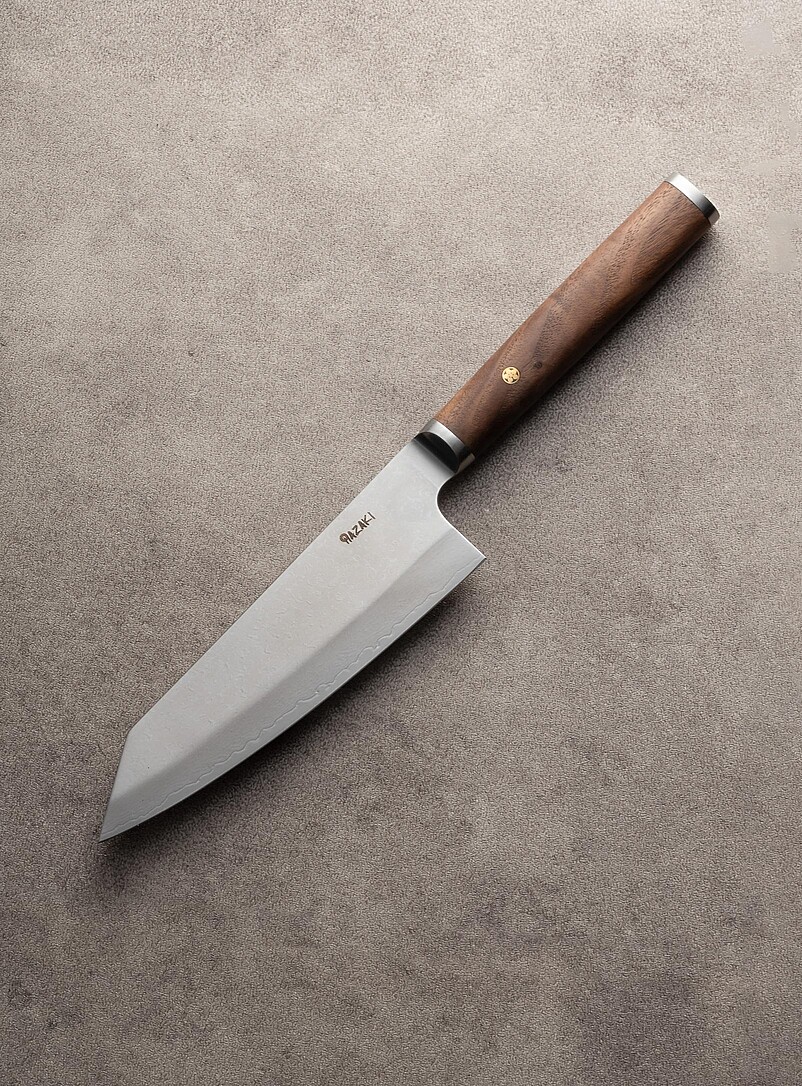
The Santoku Walnut Knife is a versatile, handcrafted kitchen knife made in Montreal, featuring a VG10 Damascus steel blade forged in Japan (Rockwell hardness 61) and a handle handcrafted from Canadian walnut. Ideal for everyday chopping, slicing, and dicing of vegetables, meat, and fish, it includes a gift box, blade guard, and wood butter for conditioning the handle. The blade measures 6.5 x 2 inches with a 4.75-inch handle; note that some users find the handle on the thinner side and recommend conditioning the walnut, as it may arrive unfinished.
- Color
- Walnut
- Material
- VG10 Damascus steel blade and Canadian walnut wood handle
- Gender
- unisex
- Style
- classic, heritage
- Category
- Home & Garden > Kitchen & Dining > Kitchen Tools & Utensils > Kitchen Knives
Specifications
Handmade Santoku knife with Canadian walnut handle and Japanese VG10 Damascus steel blade, perfect for everyday cutting tasks.
VG10 Damascus steel blade with Rockwell hardness 61, full tang design, versatile cutting of vegetables, meat, and fish.
- Color
- Walnut · brown
- Material
- VG10 Damascus steel blade and Canadian walnut wood handle
- Secondary
- wood
- Style
- classic, heritage
- Occasion
- everyday, gift
- Gender
- unisex
- Age Group
- adult
- Condition
- new
- Category
- Home & Garden > Kitchen & Dining > Kitchen Tools & Utensils > Kitchen Knives
Additional Attributes
- handmade
- Japanese forged
- Damascus steel
- full tang
- unique piece
- gift box included
Product Insights
The Santoku Walnut Knife by Hazaki Knives is a 240 CAD full-tang santoku that blends a Seki City forged VG-10 Damascus blade with an unfinished Canadian walnut handle, assembled to order and presented in a Japanese-style gift box with wood butter. Its core promise is a unique, craft-conscious gift with a transcontinental heritage story. However, the VG-10 steel is adequate but outperformed by SG2 at similar prices, the handle requires immediate sealing and may cause hand fatigue due to its weight and thin profile, and a gyuto is considered more versatile for most tasks. The premium price pays for the walnut handle and origin story, not blade performance.
Verified claims
- Steel quality
- VG-10 steel with decorative Damascus; outperformed by SG2 at similar prices.
- Finish
- Unfinished walnut handle requires immediate sealing with wood butter.
- Aesthetics
- The walnut handle is hand-cut from Canadian walnut with pronounced, one-of-a-kind grain.
- Value
- At 240 CAD, the premium pays for the walnut handle and heritage story, not for blade steel.
- Ergonomics
- The walnut handle is relatively thin.
- Material and care
- Walnut handle must be sealed; VG-10 steel is acceptable but surpassed by SG2 at similar price.
- Gift appeal
- Dual-origin story and premium unboxing create a unique gift for craft-conscious buyers.
- Assembly
- Assembled to order with a hand-fitted Japanese blade and walnut handle, presented in a gift box with wood butter.
- Initial care
- Handle must be sealed with included wood butter or cutting board wax immediately after unboxing.
- Care ritual
- Wood butter sample narrates transcontinental heritage via Canadian wood-care practice.
- Blade performance
- VG-10 steel performs well and holds an edge, but better steels such as SG2 are available at similar or lower prices.
- Handling comfort
- The walnut handle is relatively thin and must be sealed before use.
- Forging origin
- The VG-10 blade is forged in Seki City, a Japanese cutlery hub with swordsmithing lineage dating to the 13th century.
- Construction
- Full-tang integrates Japanese blade and Canadian handle.
- Unboxing ritual
- Japanese-style gift box and blade guard; Canadian wood butter included.
- Made to order
- Knife is assembled to order after purchase, shipped within 1–2 weeks.
- Sharpening angle
- The blade is pre-sharpened to a factory edge of 12–15 degrees, and 12–15 degrees is the recommended angle for resharpening.
- Blade construction
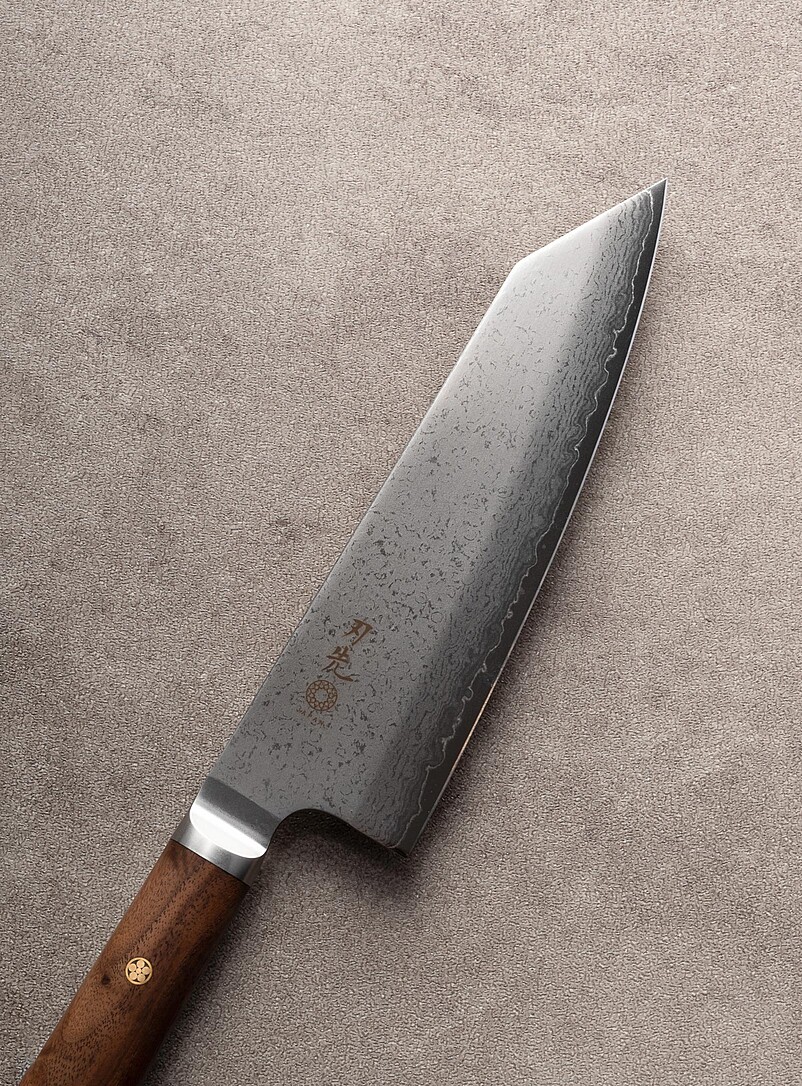
- The VG10 Damascus blade is a VG10 core clad with 67 layers of patterned steel.
- Authenticity and sourcing
- The blades are sourced from Seki City, Japan, and the handles are hand-made in Canada; they are not cheap knockoffs.
Product record
- Title
- Santoku Walnut Knife
- Brand
- Hazaki Knives
- Price
- 240 CAD
- Availability
- In stock
Buying Guide
1 comparison · 4 sourcesUses
Everyday chopping, slicing, and dicing
A versatile Santoku for daily kitchen prep, described as perfect for cutting vegetables, meat, and fish. Its design handles finely chopping, slicing, and dicing tasks.[2]
An everyday knife for chopping, slicing, and dicing
This Santoku from Hazaki Knives is designed as a versatile everyday knife, with a blade suited to finely chopping, slicing, and dicing vegetables, meat, and fish. The brand describes it as elegant and versatile, and as the only knife you'll need each day, made for both professional chefs and amateur cooks.[2]
Product comparison
Compared within this brand.
| Santoku Walnut Knife: Choose this if you want a single everyday knife described as perfect for cutting vegetables, meat, and fish, with a design made to finely chop, slice, and dice. It has a 6.5 by 2 inch blade forged in Japan from VG10 Damascus steel with a Rockwell hardness of 61 that is said to stay sharp a long time, plus a handmade Canadian walnut handle and full-tang construction for durability. Made by hand in Montreal, it comes with a gift box, paper blade guard, and wood butter sample—though each piece is unique and may vary slightly from the photo.[2] | Gyuto Walnut Chef's Knife: Choose this if you want a versatile Gyuto — a Japanese take on the classic chef's knife — as a first high-end knife for stovetop work. It has an 8.25 by 2 inch blade forged in Japan from VG10 Damascus steel with a Rockwell hardness of 61, described as very rigid and long-lasting in sharpness, plus a handmade Canadian walnut handle and full-silk construction running through the handle for a durable structure, and it arrives in a gift box with a paper blade guard. Note that one Reddit commenter found the steel unremarkable, describing it as looking like factory VG 10, and found the knife a bit heavy with a skinnier grip and walnut handles less striking than the maker's burl ones; each handmade piece is also unique and may vary slightly from the photo.[1,3] | Gyuto Maple Burl Chef's Knife: Choose this if you want an extremely versatile Japanese-style chef's knife described by the retailer as ideal for those who love working in front of the stove and as a first high-end knife. It pairs a 8.25 inch VG10 Damascus steel blade forged in Japan (Rockwell hardness of 61, rigid and staying sharp for a long time) with a handmade maple burl handle, and comes with a gift box and paper blade guard. Each Montreal-made piece is unique and may vary slightly from the photo.[4] |
Image Analysis
3 images- 01
Product
A single chef-style knife shown diagonally with a straight spine, angled tip, satin-finish steel blade showing a subtle wavy pattern near the edge, and a cylindrical walnut wood handle with a metal bolster and metal end cap.
- Blade shapeLong single-piece steel blade with a straight spine that tapers to an angled tip; the cutting edge has a shallow concave bevel visible along its length.
1 region
x 0.12 · y 0.34 · w 0.71 · h 0.49 (high) - Blade surface patternFaint wavy linear pattern running parallel to the cutting edge along most of the blade side.
1 region
x 0.16 · y 0.47 · w 0.58 · h 0.28 (high) - Blade text“HAZAKI”
1 region
x 0.30 · y 0.34 · w 0.10 · h 0.06 (high) - Handle material and shapeCylindrical wooden handle with visible walnut grain and a smooth, satin finish; gently rounded butt end.
1 region
x 0.61 · y 0.07 · w 0.29 · h 0.33 (high) - Handle decorative pinSmall round metallic pin with a gold-colored finish set into the handle near the bolster.
1 region
x 0.72 · y 0.25 · w 0.03 · h 0.04 (high) - Bolster and end capShort dark metal bolster at the blade-handle junction and a matching metal end cap at the handle butt, both with a brushed metallic finish.
2 regions
x 0.55 · y 0.30 · w 0.14 · h 0.07 (high); x 0.86 · y 0.06 · w 0.08 · h 0.08 (high) - Visible jointClear junction where the blade meets the bolster with a short recessed area forming the knife heel.
1 region
x 0.48 · y 0.29 · w 0.12 · h 0.08 (high)
Other
Knife photographed flat on a neutral textured fabric background, centered diagonally from top-right to bottom-left with soft diffuse lighting and a faint shadow below the blade and handle.
- BackgroundEvenly lit neutral light-gray textured fabric surface occupying the full image.
- Shot compositionKnife placed diagonally from the image top-right toward bottom-left, leaving ample negative space around the product.
- Lighting and shadowSoft diffuse overhead lighting producing mild diffuse shadowing beneath the knife, especially under the blade edge.
Colors
satin steel gray· blade#C5C4C2walnut brown· handlebrushed gunmetal· bolster and end cap#AEA299warm gold· handle pin#B59283- Blade shapeLong single-piece steel blade with a straight spine that tapers to an angled tip; the cutting edge has a shallow concave bevel visible along its length.
- 02
Product
Close-up of a santoku knife showing the blade face with visible layered/damascus pattern, a wavy tempered edge line, a metal bolster, and a partial walnut handle with a decorative brass mosaic pin.
- Blade geometrySingle-piece blade with a wide, flat profile tapering to an angled tip typical of a santoku-style blade; the cutting edge runs along the long lower edge and the spine is straight then bevels to form the tip.
1 region
x 0.16 · y 0.05 · w 0.71 · h 0.77 (high) - Surface patternVisible layered/damascus-like mottled texture across the blade face with irregular small markings and a lighter region near the spine transitioning to a darker midsection.
1 region
x 0.25 · y 0.12 · w 0.61 · h 0.64 (high) - Wavy edge lineDistinct wavy temper or hamon-like line running parallel to the cutting edge from near the tip toward the handle side, forming a lighter undulating band.
1 region
x 0.53 · y 0.07 · w 0.42 · h 0.72 (high) - Stamped characters“Two vertical Japanese kanji-style characters stamped near the blade shoulder above a small circular emblem.”Partial
1 region
x 0.28 · y 0.48 · w 0.14 · h 0.17 (medium) - Blade emblemSmall circular emblem stamped below the characters on the blade face, consisting of a ring with an internal pattern.
1 region
x 0.32 · y 0.60 · w 0.05 · h 0.06 (medium) - BolsterShort polished metal bolster connecting blade to handle with a visible curved cutout at the blade heel.
1 region
x 0.19 · y 0.68 · w 0.16 · h 0.12 (high) - Handle materialPartial view of a wooden handle with visible straight wood grain and a smooth, satin finish; walnut-colored brown tone.
1 region
x 0.05 · y 0.74 · w 0.18 · h 0.20 (high) - Decorative pinRound brass or gold-colored mosaic pin set into the handle showing a small floral or rosette motif.
1 region
x 0.08 · y 0.83 · w 0.04 · h 0.04 (high)
Other
Photographed on a textured neutral fabric background with soft, even lighting; composition is a diagonal close-up of the knife cropped to show the full blade and part of the handle.
- Background materialEven-textured, suede-like fabric in a warm gray/taupe tone used as the photographic background.
1 region
x 0.00 · y 0.00 · w 1.00 · h 1.00 (high) - Shot compositionDiagonal close-up framing with the blade oriented from lower-left toward upper-right and the tip near the top-right corner; handle extends out of the lower-left edge.
- Lighting and shadowSoft, diffuse lighting with subtle highlights along the bolster and spine and gentle shadowing beneath the blade indicating overhead light.
Colors
steel gray· blade#928E8Cwalnut brown· handle#6C432Cbrass gold· decorative pin#9A8D84polished silver· bolster- Blade geometrySingle-piece blade with a wide, flat profile tapering to an angled tip typical of a santoku-style blade; the cutting edge runs along the long lower edge and the spine is straight then bevels to form the tip.
- 03
Product
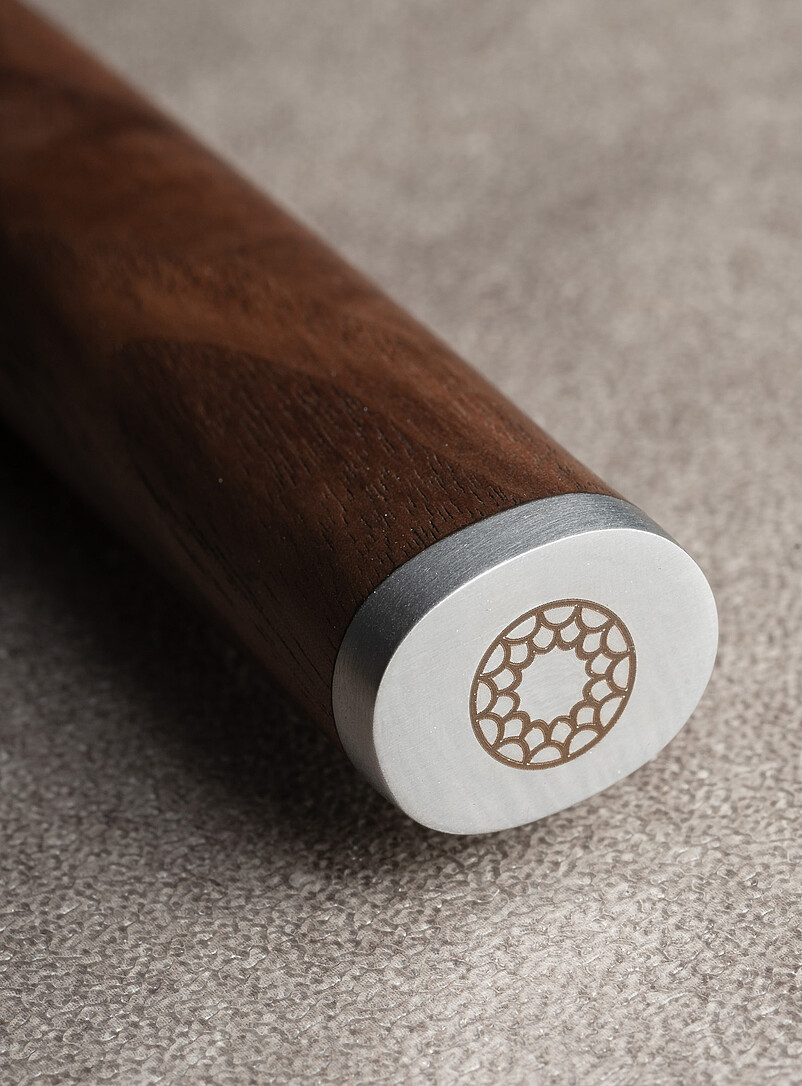
Close-up of the knife handle butt showing a smooth cylindrical walnut wooden handle with visible straight grain and a circular brushed metal butt cap with a decorative ring motif engraved at the cap face.
- Handle materialCylindrical walnut wood handle with visible straight grain and a smooth, matte finish that tapers slightly along its length.
1 region
x 0.05 · y 0.08 · w 0.68 · h 0.58 (high) - Butt cap geometryCircular metal butt cap fitted flush to the end of the handle with a slightly chamfered edge and a flat face oriented toward the camera.
1 region
x 0.58 · y 0.62 · w 0.36 · h 0.33 (high) - Decorative motifA concentric ring motif engraved or inlaid on the butt cap face consisting of repeating scalloped petal shapes forming a circular wreath; the motif contrasts in a warmer, gold-bronze tone against the silver cap.
1 region
x 0.68 · y 0.70 · w 0.14 · h 0.14 (high) - Cap finishBrushed or satin metal finish on the cap face and edge with subtle radial texture visible under the lighting.
1 region
x 0.58 · y 0.62 · w 0.36 · h 0.33 (medium) - Surface conditionHandle surface appears smooth with visible small wood pores and natural grain variations; no visible seams or fasteners at the visible end.
1 region
x 0.05 · y 0.08 · w 0.68 · h 0.58 (medium)
Other
Diagonal close-up composition on a textured neutral fabric surface with shallow depth of field and soft directional lighting from upper-left, producing gentle shadowing under the cap.
- Shot compositionMacro-detail diagonal close-up showing the handle running from top-left toward bottom-right, with the butt cap near the lower-right quadrant of the frame.
- BackgroundTextured woven or looped fabric surface in a neutral beige tone occupying the entire background and supporting surface.
1 region
x 0.00 · y 0.60 · w 1.00 · h 0.40 (high) - Lighting and depthSoft, diffused lighting with shallow depth of field; foreground (cap and nearby handle) is sharp while areas further up the handle are gradually out of focus.
- ShadowSubtle shadow cast beneath and slightly left of the butt cap indicating light from upper-left.
1 region
x 0.54 · y 0.72 · w 0.30 · h 0.18 (medium)
Colors
walnut brown· handle#5D3A2Abrushed silver· butt cap#C5C5C3warm bronze· engraved motif#83756C- Handle materialCylindrical walnut wood handle with visible straight grain and a smooth, matte finish that tapers slightly along its length.
Brand PDP Lookup
- Brand
- Hazaki Knives
Santoku - Walnut
Documents & Data
Reddit Insights
2 threads · r/TrueChefKnives, r/chefknivesReddit users appreciate Hazaki knives' aesthetics and Canadian craftsmanship but are mixed on the value due to average steel quality and some ergonomic quirks.
Opinions are split: some praise the handles and support for a Canadian brand, while others criticize the steel as unimpressive for the price and note the knife's weight and thin handle. Overall, slightly negative leaning.
Themes
Use Cases
- Everyday home cooking and food preparation
- Entry-level Japanese knife for new enthusiasts
Watch Out For
Compared To
vs Takamura SG2
Takamura SG2 is considered superior in steel quality (sharper, better edge retention) and is priced lower, making it a better value option.
vs Other Japanese knives in similar price bracket
At the VG-10 pro line price point, many would prefer alternatives with better reputations or performance.
Source Threads
Detailed first-hand impressions of Hazaki knives
I have held one. The steel is nothing impressive. Looks like a factory vg 10. You can buy just those blades for 90CAD. So it shows you how much he charges for the handles…a lot. But. His maple burl handles are gorgeous. Truly lovely. The walnut are nothing to write home about however. They are a little on the heavy side. And are of a skinnier grip. So if you prefer a skinnier grip and a burl handle then I think they are nice. He makes them I believe in a town north of Montreal which is known to be quite hippy. One of my favorite Quebec towns.
u/Lifeishardetcr/TrueChefKnivesView thread →
User experience with Hazaki bunka and thoughts on handle and steel
The Hazaki pro bunka was my first knife as the gyutos I viewed in store seemed comically large. One week later, I was walking back in for a 240 Gyuto, somewhat regretting my bunka purchase. Don’t get me wrong, it’s been great, and I reach for it pretty regularly, but the versatility of a Gyuto is far superior. The handle on the Hazaki’s are beautiful but quite thin and would suit someone with smaller hands. I’m not sure about the maple, but the walnut came unfinished, so I would highly recommend protecting it with some cutting board wax. VG-10 is great. Sure, there’s better steel out there but it’s going to perform very well, hold and edge and require minimal maintenance. I was happy to support a Canadian company and would love to recommend the same but it comes down to what will suit your needs best.
u/12357909653r/chefknivesView thread →