Riedel
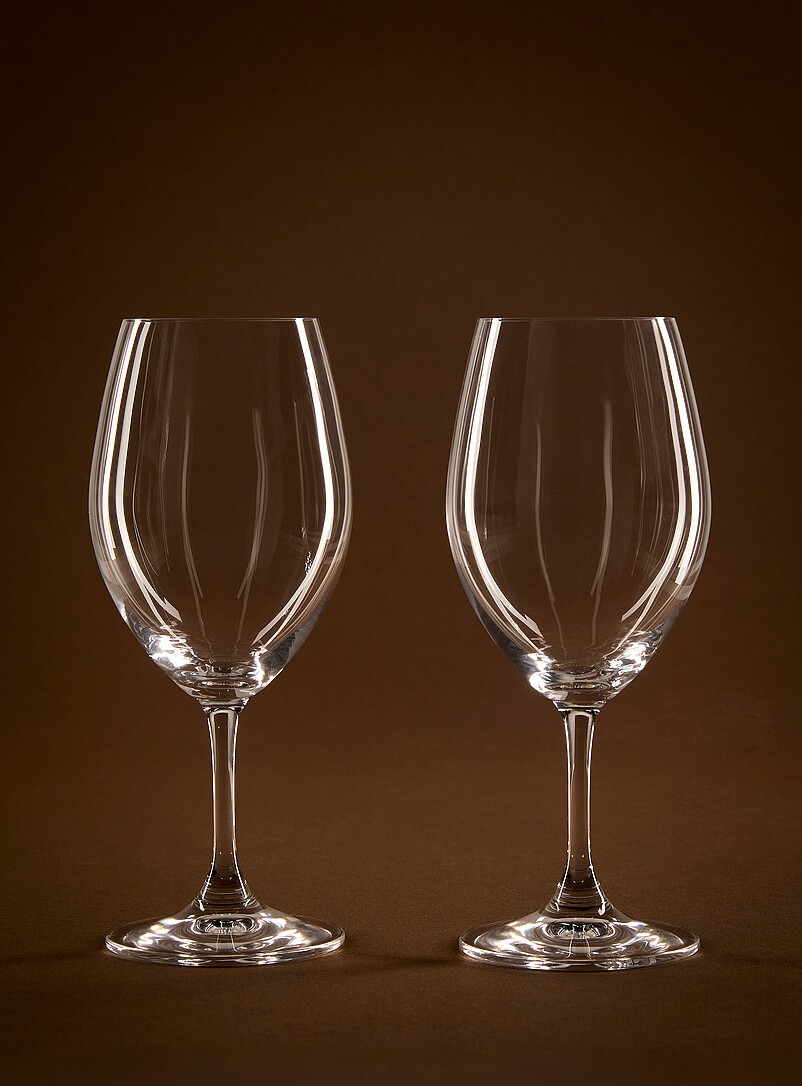
Ouverture Red Wine Glasses Set Of 2
These Riedel Ouverture red wine glasses, sold as a set of 2, are crafted from pure crystal glass in Germany and are dishwasher safe. Each glass has a 250 ml (8 oz.) fill capacity and measures 2.25 inches (5.5 cm) in diameter by 7.5 inches (19 cm) high, with a design intended to release aroma and balance tannins in red wines. User feedback highlights their durability and versatility, making them a popular choice for everyday wine drinking and casual tasting.
- Color
- Crystal
- Material
- Pure crystal glass
- Category
- Home & Garden > Kitchen & Dining > Tableware > Drinkware > Stemware
Specifications
Set of two pure crystal red wine glasses from Riedel, 250 ml capacity, dishwasher safe, made in Germany.
Crystal glass construction, dishwasher safe, 250 ml fill capacity, designed to release aroma and balance tannins in red wines.
- Color
- Crystal · white
- Material
- Pure crystal glass
- Gender
- unisex
- Age Group
- adult
- Condition
- new
- Dimensions
- 2.25 x 2.25 x 7.5 in
- Category
- Home & Garden > Kitchen & Dining > Tableware > Drinkware > Stemware
Additional Attributes
- Riedel
- crystal glass
- dishwasher safe
- set of 2
- made in Germany
- 250 ml capacity
- designed for red wine
Product Insights
The Riedel Ouverture Red Wine Glasses Set Of 2 offers a professional tasting standard at an entry-level price, delivering the core promise of durability and dishwasher safety through thicker, machine-blown crystal that sacrifices the refinement of premium stems for everyday resilience. The 250 ml tulip bowl, CNC-machined for uniform thickness, concentrates aromatics for any wine type—red, white, rosé, or sparkling—while the shorter stem ensures stability and safe cleaning. Owners praise it as a workhorse that survives drops and daily wear, making it the best value in entry-level stemware, though the thicker rim and less refined glass quality are the main tradeoff for elegance.
Verified claims
- Pro standard
- Industry-standard tasting glass used in wineries and wine shops.
- Durability
- DIN-certified dishwasher-proof and proven durable for commercial use.
- Precision
- CNC-machined molds and single-gob construction give uniform wall thickness and consistent balance.
- Dishwasher safe
- Certified dishwasher-proof to DIN EN 12857-1/2:2005; the glass stays shiny without clouding or etching after repeated dishwasher cycles.
- Bowl design
- The 250 ml tapered tulip bowl concentrates aromatics for a standard 5 oz red-wine pour and bridges to Riedel's varietal-specific shapes.
- Shape
- Tulip shape works across all wine types, matches pro tasting glass, and bridges to Vinum series.
- Glass quality
- Crystal glass: uniformly machine-blown, neutral color, seamless; thicker for durability but less refined.
- Optical clarity
- Lead-free crystal has a higher refractive index for livelier sparkle and no iron-oxide impurities, so wine color displays true without a greenish cast.
- Value
- Professional tasting adoption, universal tulip shape, and a clear upgrade path to Vinum make it a strong value among entry-level stemware.
- Glass construction
- Thicker, machine-blown crystal than premium stems, prioritizing durability and dishwasher safety over refinement.
- Aroma
- The 250 ml capacity and tulip bowl concentrate aromas for a focused tasting.
- Thickness tradeoff
- Thicker than premium Riedel lines, but still adequate aroma concentration for everyday use.
- All-purpose use
- Many users report using it for red, white, and even sparkling wines.
- Versatility
- Universal tulip bowl suits all wine styles and matches tasting glass dimensions.
- Competitive pricing
- At $45 for two, provides Gabriel Glas–level durability at roughly half the per-glass cost
- Design heritage
- Bowl bridges entry-level to Vinum, built on 260 years of precision glassmaking and seamless construction.
- Fill capacity
- 250 ml fill capacity mirrors standard tasting glass, focusing aromatics.
- Lead-free crystal
- The Ouverture red wine glass is made from lead-free crystal, as Riedel specifies.
Product record
- Title
- Ouverture Red Wine Glasses Set Of 2
- Brand
- Riedel
- Price
- 45 CAD
- Availability
- In stock
Buying Guide
1 comparison · 5 sourcesUses
Everyday red wine tasting
Designed for the simple pleasure of tasting red wine. According to the merchant, these glasses help release the wine's aroma, highlight its fruity characteristics, and balance the tannins.[3]
An everyday, all-purpose red wine glass
These Riedel Ouverture red wine glasses suit daily wine drinking across different wines, with one wine forum commenter calling the Ouverture a great every-day all-purpose glass and an absolute workhorse. They're dishwasher safe, and the same commenter credits the shorter stem with making dishwashing easy and reports having handled theirs roughly without breaking one — though that's their personal experience, not a guarantee.[1,2,3]
Product comparison
Compared within this brand.
| Ouverture Red Wine Glasses Set Of 2: Choose this if you want an everyday, all-purpose red wine glass for casual tasting: the merchant says the crystal glass helps release aroma, highlight fruity characteristics, and balance tannins in red wines. It comes as a set of 2 with a 250 ml (8 oz) fill capacity, is dishwasher safe, and a wine-forum commenter called it an absolute workhorse whose shorter stem makes dishwashing easy, reporting rough handling without breakage. Note the moderate 8 oz capacity, and that the tasting benefits are the merchant's own description.[1,2,3] | Ouverture White Wine Glasses Set Of 2: Choose this if you want an everyday pair of stemmed glasses for tasting white wine — Riedel positions the Ouverture line as glasses that release aroma and balance fruit and sugar to give wine structure. Each machine-blown, lead-free crystal glass is made in Germany, holds 250 ml (8 oz.), stands 7.25 inches (18.5 cm) tall, and is dishwasher safe for easy care. Note it is a compact 2-inch (5 cm) diameter bowl format, so pick a different Riedel style if you prefer a larger bowl.[4,5] |
Image Analysis
2 images- 01
Product
Two identical clear stemmed wine glasses shown standing side by side on a flat surface; each has an ovoid bowl, slender stem, and a round flat foot with visible concentric rings. Highlights and internal reflections from studio lighting are visible on the bowls and feet.
- Pair arrangementTwo matching wine glasses standing next to each other, spaced evenly and aligned on the same baseline; left glass slightly left of center and right glass slightly right of center.
2 regions
x 0.12 · y 0.18 · w 0.34 · h 0.66 (high); x 0.54 · y 0.18 · w 0.34 · h 0.66 (high) - Bowl geometryOvoid, slightly tapered bowls with a wider lower hemisphere narrowing toward a straight, thin rim; bowls are clear and show vertical highlight bands from lighting.
2 regions
x 0.16 · y 0.18 · w 0.28 · h 0.46 (high); x 0.58 · y 0.18 · w 0.26 · h 0.46 (high) - RimThin, straight circular rim visible at top of each bowl; rim appears uniformly thin and reflective.
2 regions
x 0.20 · y 0.18 · w 0.20 · h 0.04 (medium); x 0.64 · y 0.18 · w 0.18 · h 0.04 (medium) - StemLong, slender cylindrical stems connecting bowls to the feet; stems are clear and show subtle vertical reflections.
2 regions
x 0.32 · y 0.56 · w 0.06 · h 0.26 (high); x 0.70 · y 0.56 · w 0.06 · h 0.26 (high) - Foot/baseRound flat feet with concentric circular rings and bright reflective highlights; feet sit flat on the surface and cast soft shadows.
2 regions
x 0.20 · y 0.78 · w 0.24 · h 0.12 (high); x 0.60 · y 0.78 · w 0.24 · h 0.12 (high) - Material appearanceClear transparent glass with high optical clarity; internal and rim reflections indicate smooth polished surfaces.
- Lighting highlightsDistinct vertical white highlight bands and curved specular highlights on each bowl and foot consistent with studio strip lighting positioned in front of the glasses.
Other
Studio product photograph with a uniform brown seamless background, even frontal lighting creating vertical highlights and soft shadows under the glasses; image is vertically oriented and tightly framed around the pair.
- BackgroundUniform warm brown seamless backdrop with no visible texture aside from subtle tonal gradient.
1 region
x 0.00 · y 0.00 · w 1.00 · h 1.00 (high) - ShadowsSoft diffuse shadows beneath and slightly around each foot, indicating a flat surface and controlled studio lighting.
2 regions
x 0.18 · y 0.86 · w 0.28 · h 0.08 (high); x 0.56 · y 0.86 · w 0.28 · h 0.08 (high) - Shot compositionCentered, symmetrical composition with both glasses fully visible and vertically oriented; image crops small top margin above rims and includes full feet.
- Image qualitySharp focus on glass surfaces with crisp edge detail and clear specular highlights; no visible text or labels in the scene.
Colors
clear transparent· bowl and stem#59351Dclear transparent· foot/base#59351C- Pair arrangementTwo matching wine glasses standing next to each other, spaced evenly and aligned on the same baseline; left glass slightly left of center and right glass slightly right of center.
- 02
Product
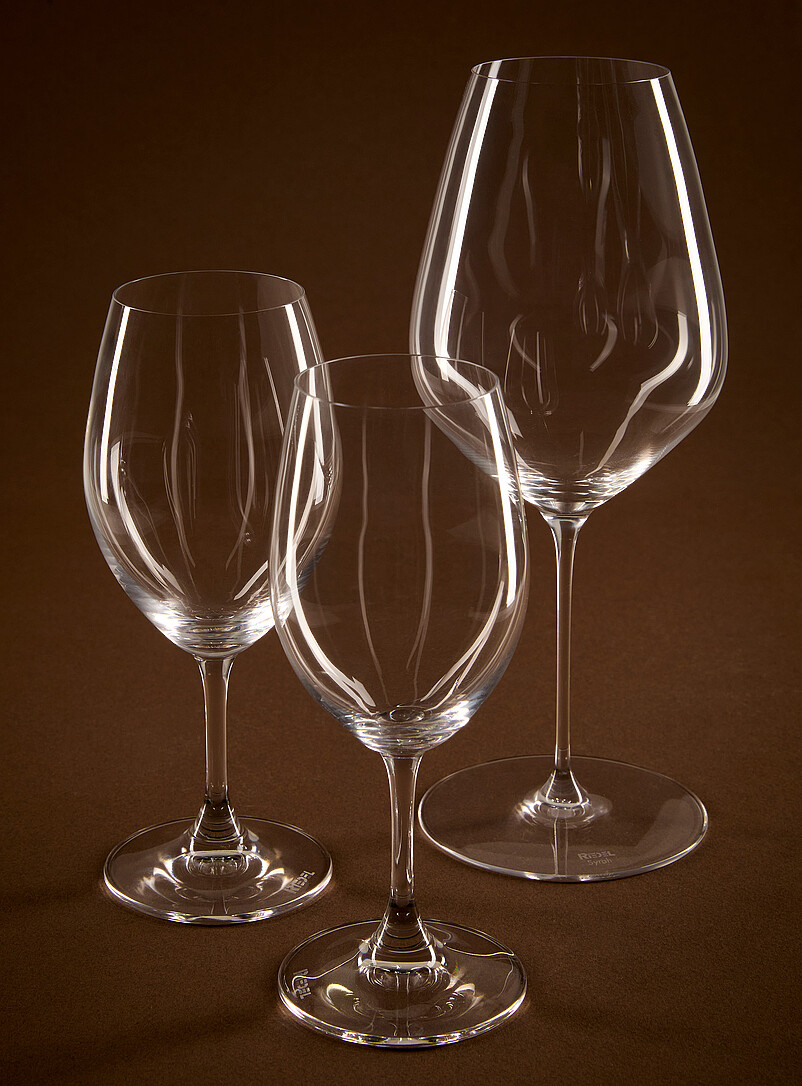
Three clear stemmed wine glasses with tall thin stems and tulip-shaped bowls are arranged in a triangular grouping; one large bowl at right and two smaller bowls at left and center front. Glass surfaces show bright linear highlights and circular base reflections.
- Overall compositionThree clear stemmed wine glasses are visible: a large wine glass at right with a tall bowl, a medium glass centered in front, and a smaller glass at left-rear; all three rest on round flat bases.
3 regions
x 0.06 · y 0.18 · w 0.34 · h 0.70 (high); x 0.28 · y 0.28 · w 0.32 · h 0.60 (high); x 0.55 · y 0.02 · w 0.42 · h 0.96 (high) - Bowl shapeBows are tulip-shaped with a wide lower curve narrowing toward a thin, slightly tapered rim; the large right bowl is noticeably taller and more elongated than the two left bowls.
1 region
x 0.58 · y 0.04 · w 0.34 · h 0.64 (high) - Stem and transitionEach glass has a long, slender, straight stem that joins a rounded knop/transition before flaring to the flat circular base.
1 region
x 0.40 · y 0.58 · w 0.20 · h 0.36 (high) - Base details and reflectionsFlat circular bases show concentric circular reflections and highlight arcs; highlights create bright rings and a small bright spot at each stem-foot junction.
2 regions
x 0.48 · y 0.80 · w 0.40 · h 0.18 (high); x 0.06 · y 0.78 · w 0.28 · h 0.20 (high) - Glass material and finishMaterial appears clear, transparent glass with smooth glossy finish producing specular highlights and internal reflections.
- Rim thinnessRims are thin and uniformly circular with crisp edges visible against the background.
1 region
x 0.34 · y 0.10 · w 0.32 · h 0.14 (medium) - Legible base marking“RIEDEL”
1 region
x 0.66 · y 0.78 · w 0.20 · h 0.12 (medium)
Other
Warm brown background and flat supporting surface with studio lighting from above creating vertical linear highlights on the glass surfaces and soft shadows under each base; image is centered and vertically oriented.
- Background and surfaceSingle-tone warm brown background and matching flat surface provide low-contrast backdrop for the clear glass.
1 region
x 0.00 · y 0.00 · w 1.00 · h 1.00 (high) - Lighting and reflectionsStudio lighting produces narrow vertical white highlights along the bowls and distinct circular reflections on the bases; highlights are brightest on the right-hand large glass.
- Arrangement and perspectiveGlasses are arranged in a triangular cluster with the largest glass set behind and to the right, creating partial overlap; camera angle is slightly above center showing full bowls and bases.
- Image qualitySharp focus on glass surfaces with clear edge definition and low noise; no visible compression artifacts.
Colors
clear/transparent· glass- Overall compositionThree clear stemmed wine glasses are visible: a large wine glass at right with a tall bowl, a medium glass centered in front, and a smaller glass at left-rear; all three rest on round flat bases.
Brand PDP Lookup
- Brand
- Riedel
RIEDEL Ouverture Red Wine
Documents & Data
Customer Reviews
1 total1 reviews · out of 5
Confortable
J'aime ces verres à vin mais je préfèrerais plus ballons
Reddit Insights
5 threads · r/wineReddit users highly recommend the Riedel Ouverture Red Wine glasses as a durable, versatile, and affordable everyday option, frequently serving as a standard tasting glass across various settings.
The majority of commenters praise the Riedel Ouverture for its all-purpose use, robustness, and value, though some note that it is not as delicate as premium glasses like Gabriel Glas.
Themes
Use Cases
- Everyday drinking for all wine types
- Use by wine stores, bars, and wineries as tasting glasses
- Use for guests and casual settings due to durability
Watch Out For
Compared To
vs Gabriel Glas Standart
Gabriel Glas offers a thinner, more elegant drinking experience but at a higher price point; Riedel Ouverture is favored for everyday durability and value.
vs Spiegelau
Spiegelau provides similar quality glasses, often at competitive prices, and is seen as a close alternative to Riedel.
vs Schott Zwiesel
Schott Zwiesel Tritan glasses are also durable and dishwasher safe, sometimes preferred for their break resistance.
Source Threads
Riedel Overture Red Wine as everyday all-purpose glass
The Riedel Overture Red Wine glass is a great every-day all-purpose glass.
u/Ausonius89r/wineView thread →
Riedel Ouverture as durable workhorse
the overture is an absolute workhorse. Can easily be dishwashed (because of the shorter stem) and I've beaten them up pretty good without ever breaking one.
u/indichutr/wineView thread →