Laguiole
Premium Steak Knife Set 6-Pack
This set of 6 Laguiole steak knives is designed for serving steak and other meats at the dining table or in restaurant settings. Each knife features a full-tang stainless steel blade with a wooden handle for balance and comfort, measuring 9.25 inches in total length with a 4.5-inch blade. Manufactured in France, the set pairs traditional craftsmanship with functional cutlery for meat carving and table service.
- Material
- Stainless steel blades, wooden handles
- Category
- Home & Garden > Kitchen & Dining > Kitchen Tools & Utensils > Kitchen Knives
Size
Specifications
Set of 6 premium steak knives with stainless steel blades and wooden handles, featuring full-tang construction for balance and comfort.
Full-tang blades extending through the handle for strength and balance; smooth cutting action; comfortable grip.
- Material
- Stainless steel blades, wooden handles
- Secondary
- wood
- Gender
- unisex
- Age Group
- adult
- Condition
- new
- Category
- Home & Garden > Kitchen & Dining > Kitchen Tools & Utensils > Kitchen Knives
Additional Attributes
- stainless steel blades
- wooden handles
- full-tang
- set of 6
- made in France
- premium
Product Insights
The Laguiole Premium Steak Knife Set 6-Pack traces its design to an 1829 shepherd's knife, with each blade marked by the Napoleonic bee and shepherd's cross symbols of imperial and pastoral heritage. Used as the standard steak knife in upscale restaurants, it offers a serrated 56 HRC steel edge that cuts cleanly without crushing, preserving crust and juices, and stays sharp for years. The full-tang design centers weight in the palm for ergonomic balance, reducing fatigue. To maintain the wooden case and handles, hand wash, towel-dry, and oil monthly.
Verified claims
- Design lineage
- Design originates from 1829 shepherd's knife.
- Cultural symbols
- Bee and shepherd's cross on each knife reflect imperial and pastoral heritage.
- Restaurant adoption
- Many upscale restaurants use Laguiole steak knives.
- Serrated edge
- Serrated 56 HRC steel edge cuts cleanly and stays sharp for years without noticeable performance loss.
- Cutting performance
- Serrated edge preserves crust and retains juices by cutting fibers without crushing.
- Sharpness longevity
- Stainless steel blades hardened to 56 HRC keep serrations sharp and chip-resistant for years.
- Ergonomic balance
- Full-tang blades extend through the handle for strength and balance, centering weight in the palm and reducing cutting effort and fatigue.
- Steel hardness
- 56 HRC 420 steel — serrated blades resist chipping on dinnerware and stay sharp for years.
- Care
- Hand wash with immediate towel-drying and periodic food-grade mineral oiling (two to four times a year) preserves wooden handles.
- Heritage
- Laguiole's design dates to 1829 with a Napoleonic bee emblem and shepherd cross pins.
- Storage
- This set is presented in an elegant wooden box for storage.
- Dishwasher safety
- The wooden handles are not dishwasher safe; hand washing is recommended to preserve the wood finish.
- Atelier
- The brand page for this set points to Laguiole en Aubrac, a maker of handcrafted table knives in the Aubrac region, but the retailer listing does not name the specific atelier for this SKU.
- Sharpening
- The serrated edges cannot be pulled through a sharpener or sharpened on a whetstone; restoring them means re-cutting each scallop individually with specialty gear, so owners should expect to run the set until it stops cutting rather than budgeting for routine sharpening.
Product record
- Title
- Premium Steak Knife Set 6-Pack
- Brand
- Laguiole
- Price
- 190 CAD
- Availability
- In stock
Buying Guide
1 comparison · 9 sourcesUses
Steak-night carving for meat lovers
This LaguoIe steak knife set is aimed at serving and cutting meat at the table, a fit the merchant describes as perfect for meat lovers. The full-tang blade and wooden handle are designed to give a smooth cutting action and a comfortable grip while you slice.[1]
Product comparison
Compared within this brand.
| Premium Steak Knife Set 6-Pack: Choose this if you want a six-piece steak knife set aimed at meat lovers, with stainless steel blades and wooden handles that the retailer says ensure a smooth cutting action and a comfortable grip. The full-length tangs extend through the handle for strength and balance, each knife measures 9.25 inches overall with a 4.5-inch blade, and the set comes in a wooden case; the knives are made in France. The set is offered in Black and Off White one-size options, though the product photos show a folding-style design whose locking function is not confirmed in the product specifications.[1,2] | Expression Steak Knife Set 4-Pack: Choose this if you want a set of four French-made steak knives with elegant olive wood handles and a contemporary take on the traditional Laguiole look. Each knife has a forged stainless steel blade of about 4.5 inches (11.43 cm) with a fine serrated edge that, per the merchant, cuts raw and cooked meats precisely, and it can double as a table knife. A signature wooden storage case is included, though the durability claim of extreme resistance comes from manufacturer-style copy rather than verified testing.[3,4,5,6] | Heritage Natural Wood Steak Knife Set 6-Pack: Choose this if you're a meat lover outfitting the table: this France-made Laguiole set includes six steak knives with serrated stainless steel blades (4.5 inches long, 9.25 inches overall) and natural wood handles. The full-length tang extending through the handle is said to add strength and balance, and the merchant states the full-tang blade and wooden handle ensure smooth cutting and a comfortable grip. It comes in a Hazelnut or Assorted color variant in one size.[7,8,9] |
Image Analysis
2 images- 01
Product
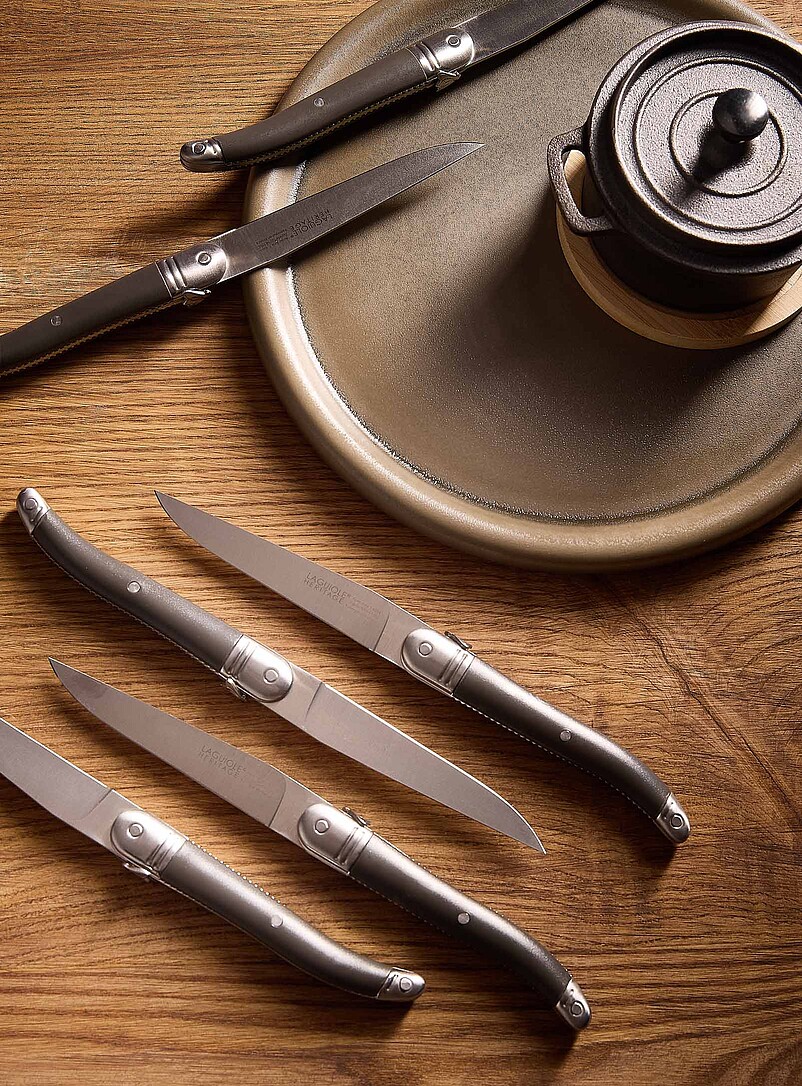
Six steak knives arranged on a wood surface; each has a curved metallic gray handle with a polished metal bolster and a straight stainless blade with a pointed tip. Two knives have blades open and visible, others show handles and folded blades.
- Handle shapeCurved single-piece handles with a rounded teardrop end and a slight taper toward the bolster; each handle has a visible round rivet near the midpoint and a small polished metal end cap.
2 regions
x 0.05 · y 0.64 · w 0.40 · h 0.29 (high); x 0.55 · y 0.44 · w 0.40 · h 0.33 (high) - Handle finishMatte metallic gray finish on handles with subtle stitched or textured edge detail along the spine side visible on several handles.
1 region
x 0.05 · y 0.64 · w 0.40 · h 0.29 (high) - Bolster and hingePolished stainless bolster at blade pivot with a small rounded locking/lever component visible on each knife where blade meets handle.
1 region
x 0.18 · y 0.50 · w 0.58 · h 0.25 (high) - Blade geometryLong, narrow straight blades with pointed tips and flat spine; two blades are fully extended showing plain edges and a satin brushed finish.
2 regions
x 0.22 · y 0.28 · w 0.55 · h 0.25 (high); x 0.10 · y 0.72 · w 0.50 · h 0.20 (high) - Blade finishBlades have a satin stainless finish with a visible faint grind line near the spine and reflective polished bevels near the cutting edge.
1 region
x 0.22 · y 0.28 · w 0.55 · h 0.25 (high) - Blade text“LAGUIOLE”
2 regions
x 0.33 · y 0.32 · w 0.16 · h 0.07 (high); x 0.12 · y 0.74 · w 0.14 · h 0.06 (medium) - Knife arrangementKnives are laid flat and fanned across the frame at varying angles, some blades pointing toward top-left and others toward bottom-right, with overlapping handles.
- Visible wear or reflectionsSpecular highlights and slight reflections are visible on metal bolsters and blade surfaces indicating polished metal parts; no visible scratches or chips.
1 region
x 0.20 · y 0.44 · w 0.50 · h 0.40 (medium)
Other
Still-life composition on a wood tabletop with a ceramic plate and a small cast-iron pot as props; warm directional lighting from top-left casts soft shadows; image is vertically oriented and cropped close to the arrangement.
- Background surfaceHorizontal wood grain tabletop with medium brown tones and visible wood texture lines.
1 region
x 0.00 · y 0.00 · w 1.00 · h 1.00 (high) - Prop plateLarge round ceramic plate with a muted beige to taupe glazed finish, positioned near the top center and partially cropped by the frame.
1 region
x 0.38 · y 0.02 · w 0.56 · h 0.37 (high) - Prop small potSmall dark cast-iron lidded pot placed on the plate at top-right, showing textured matte black surface and a round knob on the lid.
1 region
x 0.72 · y 0.00 · w 0.26 · h 0.20 (high) - Lighting and shadowsWarm directional lighting from upper-left creates soft shadows beneath knives and subtle highlights on metal surfaces.
- Image orientationVertical portrait crop showing full composition from top of plate to lower knife handles.
Colors
matte metallic gray· handle#8C5C3Bstainless steel gray· bladebeige taupe· plate propPackaging#836C5C- Handle shapeCurved single-piece handles with a rounded teardrop end and a slight taper toward the bolster; each handle has a visible round rivet near the midpoint and a small polished metal end cap.
- 02
Product
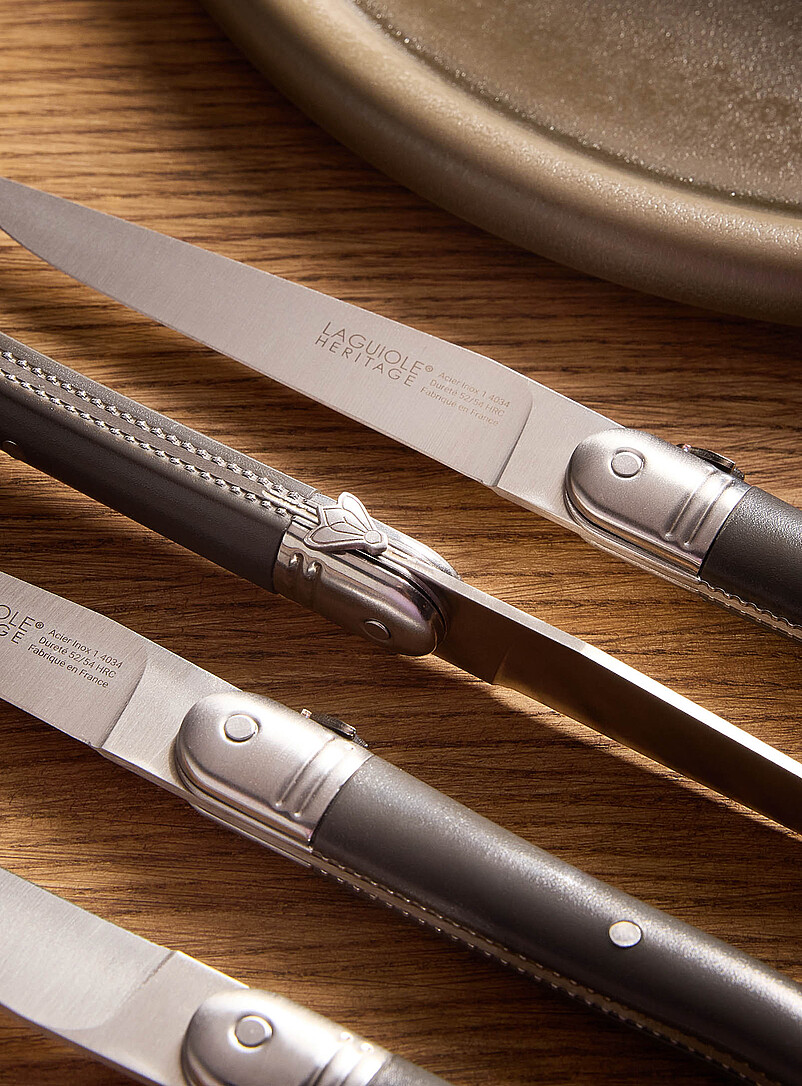
Close-up of multiple steak knife blades and handles laid flat on a wood surface, showing brushed stainless blades, polished metal bolsters with rivets, dark gray textured handles with decorative stitched-looking trim and a small bee-shaped metal inlay on one hinge.
- Blade shapeVisible blades are long, narrow, and straight with a tapered point and a brushed satin finish on the flat faces.
2 regions
x 0.10 · y 0.08 · w 0.70 · h 0.30 (high); x 0.04 · y 0.48 · w 0.46 · h 0.24 (high) - Blade text marking“LAGUIOLE HERITAGE”
1 region
x 0.20 · y 0.14 · w 0.30 · h 0.10 (high) - Blade small printed lines“Acier inox 1.4034 Durete 52/54 Hrc Fabrique en France”Partial
1 region
x 0.37 · y 0.18 · w 0.18 · h 0.08 (medium) - Bolster and hingePolished rounded metal bolsters at the handle-blade junction with a visible circular rivet or pivot on each bolster.
2 regions
x 0.64 · y 0.28 · w 0.22 · h 0.18 (high); x 0.06 · y 0.60 · w 0.20 · h 0.18 (high) - Handle material and finishDark gray handles with a slightly textured matte finish and a narrow stitched-like decorative lighter trim running along the handle edge.
1 region
x 0.20 · y 0.40 · w 0.68 · h 0.40 (high) - Decorative bee inlaySmall metal bee-shaped decorative element located on the hinge area of the central knife.
1 region
x 0.25 · y 0.44 · w 0.10 · h 0.08 (high) - Rivet on handleCircular metal rivet visible on the handle face of one knife near the bolster.
1 region
x 0.72 · y 0.74 · w 0.08 · h 0.07 (high)
Other
Staged close-up shot on a wood grain surface with a partial metallic plate in the top right; warm directional lighting produces soft shadows and highlights on metal surfaces.
- Background surfaceHorizontal wood grain surface visible beneath the knives.
1 region
x 0.00 · y 0.40 · w 1.00 · h 0.60 (high) - Plate propPartial metallic round plate or pan rim occupying the top right corner with a textured interior surface.
1 region
x 0.60 · y 0.00 · w 0.40 · h 0.24 (high) - Lighting and shadowsWarm directional light from upper-left creating soft shadows beneath the knives and subtle specular highlights on the metal parts.
- Shot compositionTight close-up composition with knives arranged diagonally across the frame and partial cropping of several knives at the image edges.
Colors
brushed stainless· blade#CDC2BBmatte dark gray· handle#633C23polished silver· bolster and rivets#C5BAB4- Blade shapeVisible blades are long, narrow, and straight with a tapered point and a brushed satin finish on the flat faces.
Brand PDP Lookup
- Brand
- Laguiole
Laguiole en Aubrac Table Knives Classic with Steak Serrated blade with Shiny stainless steel handles (Set of 6)
Variants
2 SKUsDocuments & Data
Reddit Insights
1 threads · r/TrueChefKnivesLaguiole is briefly noted as a common steak knife choice in upscale restaurants.
A single, brief mention highlights Laguiole's use in nice restaurants, which is positive but lacks detailed praise or criticism.
Themes
Use Cases
- Upscale restaurant steak service
Compared To
vs Zwilling
Zwilling is mentioned alongside Laguiole as another maker of nice steak knives.
Source Threads
Laguiole steak knives in restaurants
Japanese Steak knives are not common. Most nice restaurants use Laguiole. Zwilling also makes some nice ones.
u/kchaur/TrueChefKnivesView thread →