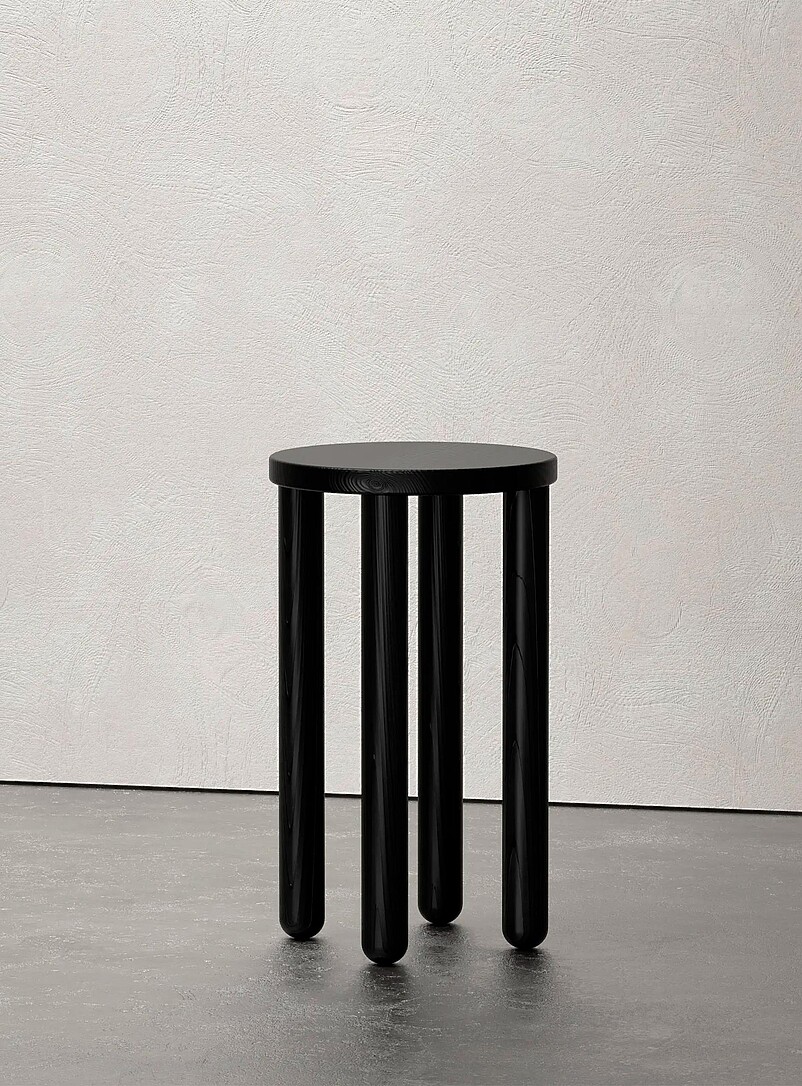
Ash round counter stool product image (primary)
A small round stool with a flat circular top and four vertical cylindrical legs with rounded ends, finished in a high-gloss dark tone showing subtle wood grain on the top edge.

Studio Super Sunday

Ash Round Counter Stool

CA$685.00CAD
In Stock

The Ash Round Counter Stool is a minimalist solid white ash stool from the Layout collection by Studio Super Sunday. Designed as a counter-height seat, it can also be used as a side table or stand. It is handmade in Montreal, Canada, measures 14 x 14 x 24 inches (35.5 x 35.5 x 61 cm), and is offered in multiple finishes including ash, black, and burgundy.

Color
Ash
Material
Solid white ash
Category
Furniture > Chairs > Table & Bar Stools

Color

BlackAshBurgundy

Size

24"

Specifications

Minimalist round counter stool made of solid white ash, also functions as side table or stand.

Round seating, minimalist design, solid white ash, can be used as side table or stand, part of Layout collection.

Color
Ash · gray
Material
Solid white ash
Gender
unisex
Age Group
adult
Condition
new
Dimensions
14x14x24 in
Category
Furniture > Chairs > Table & Bar Stools

Additional Attributes

  • solid white ash
  • made in Montreal
  • handmade upon request
  • online only
  • can be used as side table or stand
  • part of Layout collection
  • minimalist design
  • slab-and column inspiration
  • 100% solid white ash

Product Insights

The Ash Round Counter Stool by Studio Super Sunday offers a handcrafted, dual-use slab-and-column design that serves as stool, side table, or plinth, made from locally sourced Québec white ash—a critically endangered species intentionally used through traceable sourcing and made-to-order production. At CAD 685, it undercuts comparable handcrafted stools by about 14% with a 30% smaller footprint, while its Janka hardness of 1,320 lbf and density of 42 lbs/ft³ balance stability and portability. The natural variant retains textured open-pore grain under matte varnish; colored variants hide the grain. Custom dimensions are available, and all finishes share identical water-based varnish for uniform care.

Verified claims

Hardness
Janka hardness 1,320 lbf; work-to-maximum-load 19.0 in-lbf/in³.
Stability
White ash density 42 lbs/ft³ balances stability and portability.
Finish
White ash is IUCN critically endangered; this stool uses locally sourced Québec ash.
Tactile grain
Natural Ash variant retains textured open-pore grain under matte varnish.
Maintenance
Both natural and colored finishes use the same water-based varnish, so care is identical.
Dimensions
Standard 14 x 14 x 24; custom dimensions available for any finish.
Architectural concept
Slab-and-column design with dual side-table use and grid adaptability.
Handmade
Handmade under solo designer's direct authorship.
Positioning
At CAD 685, it's 14% cheaper and has a 30% smaller footprint than the Mim Concept Swan stool.
Versatility
Dual-use design: stool, side table, or plinth; customizable dimensions via grid system.
Value
At CAD 685, undercuts comparable handcrafted stool by about 14% (Mim Concept Swan at CAD 799).
Designer background
Handcrafted in Montreal by Vincent Le Sauteur, ex-Lambert & Fils designer.
Production
Stool is 100% solid white ash from Québec, made to order in Montreal.
Endangered species
White ash is critically endangered, but stool's intentional use is ensured by traceable sourcing and made-to-order model.
Collection coherence
Grid-based Layout collection coordinates round stool with shelves and square stools.
Design
Refines maximalist boldness into a primitive slab-and-column stool that also serves as a side table.
Color variant
Black and Burgundy variants (among Black, Ash, Burgundy) use opaque pigmented varnish hiding ash grain.
Artisanship
Designed, fabricated, and finished solely by founder Vincent Le Sauteur in Montreal.

Product record

Title
Ash Round Counter Stool
Brand
Studio Super Sunday
Price
685 CAD
Availability
In stock

Deep Research

The handmade process and what the lead time means

  • The 25-day lead time covers only the construction and finishing of a pre-designed piece — compared to full bespoke commissions, where design development alone often takes two to four weeks and production queuing can add eight to ten weeks before a single cut is made, this is an efficient window that delivers a handcrafted stool without the months-long wait.
  • The white ash is finished to retain a textured feel and a wide contrasting grain, so the stool’s surface invites touch and reveals the wood’s character in a way that smooth, mass-produced stools cannot — each piece carries its own grain story.
  • The solid white ash is harvested within Québec, keeping the supply chain close to the Montreal workshop and supporting regional forestry — a choice that gives the stool a locally-rooted provenance and reduces the environmental cost of long-distance material transport.
  • The matte water-based varnish provides long-lasting protection for the ash wood while preserving its wide grain and tactile surface — the absence of gloss keeps the stool visually quiet and architectural, letting the form do the work.
  • Because Studio Super Sunday designs and fabricates all pieces in its own Montreal workshop, the studio retains complete oversight of quality and artistic direction from material selection to final finishing — the stool is not an outsourced product but a direct expression of the maker’s intent.

How this stool compares to other designer counter stools

  • The Layout stool's 14-by-14-inch seat is nearly 30% narrower than the Swan's 17-by-15-inch dish-shaped seat, carving out a niche for ultra-narrow kitchen islands and giving the piece proportions better suited to a side-table second life.
  • Unlike any current competitor in the handcrafted round stool segment, the Layout is explicitly positioned as a side table or stand — its flat top and slab construction forgoing a sculpted seat to earn that double duty, which can tip the value equation for buyers furnishing small or multi-use rooms.
  • The collection's 'slab and column' inspiration borrows from dense urban construction logic, giving the Layout a conceptual narrative that sets it apart from the mid-century modern (Swan) or Shaker (ref., Naked Furniture) references that dominate the Canadian bench-made scene at this price tier.
  • At CAD 685, the Layout stool undercuts the Mim Concept Swan's regular price of $799 by about 14%, while offering a visually lighter, more architectural alternative to the Swan's sculpted saddle seat — effectively pricing itself as the minimal-architecture choice rather than the organic-form option.

Solid ash wood: durability, grain, and sustainability

  • White ash's impact resistance is measured at a work-to-maximum-load of 19.0 in-lbf/in³, outperforming both red oak and hard maple; in a stool this means it can handle the sudden load of a person dropping onto the seat or a heavy object set on its surface without splintering or cracking — it's the same material logic that makes ash the wood of choice for baseball bats and shovel handles.
  • White ash registers 1,320 pound-force on the Janka scale — just 40 lbf shy of white oak and substantially harder than cherry (950 lbf) — so the stool's surface will shrug off the dings and imprints that come from daily use as a seat or occasional side table, maintaining a crisp look without the weight penalty of oak.
  • White ash grows natively from the Great Plains to eastern Canada, overlapping with Studio Super Sunday's Montreal workshop; using a domestic species that can be sourced within the region shortens the supply chain, and for a piece that is marketed on local craftsmanship, the material itself becomes part of the 'made in Canada' story.
  • Where oak's quarter-sawn surface throws off rays and flecks, white ash presents a uniform, straight grain with a rhythmic ring-porous texture of earlywood and latewood lines; on the stool's cylindrical form this creates a clean, contemporary vertical flow that reads as intentionally minimalist rather than rustic.
  • The large, open pores of ash act like capillaries for finish, allowing pigmented varnish to penetrate deeply rather than just coating the surface — this is why the Black and Burgundy options achieve a saturated, chip-resistant color, and why the natural ash version's water-based varnish leaves a low-sheen, tactile surface with the grain pattern still clearly visible.
  • At 42 pounds per cubic foot, white ash offers enough mass to give the stool a reassuring stability that resists tipping, yet it remains lighter than white oak and many other premium hardwoods, so the piece can be shifted from counter to bedside without a struggle.
  • White ash is listed as critically endangered on the IUCN Red List, with a projected population decline of over 80% due to the emerald ash borer, so purchasing a made-to-order stool from a small atelier like Studio Super Sunday — which selects its own stock and finishes each piece by hand — represents a more traceable, intentional use of the material rather than feeding the mass-market demand that accelerates unsustainable harvest.

Studio Super Sunday's Montreal roots and local making

  • The studio's stated commitment to local sourcing means the ash likely travels a short distance from forest to workshop, cutting transport emissions and supporting Québec's wood economy — and because the piece is built to last generations, the initial carbon investment is amortized over decades of use, not the few years typical of fast furniture.
  • With the company publicly listed at one employee, this is effectively a one-person workshop where design, fabrication, and finishing all happen under the founder's hands — the stool you receive is not a batch-run product but a piece made specifically for your order by the person whose name is on the studio, an intimacy of making that is rare at this price point.
  • Workshop fabrication is core to the studio's practice, giving Le Sauteur direct oversight of every cut and joint in the Montreal atelier — unlike studios that outsource to third-party factories, this model allows the kind of material experimentation and quality control that results in a stool with consistent proportions and a finish that stands up to daily use without warranty-voiding shortcuts.
  • The studio's design ethos is to start with maximalist boldness and refine it until only the essential character remains — in this stool, that translates to a monolithic, almost brutalist cylinder of ash that adds presence to a room not through decoration but through the sheer authority of its material and proportion.
  • The Layout collection applies the structural logic of concrete slab-and-column construction — typically used in dense urban buildings — to furniture, so the stool reads as a miniature column with a flat capital, a profile that helps the eye accept it equally as a seat, a side table, or a display plinth without looking out of place.
  • The white ash for the Layout collection comes from within the province of Québec and is left with a textured, hand-finished surface that emphasizes the wood's wide contrasting grain — the result is a stool that feels substantial and visually warm, with the organic variation of solid wood rather than the engineered uniformity of MDF or veneer.
  • Vincent Le Sauteur served as Designer technique at Lambert & Fils, the internationally recognized Montreal lighting studio, from June 2021 to September 2022 before launching Studio Super Sunday — his time there places this stool in a lineage of high-concept, gallery-grade Canadian design that architects and interior designers already specify for residential and hospitality projects.

Using the stool as a side table or stand

  • A 14-inch diameter top provides roughly 154 square inches of level surface area — enough to hold a standard table lamp, a couple of coffee table books, or a drink and a phone simultaneously — making it a credible occasional table rather than a tiny perch.
  • At 24 inches tall, the stool sits within the standard height range for mid-century and contemporary accent tables, allowing it to pair seamlessly next to a sofa arm or serve as a compact nightstand alternative without the squat proportions of a shorter dining stool.
  • The natural ash variant is sealed with a water-based varnish that creates a wipeable, lightly moisture-resistant layer; the finish can withstand the occasional condensation ring from a glass or a damp plant pot without blooming or staining, which is essential for a stool expected to double as a side table.
  • The Layout collection’s direct reference to architectural slab-and-column construction gives the stool a monolithic silhouette where the flat round top deliberately reads as a tabletop, so using it as a side table is a first-class function rooted in the design, not an improvised workaround.

The architectural inspiration behind the Layout collection

  • The studio explicitly designed this stool to be the ‘bare minimum version of a stool’—a primitive object that eliminates all non-essential elements, which is why it reads as both seating and a sculptural side table without any conversion mechanism.
  • The Layout collection was conceived by Canadian designer Vincent Le Sauteur, whose studio’s workshop-first practice means each stool is handmade in Montreal under his artistic direction, giving the piece a direct line to an auteur rather than an anonymous factory.
  • The solid white ash is sourced from within the Québec province and carries a wide contrasting grain; because the stool is so reductively designed, the wood’s open grain becomes the primary visual event, making material origin a central design feature rather than a backstory.
  • The collection’s grid logic means the stool’s dimensions—14″ × 14″ × 24″ for the counter height—are not fixed; the studio can customize any Layout piece with minimal redesign, so a buyer can request a custom height or footprint to match an existing counter or nook.
  • The stool’s form directly reads as a horizontal slab (the 14″ seat) supported by vertical columns (the legs), a literal translation of the dense-construction architectural system that makes the piece feel structurally inevitable rather than styled.
  • The Round Counter Stool belongs to a broader Layout series that includes square stools, counter chairs, and shelving; the collection’s grid principle means all pieces share a proportional language, so the round stool can be paired with the square stool or a Layout shelf for a cohesive, architecturally-rational interior.

Shipping & Returns

Pickup
not_supported

Image Analysis

1 images
Ash round counter stool product image (primary)
01

Product

A small round stool with a flat circular top and four vertical cylindrical legs with rounded ends, finished in a high-gloss dark tone showing subtle wood grain on the top edge.

  • Top surfaceFlat circular top with a slightly beveled edge; top shows faint concentric wood-grain rings visible on the edge and surface.
    1 regionx 0.34 · y 0.36 · w 0.32 · h 0.08 (high)
  • LegsFour evenly spaced vertical cylindrical legs attached directly under the top; each leg has a continuous rounded bottom and a glossy reflective finish.
    1 regionx 0.36 · y 0.42 · w 0.28 · h 0.50 (high)
  • Finish and textureHigh-gloss smooth finish on legs and top producing clear specular highlights and visible vertical streak reflections on the leg surfaces.
    1 regionx 0.36 · y 0.36 · w 0.28 · h 0.56 (high)
  • Visible wood grainSubtle circular wood-grain pattern visible on the top edge of the seat, indicating a wood material pattern under the dark finish.
    1 regionx 0.34 · y 0.35 · w 0.32 · h 0.06 (medium)

Other

Studio-style product shot showing the stool centered against a textured light wall and a dark matte floor with soft directional lighting producing a soft shadow beneath the legs.

  • BackgroundLight-colored textured wall with visible plaster-like swirl patterns behind the stool.
    1 regionx 0.00 · y 0.00 · w 1.00 · h 0.68 (high)
  • SurfaceDark matte floor with slight sheen and visible texture; stool casts a soft shadow on the floor directly beneath it.
    1 regionx 0.00 · y 0.68 · w 1.00 · h 0.32 (high)
  • Shot compositionStool is centered in frame, photographed from a straight-on frontal angle at approximately mid-seat height with even studio lighting.

Colors

gloss black· seatgloss black· legs#0E0E0D

Q&A

2 answered
What type of finish does the ash wood have (e.g., matte lacquer, oil, wax) and how does it affect maintenance and durability?
The natural ash version is finished with a water-based varnish that preserves the wood grain while providing a protective coating [1]. This finish is durable, easy to clean with a damp cloth, and resists everyday wear. For colored variants like Black or Burgundy, a pigmented varnish is used, which offers similar protection but hides the natural grain.
Are the black and burgundy variants painted or stained, and do they affect the visibility of the ash wood grain?
The black and burgundy (labeled 'Port Wine Clear' on the manufacturer site) variants are colored finishes applied to the solid ash [1]. These are pigmented varnishes that cover the natural wood grain, so the grain texture is not visible beneath the opaque color. If you prefer to see the ash grain, choose the natural ash finish.

Provenance

Merchant Link
https://www.simons.ca/en/furniture/chairs-stools/counter-stools/ash-round-counter-stool--23018-251002?colourId=0
Updated