Simons Maison
Crackle-Glazed Painted Flowers Planter 4.75 In
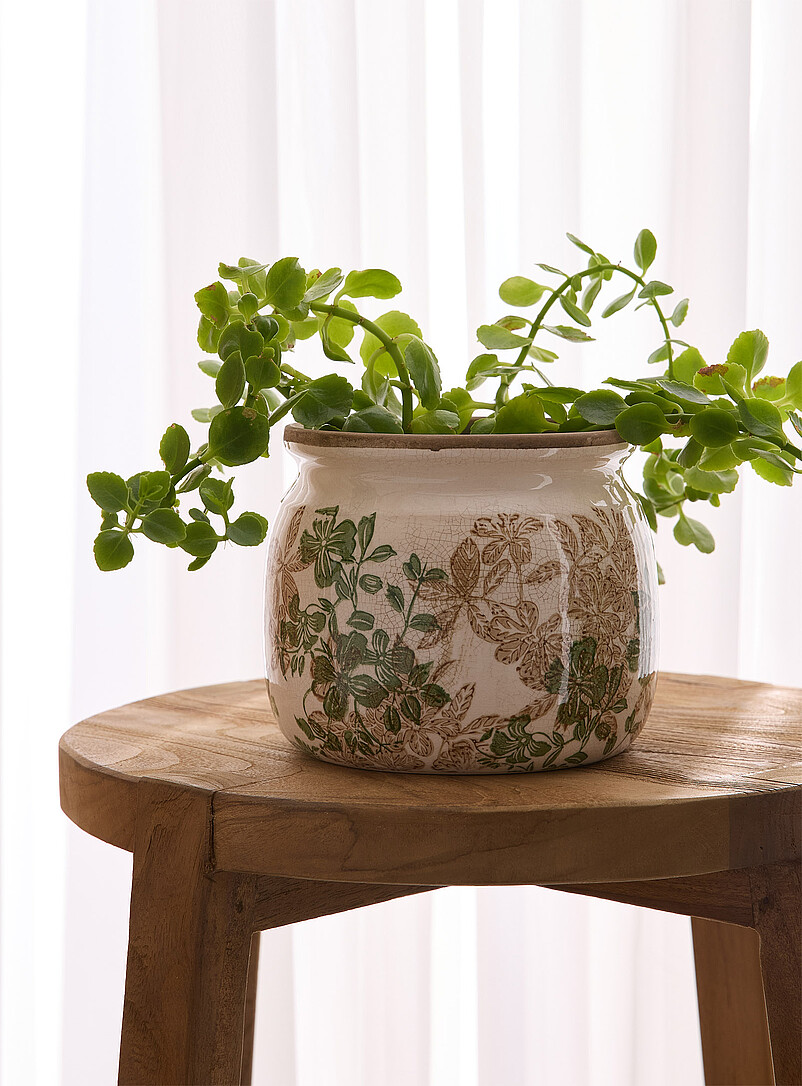
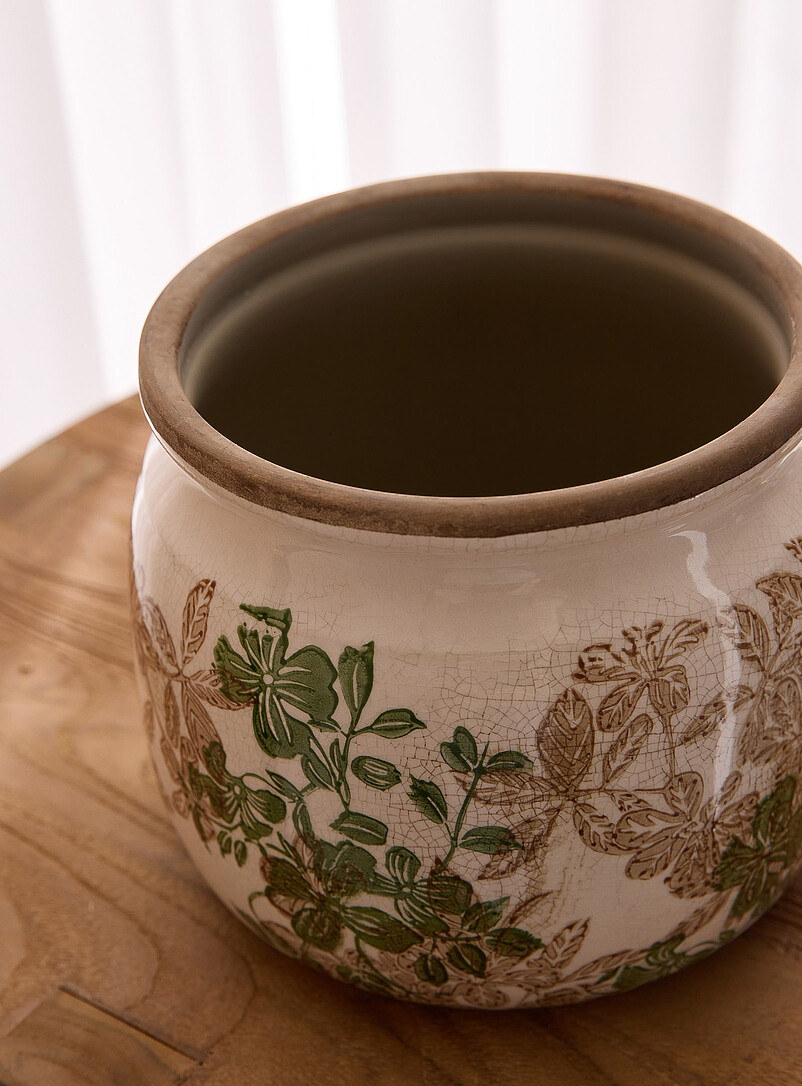
This shiny ceramic planter features a crackle glaze and painted flowers in natural tones, creating a romantic decorative accent. It is designed for decorative use only; do not plant directly in soil. Dimensions: opening width 4.75'' (12 cm), diameter 6.25'' (16 cm), height 5'' (13 cm).
- Material
- Shiny ceramic
- Style
- romantic
- Category
- Home & Garden > Decor > Vases
Color
Size
Specifications
A crackle-glazed ceramic planter with painted flowers in natural tones, for decorative use only.
Crackle glaze finish, painted floral design, shiny ceramic surface.
- Material
- Shiny ceramic
- Style
- romantic
- Age Group
- adult
- Condition
- new
- Dimensions
- 6.25x6.25x5 in
- Category
- Home & Garden > Decor > Vases
Additional Attributes
- crackle-glazed
- painted flowers
- natural tones
- shiny ceramic
- decorative-only
Product Insights
The Simons Maison Crackle-Glazed Painted Flowers Planter is an exclusive $18 decorative piece (minimally aged to $72 artisan comparable) from Canada's 185-year-old family-run department store. Each unit features an engineered, smooth-to-the-touch crackle glaze that develops uniquely over time—not a defect—and is limited to indoor use as a cachepot or dry vase/accessory holder due to intentional lack of drainage, staining risk, and thermal sensitivity. At 5 inches tall, it requires pH-neutral cleaning, no soaking, and immediate spill removal; its sealed base suits dry applications but prohibits direct soil or gravel.
- Crackle character
Crackle finish is deliberately engineered; each planter has a unique, evolving pattern.
Why this is supported
The crackle effect is intentionally created through thermal expansion mismatch between glaze and clay body. DigitalFire explains:
Crazing is a crack pattern caused by thermal expansion mismatch between body and glaze.
digitalfire.comThis yields a unique pattern on each piece; Finch & Fennel notes:
reactive crackle glaze that produces subtle, one‑of‑a‑kind variations across the surface
finchandfennel.comThe crackle can continue to develop over time. Marlborough Tiles describes:
The controlled effect is achieved through precise chemistry involving high-expansion oxides like Na2O and K2O, as stated by DigitalFire:
Thus, the crackle is deliberate and consistent across pieces.
- Usage limitations
Crackle glaze limits planter to decorative use; it has no drainage and is prone to staining and thermal stress.
Why this is supported
The decorative-only designation is intrinsic to crackle glaze. DigitalFire explains:
Crackle glazes are definitely not suitable for functional ware (because of bacteria growth and leaching).
digitalfire.comThe product prominently states,
do not set plants in soil directly in the planter.
Does this planter have a drainage hole, or is it solid at the bottom?and it has no drainage hole:
No, this planter does not have a drainage hole — it is solid at the bottom.
Does this planter have a drainage hole, or is it solid at the bottom?Additionally, the crackle network can absorb liquids, leading to staining; Claybrook Studio warns:
the crazing can allow liquids to pass through the glaze and contact the body of the tile, creating dark patches behind the glaze.
claybrookstudio.co.ukThe thermal expansion mismatch also makes it sensitive to sudden temperature changes, as Teasenz advises:
Never plunge cold or room-temperature teaware directly into a pot of rolling boiling water, as the sudden stress can crack the clay body.
teasenz.comThese factors necessitate careful handling.
- Surface feel
Crackle finish is smooth to the touch despite visible crack lines.
Why this is supported
The tactile sensation is notable despite the visual texture. Q&A confirms:
The crackle-glazed finish is smooth to the touch.
Is the crackle-glazed finish smooth to the touch, or does it have texture from the crackle effect?- Cleaning
Use a pH-neutral detergent and a dedicated microfiber cloth for cleaning.
Why this is supported
Ceramic care guides recommend using only pH-neutral detergents, stating that
For everyday cleaning use a ph neutral detergent
claybrookstudio.co.ukand that one should
Keep a dedicated microfiber cloth *only* for glazed ceramics
lifetips.alibaba.com. Additionally, for greasy deposits a 50:50 ethanol-water mix is recommended, and abrasive sponges should be avoided as they
can scratch the delicate glaze surface
teasenz.com.
- Water precautions
Never soak, avoid thermal shock, and wipe spills immediately to prevent permanent stains.
Why this is supported
The crazing network allows moisture to penetrate the glaze: as noted,
the crazing can allow liquids to pass through the glaze and contact the body of the tile, creating dark patches behind the glaze
claybrookstudio.co.uk. Therefore, care guides advise to
Never soak glazed ceramics—even briefly
lifetips.alibaba.comand to
Never plunge cold or room-temperature teaware directly into a pot of rolling boiling water
teasenz.comto avoid thermal shock. The resulting stains are permanent.
- Use restrictions
Indoor decorative use only; use as a cachepot without direct soil or gravel.
Why this is supported
This planter is strictly for indoor decorative use; the crackle glaze makes it unsuitable for direct soil or water. Adding gravel inside the planter is ineffective:
This practice does not facilitate drainage; instead, it raises the water table within the soil mass
biologyinsights.com. Additionally, crackle glazes are
not suitable for functional ware
digitalfire.com, so it should be used as a cachepot holding a nursery pot.
- Crazing progression
Continuing crazing for months after purchase is a normal property, not a defect.
Why this is supported
This is an inherent property of crackle glazes: the ongoing stress relief continues to produce fine cracks. As one resource explains,
This process can continue for a remarkably long time
marlboroughtiles.comand it
can be cracking – almost imperceptibly
marlboroughtiles.com. This is not a defect but the glaze developing its antique character.
- Crackle pattern
Each planter has a one-of-a-kind smooth crackle pattern that may continue to develop over time.
Why this is supported
The crackle pattern results from deliberate thermal expansion mismatch between glaze and body, producing
one‑of‑a‑kind variations across the surface
finchandfennel.comDespite the network, the glaze is
smooth to the touch
Is the crackle-glazed finish smooth to the touch, or does it have texture from the crackle effect?The crazing can continue to develop over time:
The glaze chemistry uses high-expansion oxides to create this effect, lending the planter
a distinct vintage aesthetic and visual depth.
ceramicfix.com- Scale
Height 5 inches; compact size accentuates the crackle and floral pattern.
Why this is supported
At 5 inches tall, the planter is compact, allowing the unique crackle pattern and painted floral motif to be appreciated at close range. The small footprint suits shelves, nightstands, and windowsills.
- Care
For decorative use only; use as cachepot, avoid liquids, and clean with pH-neutral detergent.
Why this is supported
The crackle glaze renders the planter non-functional for direct planting:
Crackle glazes are definitely not suitable for functional ware (because of bacteria growth and leaching).
digitalfire.comLiquid can wick into the body through the crazing, causing
dark patches behind the glaze
claybrookstudio.co.ukTherefore, the planter is designed as a cachepot—it has no drainage hole and is solid-bottomed, so it should be used with a nursery pot. For cleaning,
use a ph neutral detergent
claybrookstudio.co.ukand
Never soak glazed ceramics—even briefly.
lifetips.alibaba.comAlso avoid thermal shock to prevent the crazing from widening.
- Market position
Price $18 CAD, exclusive to Simons and limited production, similar to a $72 artisan piece.
Why this is supported
At $18 CAD, this planter offers the look of a
$72.00
antiquefarmhouse.comartisan crackle planter. It is part of Simons Maison, a private label that is
available only at Simons
therecord.comand produced in limited quantities, so its one-of-a-kind crackle finish is matched by its exclusivity in the market.
- Cachepot use
Lack of drainage is intentional; use with a nursery pot.
Why this is supported
The planter's solid bottom forces a cachepot use:
No, this planter does not have a drainage hole — it is solid at the bottom.
Does this planter have a drainage hole, or is it solid at the bottom?The correct method is to
house a nursery pot inside, not for direct planting
Styling a romantic floral accent piece — cachepot_potentialA gravel layer is ineffective:
This practice does not facilitate drainage; instead, it raises the water table within the soil mass.
biologyinsights.comCare requires no soaking:
Never soak glazed ceramics—even briefly.
lifetips.alibaba.comStanding at 5 inches tall, it fits intimate shelf displays.
- Non-plant uses
Sealed base suits dry uses: dry-flower vase, cutlery caddy, or brush holder.
Why this is supported
The sealed base suits the planter for dry uses:
dry-flower vase, cutlery caddy, or make-up brush holder
Using a decorative planter without drainage — non_plant_use_as_dry_vase- Aging process
Crackle develops after purchase; surface stays smooth.
Why this is supported
The crackle pattern results from intentional glaze engineering:
Crazing is a crack pattern caused by thermal expansion mismatch between body and glaze.
digitalfire.comAfter firing, the crazing continues to develop almost imperceptibly over many months.
This process can continue for a remarkably long time. Even a week after the tile has come out of the kiln, after it has been sealed and tiled onto the wall of someone’s kitchen, it can be cracking – almost imperceptibly.
marlboroughtiles.comThis ongoing evolution creates subtle, one-of-a-kind variations across each planter.
reactive crackle glaze that produces subtle, one‑of‑a‑kind variations across the surface
finchandfennel.comYet the surface remains smooth to the touch throughout the process.
The crackle-glazed finish is smooth to the touch.
Is the crackle-glazed finish smooth to the touch, or does it have texture from the crackle effect?- Intended use
For display use only; crackle-glaze is traditionally non-functional.
Why this is supported
The planter purpose is for decoration, rooted in crackle-glaze craft history:
Crackle glazes are definitely not suitable for functional ware (because of bacteria growth and leaching).
digitalfire.comThis places the planter in a tradition of display ceramics where the evolving crackle is an asset, not a flaw.
- Brand heritage
Simons, founded 1840, offers this planter via its exclusive private-label collection.
Why this is supported
Catalog verified that Simons,
, offers this planter as part of its exclusive private-label collection, which comprises
About 70 per cent of Simons’ offerings
therecord.com. The homewares selection is described as
an elegantly curated lineup
expertbeacon.com.
- Craftsmanship
Crackle glaze uses an ancient ceramic technique, making each planter one-of-a-kind.
Why this is supported
Catalog verified the craft behind the crackle glaze:
Crazing is a crack pattern caused by thermal expansion mismatch between body and glaze.
digitalfire.com. The firing process yields
subtle, one‑of‑a‑kind variations across the surface
finchandfennel.com. The planter’s 'decorative purposes only' label aligns with traditional practice, as crackle glazes are
not suitable for functional ware
digitalfire.com.
- Finish
Each planter has a unique engineered crackle glaze that is smooth to the touch.
Why this is supported
The crackle glaze is a
reactive crackle glaze that produces subtle, one‑of‑a‑kind variations across the surface
finchandfennel.com. Digitalfire.com explains that
Crazing is a crack pattern caused by thermal expansion mismatch between body and glaze.
digitalfire.com, confirming the intentional process. This crackle
transforms simple clay vessels into intricate works of art that look beautifully aged right out of the kiln.
ceramicfix.com. Additionally, the finish is
smooth to the touch
Is the crackle-glazed finish smooth to the touch, or does it have texture from the crackle effect?.
- Versatility
At 5 inches tall, it suits bedside tables, cachepots, dry vases, and accessory holders.
Why this is supported
The planter’s size and shape invite a range of styling uses.
Standing only 5 inches tall with a 4.75-inch opening, this planter is scaled for intimate vignettes
Styling a romantic floral accent piece — petite_footprint. As a cachepot, it is
designed to house a nursery pot inside, not for direct planting; this makes it a low-maintenance styling tool
Styling a romantic floral accent piece — cachepot_potential, and the same opening
also suit the planter as a dry-flower vase, cutlery caddy, or make-up brush holder
Using a decorative planter without drainage — non_plant_use_as_dry_vase.
- Brand reputation
Simons Maison is the in-house brand of Canada's 185-year-old family-run department store.
Why this is supported
The planter is sold under Simons Maison, the in-house brand of
The 185-year-old retailer, founded by Scottish immigrant John Simons in 1840 in Quebec City
therecord.com. Editorial sentiment echoes that
Simons Maison selection never fails to impress
expertbeacon.com.
- Crackle authenticity
Crackle glaze is an intentional craft technique, not a defect.
Why this is supported
The crackle effect on this planter is produced by a deliberate thermal expansion mismatch between glaze and clay body, a technique that has been used for display pieces because the crazing weakens ceramic.
Crazing is a crack pattern caused by thermal expansion mismatch between body and glaze.
digitalfire.comEach planter's crackle network is unique, adding to its artisanal character.
reactive crackle glaze that produces subtle, one‑of‑a‑kind variations across the surface
finchandfennel.comThe decorative-only designation reflects this historic craft practice, where crackle glazes are not suitable for functional ware due to bacteria growth and leaching.
Crackle glazes are definitely not suitable for functional ware (because of bacteria growth and leaching).
digitalfire.com- Use cases
Indoor cachepot for plants or dry vase; ideal for small vignettes.
Why this is supported
The planter has no drainage hole and is explicitly for decorative purposes only. It functions as a cachepot for nursery pots or a dry vase for dried flowers. Its small scale suits intimate display settings.
No, this planter does not have a drainage hole — it is solid at the bottom. The product is designed for decorative purposes only; do not set plants in soil directly in the planter.
Does this planter have a drainage hole, or is it solid at the bottom?Additionally, it is intended for indoor use only, as outdoor exposure could damage the finish.
This planter is designed for indoor decorative use. The product states it is 'for decorative purposes only' and advises against setting plants in soil directly, suggesting it is not intended for outdoor exposure that may affect the finish.
Can this planter be used outdoors, or is it strictly for indoor decoration?- Value
Simons Maison: 185-year Canadian heritage; $18 vs. $72 for artisan piece.
Why this is supported
Simons Maison is the exclusive private-label brand of Simons, Canada’s oldest family-owned department store, founded in 1840.
About 70 per cent of Simons’ offerings are high-margin private-label goods available only at Simons.
therecord.comThis planter is priced at 18 CAD, compared to 72 USD for a comparable artisan piece.
$72.00
antiquefarmhouse.com- Drainage
Adding gravel does not create drainage; use a nursery pot inside instead.
Why this is supported
Many gardeners believe adding a gravel layer at the bottom improves drainage, but
This practice does not facilitate drainage; instead, it raises the water table within the soil mass.
biologyinsights.comThis planter is designed as a cachepot: the correct method is to house a nursery pot inside, preserving the crackle glaze. Direct planting risks permanent dark stains because
the crazing can allow liquids to pass through the glaze and contact the body of the tile, creating dark patches behind the glaze.
claybrookstudio.co.ukBeyond plant use, its dimensions also suit it as a dry vase or organizer.
Image Analysis
2 images- 01
Product
A short, rounded ceramic planter with a glossy crackle-glaze cream background, a flared lip with a darker brown rim, and an all-over painted botanical motif in green and brown on the body.
- Overall shapeShort, rounded jar shape with a gently curved body and a slightly flared lip at the top.
1 region
x 0.18 · y 0.32 · w 0.64 · h 0.35 (high) - Surface finishGlossy glazed surface exhibiting visible crackle network across the cream background.
1 region
x 0.20 · y 0.35 · w 0.60 · h 0.30 (high) - Top rimNarrow darker brown rim around the inner edge of the flared lip contrasting with the cream glaze.
1 region
x 0.31 · y 0.40 · w 0.38 · h 0.06 (high) - Botanical decorationPainted botanical motif wrapping the visible front of the planter composed of green leafy clusters and brown floral outlines and detailing.
1 region
x 0.25 · y 0.46 · w 0.50 · h 0.25 (high) - Visible glazing irregularitySlight variation in glaze near the lip where crackle pattern and gloss intensity change, visible as subtle darker lines and spots.
1 region
x 0.28 · y 0.36 · w 0.44 · h 0.18 (medium)
Other
Image shows the planter staged on a round wooden stool with a trailing green plant inside; background is a soft, bright curtain with diffused lighting and gentle shadows.
- Staging surfaceRound wooden stool with visible wood grain and a natural finish supporting the planter.
1 region
x 0.08 · y 0.62 · w 0.84 · h 0.30 (high) - Plant propTrailing green succulent-like plant with rounded leaves spilling over the planter rim and extending outward; plant is used as a prop and not described as packaging.
1 region
x 0.18 · y 0.18 · w 0.64 · h 0.28 (high) - Background and lightingVertical sheer curtains provide a bright, diffused backlight that creates soft highlights on the planter glaze and light shadows on the stool.
- Shot compositionCentered product composition with the planter occupying the middle of the frame and visible top and front surfaces; image is vertically oriented.
Colors
glossy cream· body backgroundmedium botanical green· painted leaves#84644Bwarm brown· painted floral outlines and rim#8D725D- Overall shapeShort, rounded jar shape with a gently curved body and a slightly flared lip at the top.
- 02
Product
Top-front view of a round, crackle-glazed ceramic planter with a rolled brown rim and painted floral motifs in green and brown on an off-white background; interior appears dark and unglazed.
- Overall shapeBulbous, rounded ceramic pot with a wide, circular top opening and a gently curved body tapering inward below the rim.
1 region
x 0.10 · y 0.03 · w 0.80 · h 0.94 (high) - Rim detailThick rolled top rim with a matte brown band around the lip that contrasts with the glazed body; rim interior shows several concentric shadow bands.
1 region
x 0.18 · y 0.03 · w 0.64 · h 0.20 (high) - Interior finishInterior appears dark and unglazed or shadowed, creating a deep uniform dark brown to near-black cavity.
1 region
x 0.28 · y 0.05 · w 0.44 · h 0.38 (high) - Glaze textureCrackle-glaze surface visible across the exterior as a network of fine hairline cracks in the off-white glaze.
1 region
x 0.30 · y 0.36 · w 0.60 · h 0.42 (high) - Painted floral motif - greenClustered green painted leaves and flowers applied over the crackle glaze, with visible brush edges and slight color variation.
1 region
x 0.22 · y 0.52 · w 0.36 · h 0.31 (high) - Printed floral motif - brownBrown floral and leaf outlines printed or painted around the body, often overlapping the crackle pattern and some green elements.
1 region
x 0.52 · y 0.52 · w 0.42 · h 0.34 (high)
Other
Product photographed on a wooden surface with a soft vertical white curtain background; soft, diffused lighting from above-left produces gentle highlights and subtle shadows.
- Supporting surfaceLight-to-medium toned wooden tabletop with visible grain and a knot near the lower-left of the frame.
1 region
x 0.02 · y 0.64 · w 0.66 · h 0.34 (high) - BackgroundOut-of-focus vertical white or pale curtain panels forming a soft neutral backdrop.
1 region
x 0.00 · y 0.00 · w 0.60 · h 0.36 (medium) - Lighting and reflectionsDiffuse soft lighting creates glossy highlights on the glazed surface and gentle shadowing inside the rim; reflections of the light source visible as narrow specular streaks on the pot body.
- Crop and framingImage is a close crop showing the upper and front portion of the planter; lower base and full circumference are out of frame.
1 region
x 0.00 · y 0.00 · w 1.00 · h 1.00 (high)
Colors
antique off-white· body glazewarm brown· rimdeep leaf green· painted leaves and flowers#5A532Dmuted sepia brown· printed floral outlines#9A7B65very dark brown· interior cavity#271707- Overall shapeBulbous, rounded ceramic pot with a wide, circular top opening and a gently curved body tapering inward below the rim.