Liberty
Hera Pure Silk Scarf Made With Liberty Fabric
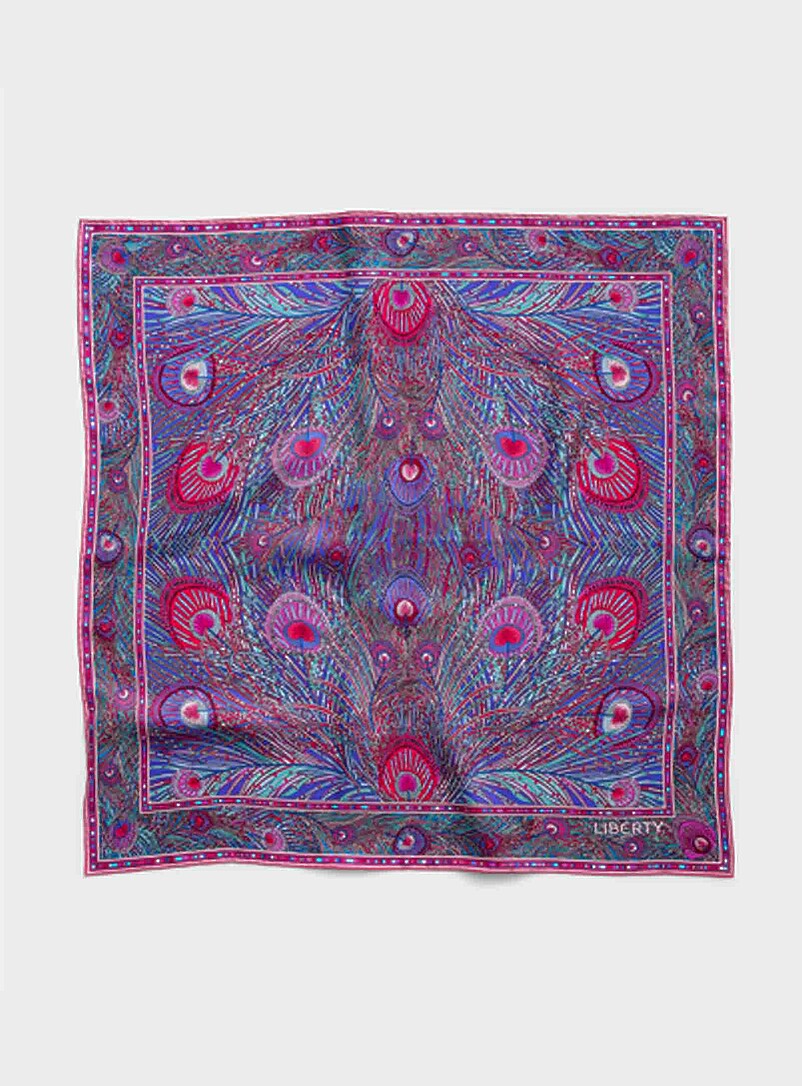
The Hera Pure Silk Scarf is a square silk twill accessory made with Liberty fabric, featuring a peacock feather pattern. It is crafted from 100% silk twill and made in Italy. The scarf measures 65 x 66 cm (25.6 x 26 inches), suitable for wearing as a neck scarf or hair accessory.
- Material
- 100% silk twill
- Gender
- unisex
- Category
- Apparel & Accessories > Clothing Accessories > Scarves & Shawls > Scarves
Color
Size
Specifications
Luxurious 100% silk twill scarf featuring a vibrant peacock feather pattern in an enchanting forest scene, made in Italy.
100% silk twill, made in Italy, Liberty fabric design, square shape, dimensions 65 x 66 cm
- Material
- 100% silk twill
- Gender
- unisex
- Age Group
- adult
- Condition
- new
- Category
- Apparel & Accessories > Clothing Accessories > Scarves & Shawls > Scarves
Additional Attributes
- 100% silk twill
- Made in Italy
- Liberty fabric design
- printed peacock feather pattern
- enchanting forest scene
- invigorating colours
- square scarf
- dimensions 65 x 66 cm
Product Insights
First created in 1887 by Arthur Silver as an Aesthetic Movement furnishing fabric, Liberty’s Hera Pure Silk Scarf reimagines the peacock motif—mythologically linked to the Greek goddess Hera and symbolizing divine beauty and feminine regality—as a 100% Italian silk twill accessory with hand-rolled edges. At 65 x 66 cm, its diagonal weave delivers a lustrous sheen, fluid drape, and clean knot-holding, allowing versatile styling as a bias-fold drape, narrow band, choker collar, or Italian twist. However, the silk twill and hand-rolled edges require dry cleaning only, as water damages the fabric and archival print.
- Heritage
First created in 1887 by Arthur Silver for Liberty as an Aesthetic Movement furnishing fabric.
Why this is supported
The Hera print is attributed to Arthur Silver, founder of the Silver Studio, as confirmed by Liberty’s records:
Credited to an 1887 design by Arthur Silver, founder of the Silver Studio, Hera has been a Liberty favourite since the mid 1890s when it was first printed onto Liberty furnishing fabrics.
libertylondon.comThe peacock feather motif was a key symbol of the 1880s Aesthetic Movement:
The peacock feather was a frequently used symbol during the Aesthetic Movement of the 1880s.
libertylondon.comOriginally a roller-printed cotton furnishing fabric, it was revived for the V&A’s 1975 Liberty exhibition and
since then has become almost a trademark for the company.
collections.vam.ac.uk.
- Fabric quality
100% Italian silk twill with hand-rolled edges.
Why this is supported
The scarf is made from Italian silk twill:
Silk twill - the weave structure used in luxury scarves - is defined by its diagonal interlacing pattern, which gives the fabric its body, characteristic sheen, and the ability to hold a knot cleanly.
ghinicomo.comAdditionally,
This scarf features rolled edges (commonly hand-rolled on Liberty scarves) rather than a machine-stitched hem.
Does the Liberty Hera scarf have hand-rolled edges or a machine-stitched hem?.
The silk twill weave gives the scarf body to hold knots cleanly.
Hand-rolled edges prevent fraying and support flat folds.
- Size
At 65 x 66 cm, the scarf is a classic neckerchief size for a delicate accent.
Why this is supported
At 65 x 66 cm, the scarf falls within the classic neckerchief size range of 50-70 cm, making it ideal for a delicate neck accent.
- Mythological meaning
Peacock motif symbolizes divine beauty and feminine regality through its mythological association with Hera.
Why this is supported
The scarf's design explicitly references Greek mythology:
named after the Greek goddess whose sacred animal was the peacock, Hera is a true heritage icon of Liberty Fabrics
libertylondon.com. This naming associates the peacock motif with ancient symbolism:
wearing it invokes the peacock’s ancient symbolism of divine beauty and feminine regality rather than mere decorative prettiness.
Peacock motif and its symbolism — hera_s_mythological_nameThe pattern's heritage is further confirmed:
Hera has been a Liberty favourite since the mid 1890s when it was first printed onto Liberty furnishing fabrics.
libertylondon.comMoreover,
It was revived and reprinted for the V&A's Liberty exhibition in 1975 and since then has become almost a trademark for the company.
collections.vam.ac.uk- Symbolism
The peacock motif combines Greek mythology with Aesthetic Movement iconography.
Why this is supported
The design takes its name from
the Greek goddess whose sacred animal was the peacock, Hera is a true heritage icon of Liberty Fabrics
libertylondon.comThe peacock feather motif also
became an icon of the Aesthetic style. It was used in all forms of decoration and symbolised the movement's reputation for decadence.
collections.vam.ac.ukThus the scarf carries both mythological and artistic movement significance.
- Material transformation
Originally cotton furnishing; reappears as Italian silk twill personal accessory.
Why this is supported
The Hera pattern was originally a furnishing fabric printed by roller on cotton:
Liberty's had this pattern printed by roller, the quickest and cheapest commercial techniques available.
collections.vam.ac.ukToday the same design appears on Italian silk twill, a fabric known for its body and sheen:
Silk twill - the weave structure used in luxury scarves - is defined by its diagonal interlacing pattern, which gives the fabric its body, characteristic sheen, and the ability to hold a knot cleanly.
ghinicomo.comThe shift from utilitarian furnishing fabric to personal luxury accessory is a complete reversal of the original mission.
- Craftsmanship
Hand-rolled edges and 65×66 cm size suited for neckwear.
Why this is supported
The scarf's finishing includes a traditional detail:
This scarf features rolled edges (commonly hand-rolled on Liberty scarves) rather than a machine-stitched hem.
Does the Liberty Hera scarf have hand-rolled edges or a machine-stitched hem?Its dimensions, 65 x 66 cm, fall within the ideal range for a neckerchief:
Best size: 20″–27″ (50–70cm)Vibe: French, minimal, Audrey Hepburn–inspired [2]
bysporting.comThis contrasts with the original furnishing fabric sold by the yard.
- Knot-holding
Silk twill holds a clean knot without slipping.
Why this is supported
The diagonal interlacing pattern of silk twill gives the fabric body, enabling it to hold a knot cleanly without slipping.
Silk twill - the weave structure used in luxury scarves - is defined by its diagonal interlacing pattern, which gives the fabric its body, characteristic sheen, and the ability to hold a knot cleanly.
ghinicomo.comAt 65x66 cm, the scarf is sized for classic neckerchief styles, and the twill's body ensures knots hold a visible structure.
- Sheen and drape
Lustrous sheen and fluid drape from the diagonal weave.
Why this is supported
The silk twill weave's diagonal interlacing pattern is responsible for both the scarf's lustrous sheen and its fluid drape.
Silk twill - the weave structure used in luxury scarves - is defined by its diagonal interlacing pattern, which gives the fabric its body, characteristic sheen, and the ability to hold a knot cleanly.
ghinicomo.comThe body and sheen contribute to the scarf's ability to drape elegantly on the shoulders.
- Luxury weave
Same silk twill weave as top-tier fashion scarves.
Why this is supported
Silk twill is the weave of choice for luxury scarves, prized for its balance of brightness and crispness, placing this scarf in the same quality tier as high-luxury accessories.
- Finishing
Hand-rolled edges prevent fraying and add refinement.
Why this is supported
The hand-rolled edges, a hallmark of Liberty scarf craftsmanship, prevent fraying and create a refined finish that enhances the overall feel and durability of the silk twill fabric.
- Hand-rolled edges
Hand-rolled edges, a Liberty hallmark, not machine-stitched.
Why this is supported
The scarf features
rolled edges (commonly hand-rolled on Liberty scarves) rather than a machine-stitched hem
Does the Liberty Hera scarf have hand-rolled edges or a machine-stitched hem?. This hand-rolled hem is
a hallmark of Liberty's scarf craftsmanship
Does the Liberty Hera scarf have hand-rolled edges or a machine-stitched hem?. The silk twill construction provides structure and clean knotting, while the rolled edges avoid stiffness for better drape.
- Care
Dry clean only, required by silk and hand-rolled edges.
Why this is supported
The scarf requires dry cleaning because of its
rolled edges (commonly hand-rolled on Liberty scarves)
Does the Liberty Hera scarf have hand-rolled edges or a machine-stitched hem?and silk construction, as stated:
The Liberty Hera silk scarf should be dry cleaned only
How should the Liberty Hera silk scarf be cleaned? Can it be hand-washed or should it be dry-cleaned only?- Folding
Can be styled as a bias-fold drape, narrow band, choker collar, or Italian twist.
Why this is supported
The bias fold allows the silk to stretch and lie flat against the body, a standard technique for fluid drape.
The bias fold (folding diagonally) allows silk to stretch slightly and lie flat against the body—this technique is widely used in luxury scarf styling and tailoring for fluid drape and comfort [1].
bysporting.comThe band fold transforms the all-over print into a narrow striped band for linear accent.
Then, starting from the pointed tip of the triangle, fold the fabric inward in narrow strips (about 5 to 8 centimeters wide) until you have a long, narrow band of silk.
dreamsilken.comThe choker style concentrates the pattern into a structured necklace accent.
This creates a smooth, collar-like effect—very popular in modern Parisian styling.
bysporting.comThe Italian twist adds structured texture for a refined look with blazers.
The Italian twist is a slightly more refined version of the drape — it adds structure without sacrificing ease. This silk scarf style looks particularly sophisticated with tailored jackets and button-down shirts.
dreamsilken.com- Weave structure
Silk twill diagonal weave gives knots clean hold and fluid drape.
Why this is supported
Silk twill, the weave structure used in luxury scarves, is defined by its diagonal interlacing pattern, which
gives the fabric its body, characteristic sheen, and the ability to hold a knot cleanly.
ghinicomo.com.
- Styling techniques
Band fold turns the peacock print into a linear stripe.
Why this is supported
The band fold technique folds the scarf into a narrow 5-8 cm band, converting the dense peacock pattern into a controlled stripe:
Then, starting from the pointed tip of the triangle, fold the fabric inward in narrow strips (about 5 to 8 centimeters wide) until you have a long, narrow band of silk.
dreamsilken.comOther techniques also showcase the size: the Italian twist adds structured texture for jacket pairings
The Italian twist is a slightly more refined version of the drape — it adds structure without sacrificing ease. This silk scarf style looks particularly sophisticated with tailored jackets and button-down shirts.
dreamsilken.com, the choker style creates a collar-like effect
This creates a smooth, collar-like effect—very popular in modern Parisian styling.
bysporting.com, and the bias fold allows the silk to stretch and lie flat, keeping the pattern visible
The bias fold (folding diagonally) allows silk to stretch slightly and lie flat against the body—this technique is widely used in luxury scarf styling and tailoring for fluid drape and comfort [1].
bysporting.com.
- Dry cleaning
Must be dry cleaned; water damages silk twill, hand-rolled edges, and archival print.
Why this is supported
Catalog verified that the scarf requires dry cleaning only, per the care instructions:
The Liberty Hera silk scarf should be dry cleaned only, as indicated in the care instructions for the product.
How should the Liberty Hera silk scarf be cleaned? Can it be hand-washed or should it be dry-cleaned only?The scarf features hand-rolled edges, which are delicate and must be dry cleaned:
This scarf features rolled edges (commonly hand-rolled on Liberty scarves) rather than a machine-stitched hem.
Does the Liberty Hera scarf have hand-rolled edges or a machine-stitched hem?The silk twill weave, essential for the scarf's body and knot-holding, is also susceptible to water damage:
Silk twill - the weave structure used in luxury scarves - is defined by its diagonal interlacing pattern, which gives the fabric its body, characteristic sheen, and the ability to hold a knot cleanly.
ghinicomo.comThe vivid peacock feather print, described as
bold, colourful peacock feather print with vibrant hues
Does the Liberty Hera silk scarf have a bold, colorful pattern?, and the scarf's archival heritage,
Credited to an 1887 design by Arthur Silver, founder of the Silver Studio, Hera has been a Liberty favourite since the mid 1890s when it was first printed onto Liberty furnishing fabrics.
libertylondon.comfurther mandate dry cleaning.
- Color vibrancy
Buyers confirm the bright magenta, deep purple, and teal colors are bold and harmonious.
Why this is supported
Buyer Q&A describes the print as having
bold, colourful peacock feather print with vibrant hues
Does the Liberty Hera silk scarf have a bold, colorful pattern?and reports that the peacock feathers
blend harmoniously in a forest of invigorating colours
Does the Liberty Hera silk scarf have a bold, colorful pattern?. The diagonal weave of the silk twill adds a gentle sheen that enhances the saturation, and the scarf's 65x66 cm size ensures the dense pattern remains readable around the neck.
- Design story
The peacock motif is a Liberty heritage print named after the Greek goddess Hera, rooted in the Aesthetic Movement.
Why this is supported
Liberty describes the scarf as featuring
invigorating colours
Does the Liberty Hera silk scarf have a bold, colorful pattern?, and the peacock feather motif is
a frequently used symbol during the Aesthetic Movement of the 1880s
libertylondon.com. The name “Hera” draws from
the Greek goddess whose favorite animal was the peacock
theeyehasit.com, framing the magenta, purple, and teal as part of a deliberately regal and historically inspired palette.
Image Analysis
1 images- 01
Product
Square silk scarf laid flat showing a dense peacock-feather motif with a narrow double-line inner border and a thin decorative outer border; slight surface wrinkles near the center and lower edge. 'LIBERTY' text printed on the lower-right corner of the fabric.
- Overall shape and layoutSquare scarf displayed flat with all four edges visible and slight undulation causing small wrinkles toward the center and lower-middle edge.
1 region
x 0.05 · y 0.06 · w 0.90 · h 0.88 (high) - Main patternDense repeating peacock-feather motif radiating from near the center toward edges, composed of layered feather lines and multiple 'eye' shapes across the field.
1 region
x 0.08 · y 0.10 · w 0.84 · h 0.74 (high) - Border designInner double-line rectangular border in contrasting light tone and a surrounding decorative outer border band containing small circular motifs and fine linear patterns.
1 region
x 0.06 · y 0.08 · w 0.88 · h 0.84 (high) - Fabric finish and textureSmooth, slightly glossy surface consistent with lightweight shiny fabric; reflections create subtle highlights on folds and wrinkles.
1 region
x 0.20 · y 0.30 · w 0.60 · h 0.40 (medium) - Corner text“LIBERTY”
1 region
x 0.78 · y 0.86 · w 0.16 · h 0.08 (high)
Other
Product photographed on a light neutral background with even frontal lighting; small soft shadowing around the scarf edges and minimal perspective distortion.
- Background and stagingNeutral light-gray background with the scarf centered and isolated; no props visible.
- Lighting and shadowEven diffuse lighting producing soft shadows beneath the scarf edges and minor specular highlights on folds.
- Image qualitySharp and well-resolved overall; fine printed pattern is visible across the fabric.
Colors
vivid magenta· dominant magenta accentsdeep purple· field base and feather linesbright teal· teal and aqua feather streaksoff-white· thin inner border lines#EBECEC- Overall shape and layoutSquare scarf displayed flat with all four edges visible and slight undulation causing small wrinkles toward the center and lower-middle edge.