Marimekko
Lokki Pure Wool Rug See Available Sizes
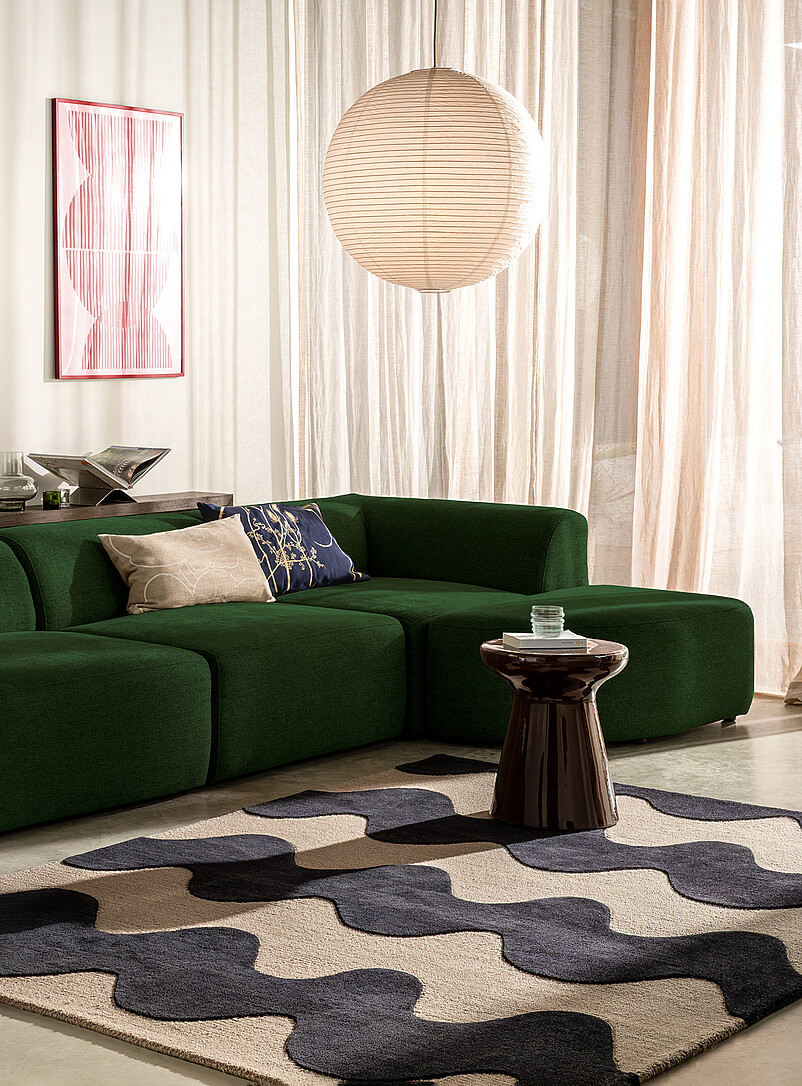
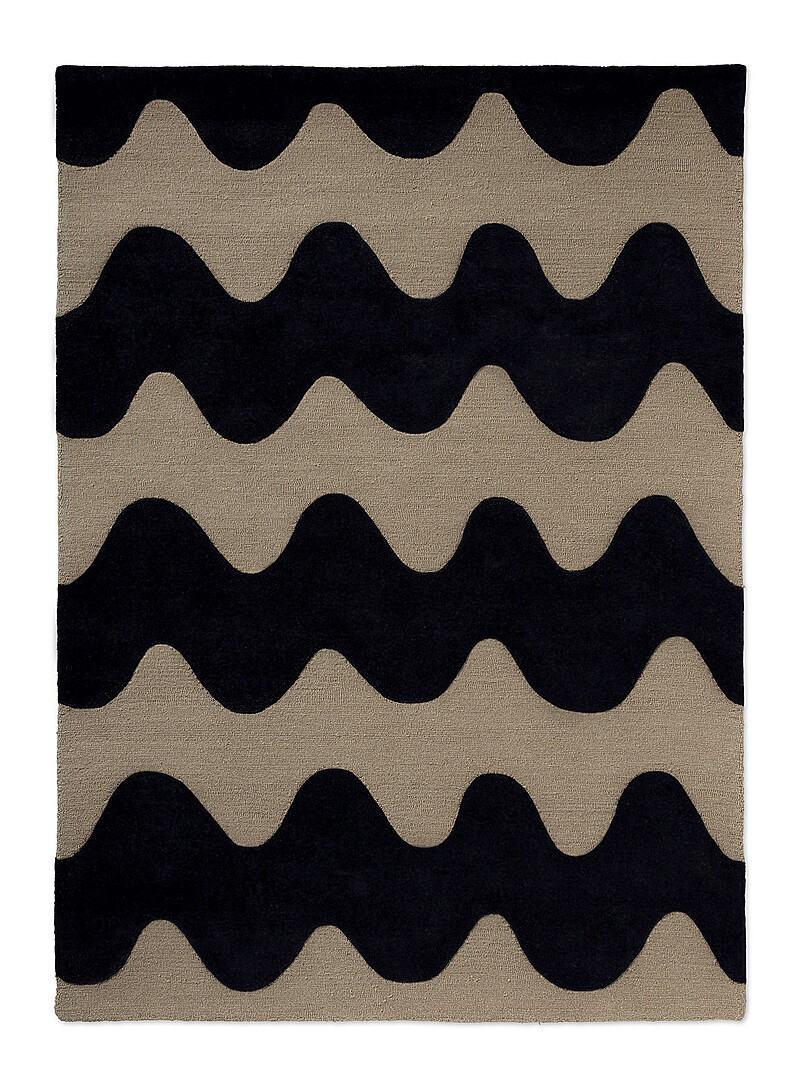
This Lokki pure wool rug by Marimekko is a hand-tufted area rug made from pure New Zealand wool with a low pile height. It features the wavy Lokki pattern in contrasting two-tone shades and is suitable for use on hard floors, including placement under furniture. A rug pad is recommended for safety; the rug is available in multiple sizes and, for online orders, is shipped directly from the supplier.
- Material
- pure New Zealand wool
- Category
- Home & Garden > Decor > Rugs
Specifications
Hand-tufted pure New Zealand wool rug with low pile height and iconic Marimekko design. Available in multiple sizes.
Hand-tufted construction, pure New Zealand wool, low pile height, iconic Marimekko design, available in multiple sizes.
- Material
- pure New Zealand wool
- Age Group
- adult
- Condition
- new
- Category
- Home & Garden > Decor > Rugs
Additional Attributes
- hand-tufted
- pure New Zealand wool
- low pile height
- available in multiple sizes
- iconic Marimekko design
Product Insights
Originating from Maija Isola's 1960s paper-cut of curtain shadows, the Marimekko Lokki Pure Wool Rug hand-tufted in New Zealand wool by century-old Brink & Campman offers a sculptural cut-and-loop pile that shifts with light, visually widening narrow rooms when oriented horizontally. Its natural lanolin resists stains and fire, and the rug endures 5–15 years in high-traffic areas, but requires a rug pad for floor protection and initial shedding that resolves with vacuuming. At $2,249, the rug's color accuracy and biodegradable wool justify the investment.
Verified claims
- Design origin
- Lokki pattern originated as a 1960s paper-cut of a curtain shadow, now a Marimekko icon.
- Spatial effect
- Oriented across a room's short axis, the horizontal waves visually widen the space.
- Craftsmanship
- Hand-tufted by century-old Brink & Campman using pure New Zealand wool.
- Resilience
- The 12mm pile with natural fiber crimp springs back under heavy traffic.
- Stain resistance
- The wool's natural lanolin coating makes spills bead up, slowing absorption.
- Durability
- Hand-tufted New Zealand wool rug lasts 5 to 15 years with proper care.
- Pile texture
- Handcrafted cut-and-loop pile creates shifting shadows and sculptural texture.
- Longevity
- Physical carving and wool resilience keep pattern and pile height intact over time.
- Size effect
- 170x240cm acts as a coffee-table accent; 250x350cm as a room foundation.
- Custom sizing
- Custom sizes available on request from Brink & Campman.
- Design heritage
- Maija Isola’s 1960s Lokki pattern, inspired by curtain shadows, is an iconic collectible Marimekko design.
- Construction quality
- Hand‑tufted in Holland by Brink & Campman with a cut‑and‑loop pile that creates a sculptural, light‑responsive texture.
- Sizing versatility
- The repeating Lokki pattern scales identically across stock and custom sizes without distorting the wave proportion.
- Floor protection
- A rug pad is strongly advised to prevent scratches and allow airflow to avoid discoloration on hardwood floors.
- Shedding
- Shedding resolves after a few months with regular vacuuming.
- Traffic suitability
- Low-pile wool is resilient for moderate to high-traffic areas.
- Vacuuming
- Suction-only or brush-off vacuuming without a beater bar minimizes shedding on low-pile wool.
- Stain management
- Blot spills immediately; lanolin provides a few seconds before absorption.
- Rug pad
- A rug pad is strongly recommended to protect hardwood and prevent slipping.
- Biodegradability
- 100% New Zealand wool that biodegrades fully in months, leaving no microplastics.
- Inherent properties
- Wool's natural lanolin, flame resistance, and resilience reduce chemical treatments and extend lifespan to 5-15 years.
- Hypoallergenic
- Resists dust mites, mold, and absorbs volatile pollutants.
- Flame resistance
- Self-extinguishing wool pile without chemical flame retardants.
- Manufacturer
- Crafted by Brink & Campman, a specialist with over 125 years.
- Acoustic and thermal
- Wool fibers absorb sound and buffer heat underfoot, even in a low 12mm pile.
- Visual contrast
- Cut-and-loop pile and carved texture cast shadows that deepen black and sharpen color contrast.
- Value
- Priced at $2,249, but New Zealand wool's color accuracy exceeds that of cheaper hand-tufted wool rugs.
- Light and shadow
- Waves shift appearance with changing light and viewing angle.
- Contrast buffer
- Taupe ground buffers pattern against dark floors.
- Pile feel
- The rug's 12mm pile sits at the upper edge of the medium-height range, so it cushions more than a typical low-pile wool rug while remaining easy to vacuum and resistant to deep dirt.
- Mood
- The black-on-beige Lokki pattern retains cheerful roots while grounding a space, so it reads as lively rather than dour.
Product record
- Title
- Lokki Pure Wool Rug See Available Sizes
- Brand
- Marimekko
- Price
- 2249 CAD
- Availability
- In stock
Image Analysis
3 images- 01
Product
Rectangular floor rug with a low-to-medium pile and a repeating large wavy two-tone pattern that covers most of the foreground, positioned on a hard floor and partially under furniture.
- Overall shapeRectangular rug with visible finished straight edges and square corners, laid flat on the floor.
1 region
x 0.04 · y 0.56 · w 0.92 · h 0.40 (high) - Pile and textureTextured, tufted pile surface with the dark pattern appearing slightly raised or denser than the lighter background, creating a visible height and texture contrast.
1 region
x 0.12 · y 0.63 · w 0.76 · h 0.30 (medium) - PatternLarge organic wavy shapes in a repeating arrangement across the rug surface; the waves interlock across the width and create a rhythmic silhouette.
1 region
x 0.06 · y 0.60 · w 0.88 · h 0.34 (high) - Placement under furnitureRug is positioned on a hard floor and extends partially under a low coffee table and the front edge of a sectional sofa.
1 region
x 0.30 · y 0.66 · w 0.40 · h 0.24 (high)
Other
Interior lifestyle scene showing the rug in a living room with a green sectional sofa, a small dark ceramic side table, sheer floor-to-ceiling curtains, a hanging round paper lantern, framed wall art, and neutral hard flooring.
- Shot compositionIndoor lifestyle photograph taken from a slightly elevated frontal angle, showing the rug in the foreground and seating and decor in the midground and background.
- LightingSoft natural-looking light from the right, producing gentle shadows and warm highlights on the curtains and floor.
1 region
x 0.60 · y 0.00 · w 0.40 · h 0.75 (medium) - Visible furnitureLow modern sectional sofa upholstered in a dark green fabric visible along the left and midground, and a small glossy dark ceramic stool-style side table placed on the rug.
2 regions
x 0.02 · y 0.35 · w 0.78 · h 0.35 (high); x 0.60 · y 0.68 · w 0.18 · h 0.20 (high) - Lighting fixture and wall artA round paper lantern pendant hangs above the scene near the center, and a vertically oriented framed piece of wall art with red linear shapes is mounted on the left wall.
2 regions
x 0.40 · y 0.02 · w 0.34 · h 0.28 (high); x 0.04 · y 0.06 · w 0.18 · h 0.28 (high) - Flooring materialSmooth neutral hard flooring visible at the rug edges and where the rug does not cover the floor.
1 region
x 0.02 · y 0.92 · w 0.96 · h 0.06 (high)
Colors
warm beige· background field#DCCCBBcharcoal gray· wavy pattern#322D33- Overall shapeRectangular rug with visible finished straight edges and square corners, laid flat on the floor.
- 02
Product
Rectangular area rug viewed flat-on showing an all-over repeating horizontal wavy stripe pattern in two contrasting pile/textures.
- Overall shapeRectangular rug with straight edges visible on all four sides; image shows the full rug within frame with small white margin around edges.
1 region
x 0.02 · y 0.02 · w 0.96 · h 0.96 (high) - PatternRepeating horizontal undulating wave bands that alternate between a darker raised pile and a lighter flatter-textured band; waves are continuous across the width.
1 region
x 0.00 · y 0.00 · w 1.00 · h 1.00 (high) - Dark band textureDark-colored wave bands appear to have a denser, slightly higher pile that reads visually smoother and more plush than the lighter bands.
3 regions
x 0.02 · y 0.05 · w 0.96 · h 0.20 (high); x 0.02 · y 0.30 · w 0.96 · h 0.20 (high); x 0.02 · y 0.55 · w 0.96 · h 0.20 (high) - Light band textureLighter-colored bands have a coarser, looped or flat-woven appearance with visible horizontal yarn texture.
3 regions
x 0.02 · y 0.18 · w 0.96 · h 0.18 (high); x 0.02 · y 0.43 · w 0.96 · h 0.18 (high); x 0.02 · y 0.68 · w 0.96 · h 0.18 (high) - Edge finishEdges appear finished with fold-over or bound seam matching the rug body; corners are square with slight rounding from pile.
2 regions
x 0.00 · y 0.00 · w 0.02 · h 1.00 (medium); x 0.98 · y 0.00 · w 0.02 · h 1.00 (medium) - Color contrastHigh contrast between the dark wave bands and the lighter taupe bands producing a bold graphic rhythm.
Other
Studio product shot photographed top-down on a white background with even lighting and minimal shadowing around the rug edges.
- Shot compositionRug photographed flat-on from above, centered in frame with a narrow white border visible on all sides.
1 region
x 0.00 · y 0.00 · w 1.00 · h 1.00 (high) - Background and surfacePlain bright white background with no props or visible flooring; slight soft shadowing around the rug perimeter.
- LightingEven diffuse lighting with minimal directional highlights; texture details in both light and dark bands are visible.
Colors
charcoal black· dark wave bands#0D0D14taupe beige· light wave bands#AC9D8A- Overall shapeRectangular rug with straight edges visible on all four sides; image shows the full rug within frame with small white margin around edges.
- 03
Product
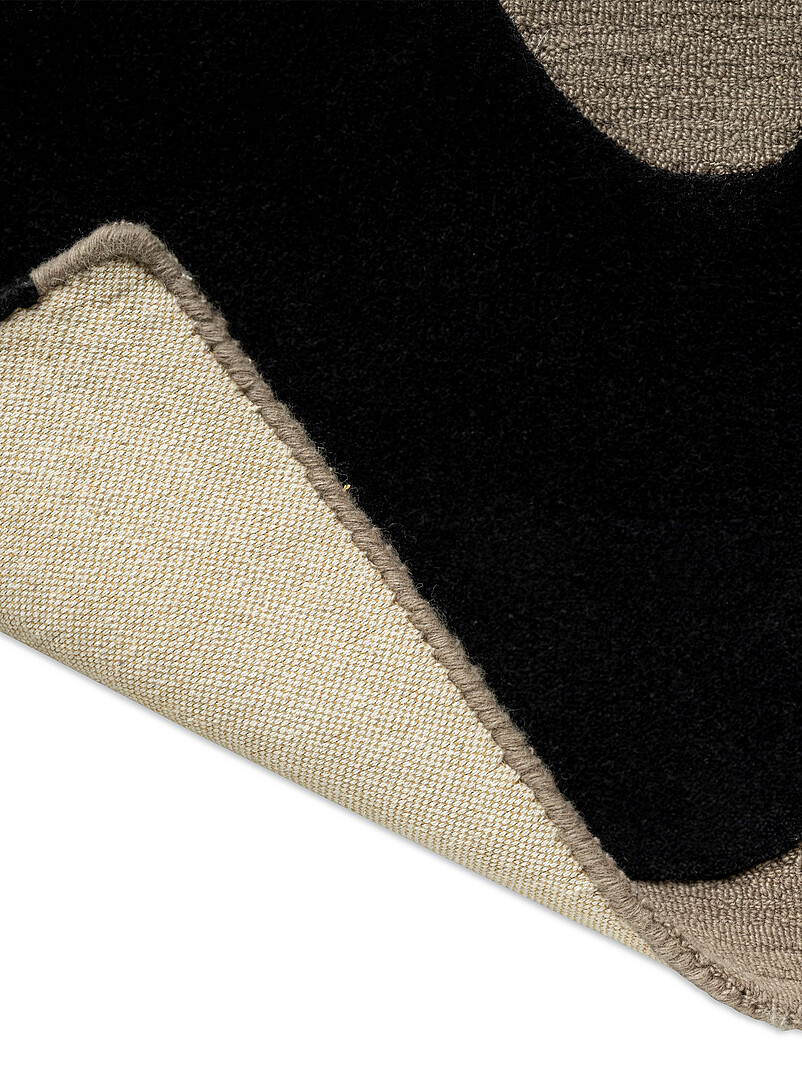
Close-up of a wool rug corner showing folded corner with woven backing, dense black pile field, taupe shaped motif, and a taupe bound edge.
- Folded corner showing backingLower-left corner of the rug is folded back to expose the underside woven backing, which is a tightly woven beige fabric with visible weave texture.
1 region
x 0.02 · y 0.62 · w 0.46 · h 0.36 (high) - Dense black pile fieldLarge area of dense, short black wool pile covering the visible rug surface; appears matte with a uniform texture.
1 region
x 0.18 · y 0.00 · w 0.70 · h 0.80 (high) - Taupe motifA rounded taupe-colored shaped motif with a looped woven texture contrasting the black pile; a portion is visible at the top-right and another small taupe area at bottom-right.
2 regions
x 0.70 · y 0.00 · w 0.30 · h 0.20 (high); x 0.72 · y 0.74 · w 0.26 · h 0.20 (medium) - Bound edge with pile-over bindingEdge of the rug has a narrow taupe fabric binding that wraps the pile edge; binding shows small pile fibers and a stitched appearance where face meets backing.
1 region
x 0.25 · y 0.50 · w 0.60 · h 0.25 (high) - Visible pile-to-backing transitionClear transition between cut/tufted pile surface and flat woven backing along the folded edge, showing pile thickness and backing weave interlock.
1 region
x 0.12 · y 0.58 · w 0.60 · h 0.38 (medium)
Other
Studio product detail shot with a white background and soft diffuse lighting; slight shadowing around folded corner. Image is tightly cropped to the rug detail.
- Shot compositionTight close-up crop focusing on a folded corner and adjacent rug surface, leaving white background visible in lower-left corner outside the fold.
1 region
x 0.00 · y 0.88 · w 0.40 · h 0.12 (high) - Lighting and shadowEven, diffuse lighting with a subtle shadow along the interior edge of the folded corner indicating slight depth and pile height.
- Image qualitySharp focus on fiber texture and weave; no legible printed text present in the image.
Colors
deep black· black pile#0B0B0Btaupe brown· taupe motif#9C8C7Bbeige· backing#FFFFFFlight taupe· bound edge- Folded corner showing backingLower-left corner of the rug is folded back to expose the underside woven backing, which is a tightly woven beige fabric with visible weave texture.
Variants
6 SKUs| SKU | Title | Price | Avail |
|---|---|---|---|
| 4707801 | Lokki Pure Wool Rug See Available Sizes - Patterned Black - 200x280cm | CA$3,079.00 | Yes |
| 4707797 | Lokki Pure Wool Rug See Available Sizes - Patterned Black - 170x240cm | CA$2,249.00 | Yes |
| 4707806 | Lokki Pure Wool Rug See Available Sizes - Patterned Black - 250x350cm | CA$4,849.00 | Yes |
| 4707802 | Lokki Pure Wool Rug See Available Sizes - Patterned Yellow - 200x280cm | CA$3,079.00 | Yes |
| 4707798 | Lokki Pure Wool Rug See Available Sizes - Patterned Yellow - 170x240cm | CA$2,249.00 | Yes |
| 4707807 | Lokki Pure Wool Rug See Available Sizes - Patterned Yellow - 250x350cm | CA$4,849.00 | Yes |