Simons Maison
Sage Green Gingham Checkers Woven Rug 60 X 90 Cm
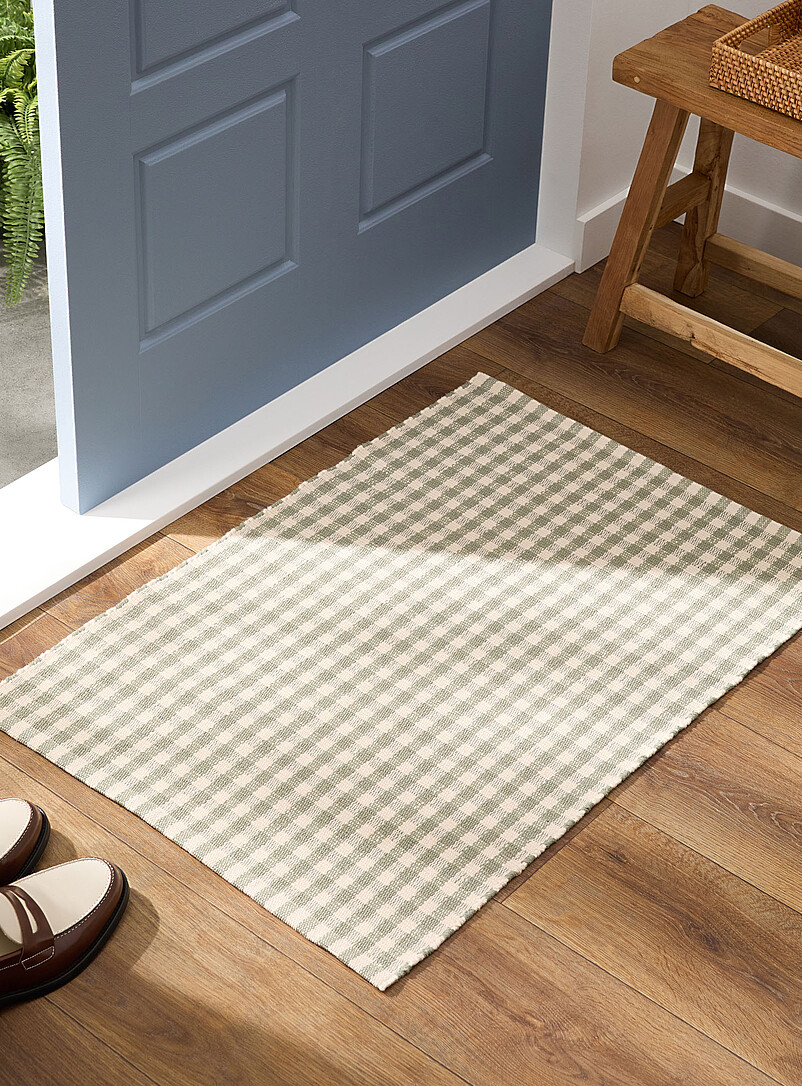
This flatwoven rectangular rug features a small-scale gingham checker pattern in sage green and off-white, finished with short selvedge fringe along the edges. It is made from 100% reprocessed cotton and is suitable for use on the floor, with a rug pad recommended for safety and stability. The rug measures 23.5 x 35.5 inches (60 x 90 cm) and is part of a Simons Maison exclusive collection designed in Canada.
- Color
- Sage Green
- Material
- 100% reprocessed cotton
- Style
- farmhouse
- Category
- Home & Garden > Decor > Rugs
Specifications
A country-style sage green gingham rug on an ivory background, made from 100% reprocessed cotton, providing a bright and soothing vibe.
Bright and soothing country-style design, gingham pattern, made from 100% reprocessed cotton, rug pad recommended for safety.
- Color
- Sage Green · green
- Material
- 100% reprocessed cotton
- Style
- farmhouse
- Gender
- unisex
- Condition
- new
- Category
- Home & Garden > Decor > Rugs
Additional Attributes
- bright
- soothing
- country-style
- gingham pattern
- 100% reprocessed cotton
- rug pad recommended
- other sizes available
Product Insights
The Simons Maison Sage Green Gingham Checkers Woven Rug (60x90 cm) is a C$25 flatweave made from 100% reprocessed cotton via chemical-free mechanical recycling, offering environmental savings of 15.29 kWh, 6,600 kg CO2, and 2,783 m³ water per tonne. Its low-profile, reversible construction resists wear, snags, and pulls, doubling the usable lifespan when flipped, and clears doors while keeping dirt on the surface. The traditional small-scale gingham style, which has surged in 2026 searches, mixes with stripes, florals, and dots, and its matte nubby texture pairs with linen, jute, and rattan. Care requires suction-only vacuuming and machine-washing on cool gentle cycle with mild detergent and air-drying flat, but dye may bleed into lighter fibers—test before wet cleaning. The rug lacks non-slip backing, so a rug pad is recommended on hard floors to prevent slipping and further extend longevity, representing an additional expense.
Verified claims
- Price edge
- Costs less than half the typical C$59 starting price for comparable cotton flatweaves.
- Durability
- Flatweave construction resists wear and is reversible for double the lifespan.
- Environmental impact
- Reprocessed cotton saves 15.29 kWh of energy per kilogram over virgin cotton, plus roughly 6,600 kg CO2 and about 2,783 m³ of irrigation water per tonne of yarn.
- Material
- 100% reprocessed cotton from pre-consumer scraps via chemical-free mechanical recycling.
- Eco savings
- Saves 6600 kg CO₂, 2783 m³ water, and 0.5 ha land per tonne of yarn.
- Care
- Test a hidden area for dye bleeding first; if the care label permits machine washing, use a cool gentle cycle with mild detergent and flat air-dry only.
- Vacuuming
- Suction-only vacuuming protects the weave and easily removes surface dirt.
- Pile height
- The woven cotton flatweave is typically low-pile (around 0.25–0.5 inches), low enough to clear door swings and keep dirt on the surface.
- Style profile
- Small-scale gingham reads traditional but has surged in 2026 searches.
- Mixing versatility
- Two-color gingham weave works with stripes, florals, and dots.
- Texture pairing
- Matte, nubby cotton weave pairs naturally with linen, jute, and rattan.
- Placement
- Common placements: kitchen sink, entryway, bedside, behind doors.
- Layering
- Layers over a larger neutral rug for visual depth.
- Non-slip backing
- Rug pad recommended on hard floors to prevent slipping.
- Non-slip requirement
- This rug has no non-slip backing; the product description recommends a rug pad for safety, especially on hard floors.
- Longevity
- Using a rug pad can extend the rug's life and prevent slipping, while flipping the reversible flatweave distributes wear and sun exposure.
- Cost
- Rug pad is an extra expense beyond the $25 purchase price.
- Reversible design
- Flipping the rug distributes wear and sun fading, doubling its usable lifespan.
- Construction
- The interlocked flatweave resists pulls and matting under foot traffic, so the woven surface stays uniform rather than snagging or matting.
- Dye bleeding
- Dye may bleed into ivory; test a hidden area before wet cleaning.
- Country style
- The rug's smaller gingham checks read as traditional and country-style, making it a natural anchor for farmhouse, shabby chic, or vintage-leaning rooms.
- Small-space footprint
- At 60 x 90 cm, this cotton rug is scaled for use as an entry mat, a bedside strip, or a kitchen comfort spot, and its flatweave construction handles dirt and foot traffic in those compact zones.
- Reprocessed cotton meaning
- The rug's 100% reprocessed cotton is made from fibers reclaimed from manufacturing scraps (pre-consumer waste), not post-consumer recycled sources; it reduces textile waste while keeping the softness and durability of cotton.
- Shedding
- Cotton rugs may shed lightly at first, but the reprocessed cotton fibers tend to shed less than new cotton, and this rug holds up well to moderate foot traffic.
Product record
- Title
- Sage Green Gingham Checkers Woven Rug 60 X 90 Cm
- Brand
- Simons Maison
- Price
- 25 CAD
- Availability
- In stock
Image Analysis
2 images- 01
Product
Rectangular flatwoven rug shown flat on a wooden floor with a small-scale gingham checker pattern in sage green and off-white. Edges are slightly irregular with a short selvedge fringe visible on at least one side.
- Overall shapeRectangular rug shown laying flat on the floor with all visible corners roughly rectangular and one corner cropped by the image frame.
1 region
x 0.08 · y 0.36 · w 0.84 · h 0.56 (high) - PatternSmall-scale gingham checker pattern formed by alternating sage green and off-white squares in a grid across the entire visible surface.
1 region
x 0.12 · y 0.45 · w 0.76 · h 0.42 (high) - Weave and textureFlatwoven textile with visible woven texture and slight surface irregularity consistent with a low-pile or flatweave construction.
1 region
x 0.18 · y 0.52 · w 0.56 · h 0.32 (medium) - Edge finishShort, slightly irregular selvedge fringe along the nearest long edge and a similarly finished opposite edge; fringe is short and not densely tufted.
2 regions
x 0.08 · y 0.86 · w 0.84 · h 0.06 (medium); x 0.64 · y 0.40 · w 0.30 · h 0.06 (low) - Shadow and lighting on surfaceSoft diagonal shadow crosses the rug from upper-left toward lower-right, creating a band of darker tone over the pattern.
1 region
x 0.22 · y 0.40 · w 0.56 · h 0.18 (high) - Partial occlusion by propsLower-left corner of the rug is partially visually close to a pair of shoes that sit on the floor adjacent to the rug; top-right edge of rug is near a wooden bench leg.
2 regions
x 0.00 · y 0.78 · w 0.22 · h 0.22 (high); x 0.76 · y 0.22 · w 0.24 · h 0.34 (high)
Other
Lifestyle scene showing the rug on a wood-look floor beside a closed blue paneled door and a wooden bench; soft natural lighting casts shadows and a small potted fern and shoes are visible at the image edges.
- FlooringWood-look plank flooring with medium brown tone and visible wood grain under the rug and around it.
1 region
x 0.04 · y 0.52 · w 0.92 · h 0.44 (high) - Door and trimPart of a closed paneled door painted a muted blue is visible along the left side of the image with white baseboard trim at floor level.
1 region
x 0.00 · y 0.00 · w 0.40 · h 0.48 (high) - Bench propWooden bench or small table with visible leg and woven basket on top located at the top-right corner of the image framing the rug.
1 region
x 0.72 · y 0.08 · w 0.28 · h 0.28 (high) - Shoes propPair of two-tone shoes (cream and brown) positioned just outside the rug at lower-left, visible only partially.
1 region
x 0.00 · y 0.78 · w 0.20 · h 0.20 (high) - Plant propGreen fern fronds are visible at the far left edge of the image, partially cropped.
1 region
x 0.00 · y 0.04 · w 0.08 · h 0.26 (medium) - Lighting and shadowsSoft directional natural light from the upper-left creates distinct but soft shadows on the rug and floor.
1 region
x 0.18 · y 0.36 · w 0.60 · h 0.40 (high)
Colors
sage green· gingham squares - sage green#ADA994off-white· gingham squares - off-white- Overall shapeRectangular rug shown laying flat on the floor with all visible corners roughly rectangular and one corner cropped by the image frame.
- 02
Product
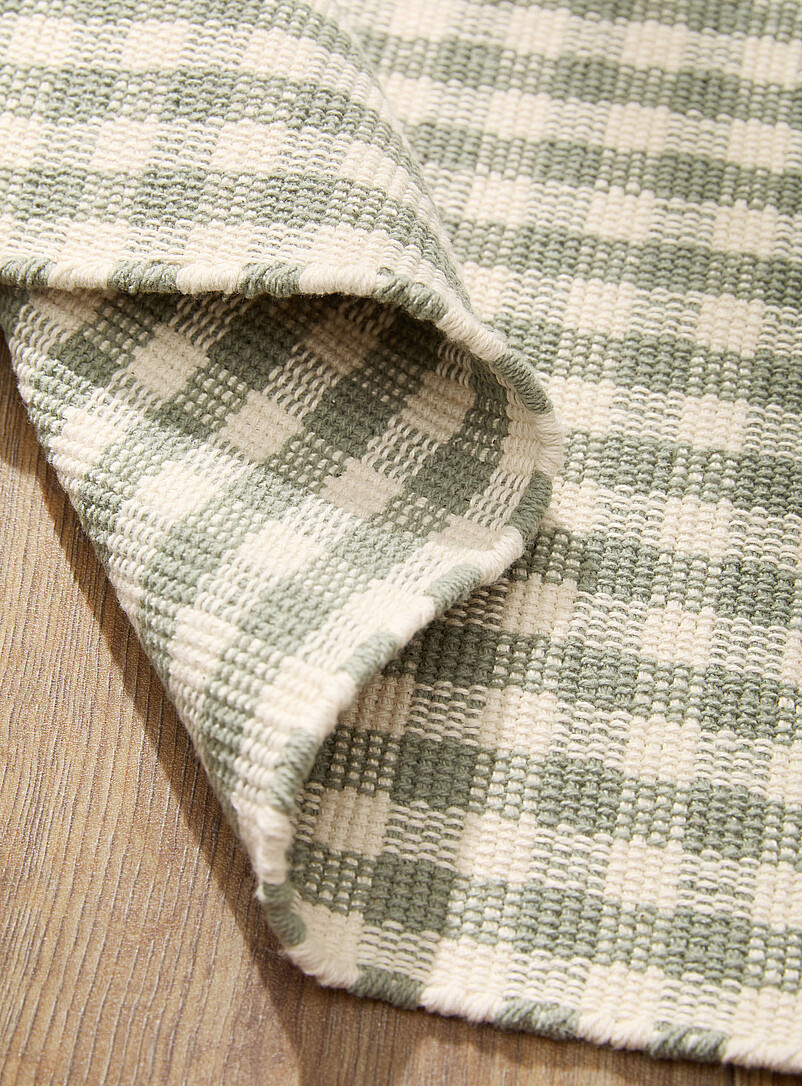
Close-up of a flat-woven rug with a two-color gingham check pattern in sage green and off-white; a folded corner shows the rug's thickness, selvedge, and reverse side with the same weave.
- PatternRegular gingham check grid formed by alternating sage green and off-white squares; checks are made from woven yarns that create a slightly ribbed texture within each square.
1 region
x 0.45 · y 0.00 · w 0.55 · h 0.50 (high) - Folded cornerLower-left-to-center area of the rug is folded back, exposing the underside and showing the rug's finished rounded selvedge and the layered thickness at the fold.
1 region
x 0.05 · y 0.12 · w 0.56 · h 0.62 (high) - Weave textureFlat, tightly woven construction with visible horizontal and vertical yarn ridges producing a slightly raised, ribbed surface across squares.
1 region
x 0.35 · y 0.30 · w 0.58 · h 0.60 (high) - Edge finishingRounded selvedge edge with wrapped yarn visible along the folded rim, same two colors appearing in the edge wrapping.
1 region
x 0.18 · y 0.18 · w 0.28 · h 0.18 (medium)
Other
Image is a close-up product detail shot on a wood-grain surface with soft directional lighting that casts mild shadows and highlights the weave; cropped to focus on the folded rug corner.
- Background surfaceWood-grain floor or tabletop visible beneath the rug, running diagonally from lower-left to upper-right.
1 region
x 0.00 · y 0.70 · w 0.40 · h 0.30 (high) - Shot compositionTight close-up framing focused on texture and pattern; rug occupies most of the frame with a single folded area as the focal point.
- Lighting and shadowSoft, warm directional light from upper-left producing subtle shadows in weave recesses and along the folded edge.
Colors
sage green· sage check squares#ACAB93off-white· off-white check squares#C3BDAB- PatternRegular gingham check grid formed by alternating sage green and off-white squares; checks are made from woven yarns that create a slightly ribbed texture within each square.
Documents & Data
Customer Reviews
1 total1 reviews · out of 5
Il est parfait
Il est parfait