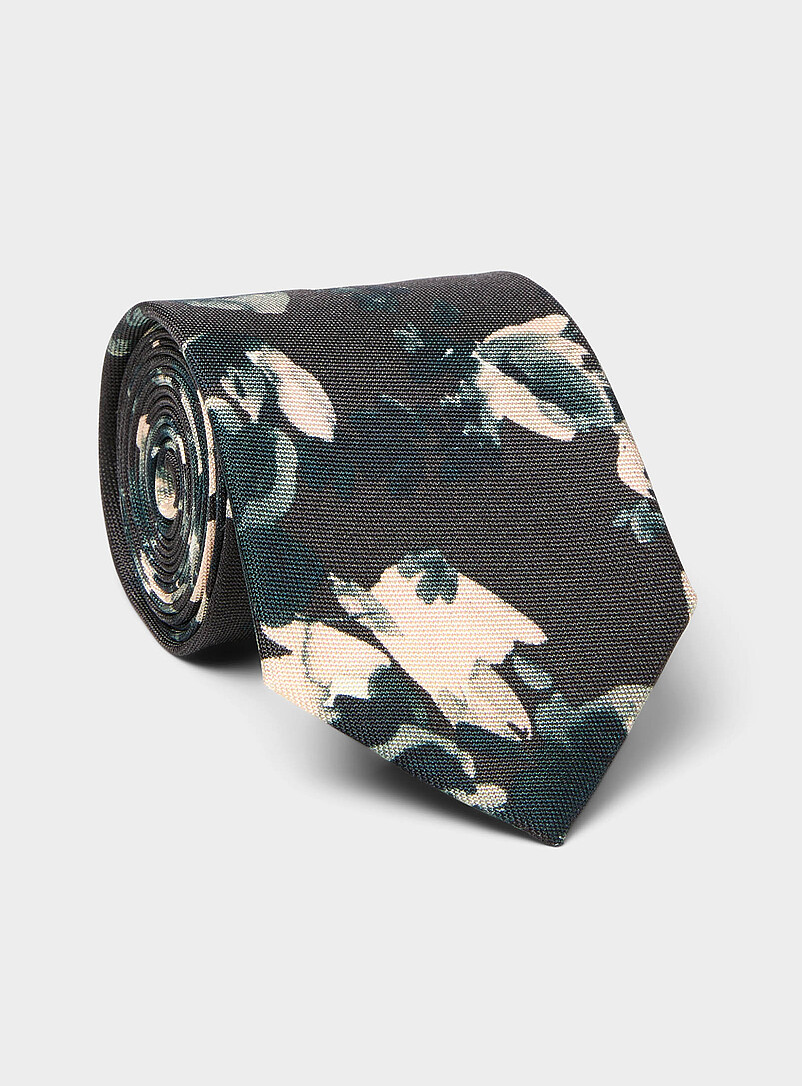
Tiger of Sweden
Printed Floral Tie
This printed floral tie from Tiger of Sweden is a skinny-style necktie made of 100% silk. It measures 2.5 inches (6 cm) wide and is made in Italy. The tie features a floral pattern with pale cream and green motifs on a brown ground, suitable for formal or professional occasions.
- Material
- 100% silk
- Gender
- male
- Style
- slim-fit, classic
- Category
- Apparel & Accessories > Clothing Accessories > Neckties
Color
Size
Specifications
Skinny silk necktie featuring a printed floral pattern, crafted in Italy.
Floral print design, 100% silk construction, 2.5 inch width.
- Material
- 100% silk
- Style
- slim-fit, classic
- Occasion
- wedding, party, date-night
- Gender
- male
- Age Group
- adult
- Condition
- new
- Category
- Apparel & Accessories > Clothing Accessories > Neckties
Additional Attributes
- Floral print pattern
- 100% silk construction
- Skinny silhouette (2.5 inch width)
- Made in Italy
- Tiger of Sweden x Le 31 collaboration
- Self-tie necktie design
- Luxury silk with subtle sheen
- Suitable for slim lapel jackets
Product Insights
The Tiger of Sweden Printed Floral Tie uses 100% Como silk with hand-rolled hems, a slip-stitch, and a bar tack to protect the floral print from creases and edge distortion, while offering a clean four-in-hand knot with a dimple and self-recovering shape. Its three-fold construction and polyester-lined neckband resist stretch, sweat, and fraying, but the tie requires professional dry cleaning—the main tradeoff for its lightweight, wrinkle-releasing drape suitable for year-round wear.
- Cleaning
Professional dry clean only — do not wash, bleach, or tumble dry.
Why this is supported
The product Q&A states:
This tie is 100% silk and should be professionally cleaned.
How should this silk tie be cleaned or cared for?and explicitly bans home washing:
Do not wash or bleach. Do not tumble dry;
How should this silk tie be cleaned or cared for?The hand-rolled edges, a hallmark of Italian silk tie craftsmanship, are delicate:
The blade edges are finished with a hand-rolled hem, a labor-intensive technique where silk is folded and stitched by hand to produce a subtle, wavy contour
What Italian craftsmanship brings to a silk tie — hand_rolled_bladeswhich would be damaged by washing, corroborating that professional cleaning is the only safe method.
- Care
Wrinkles release when hung or ironed; knot creases self-recover.
Why this is supported
Ironing is safe for this tie:
iron with or without steam is acceptable.
How should this silk tie be cleaned or cared for?Moreover, light creases from wear naturally release when the tie is hung due to the polyester interlining's shape memory:
Polyester's shape memory means that light creases from folding or knotting release with a few hours of hanging
How the lining affects the tie’s drape and knot — travel_and_wrinkle_recoveryThe hand-sewn slip-stitch spine also helps the tie snap back after knotting:
A hand-sewn slip-stitch runs the length of the back seam, joined by a single thread that acts as a spine; it lets the tie stretch slightly when knotted and then pull back into shape
What Italian craftsmanship brings to a silk tie — self_recovering_slip_stitchFinally, hanging rather than folding preserves the drape:
The 100% polyester interlining gives the 2.5-inch silk shell enough weight and rigidity to fall straight without twisting
How the lining affects the tie’s drape and knot — polyester_interlining_s_structural_roleAll these features mean the tie requires minimal intervention to stay crisp.
- Neckband durability
Polyester lining resists stretch and sweat stains.
Why this is supported
The polyester lining in the neckband improves durability:
The polyester lining sheds moisture and friction better than silk alone, so the neckband resists stretching and sweat-induced discoloration
How the lining affects the tie’s drape and knot — neckband_longevityThis reduces visible wear in the area that sees the most friction and moisture.
- Seasonality
Lightweight and generally suitable for year-round wear.
Why this is supported
Catalog verified the year-round suitability through the Q&A, which states the tie is
As a 100% silk skinny tie, it is lightweight and generally suitable for year-round wear.
What is the weight or thickness of the silk fabric used? Is it suitable for year-round wear or more seasonal?. This is achieved by the three-fold construction:
silk shell folded around a wool-cotton interlining, then stitched closed
What Italian craftsmanship brings to a silk tie — three_fold_foderato_construction. The interlining also enables a neat, long-lasting dimple:
consistent thickness helps the knot compress into a neat, long-lasting dimple
How the lining affects the tie’s drape and knot — knot_architecture_and_dimple_retention. Italian manufacturers balance the interlining for the narrow blade, ensuring full drape, and creases release with a few hours of hanging.
- Fabric quality
100% Como silk yields sharper floral edges and deeper colorfastness.
Why this is supported
The silk originates from Como, a region known for superior dyeing and printing.
the floral pattern on this tie will have sharper edges and deeper colorfastness than prints from non-specialist sources
What Italian craftsmanship brings to a silk tie — como_silk_sourceThis verifies that the Como source directly enhances print precision and color retention.
- Print preservation
Hand-rolling, slip stitch, and interlining protect the floral pattern from creases and edge distortion.
Why this is supported
The hand-rolled blades contribute to print preservation by creating a softer edge:
yields a softer edge that never looks stiff or machine-pressed against the shirt
What Italian craftsmanship brings to a silk tie — hand_rolled_bladesThe hand-sewn slip stitch inside the tie prevents creasing that would disrupt the floral pattern.
The tie's interlining ensures pattern continuity even after storage:
light creases from folding or knotting release with a few hours of hanging, whereas unlined 100% silk ties tend to hold fold lines more permanently, requiring steaming — a practical consideration for a floral print where visible creases would disrupt the pattern
How the lining affects the tie’s drape and knot — travel_and_wrinkle_recovery- Hand-finishing
Hand-rolled hem produces a soft, wavy edge—a hallmark of Italian craftsmanship.
Why this is supported
labor-intensive technique where silk is folded and stitched by hand to produce a subtle, wavy contour
What Italian craftsmanship brings to a silk tie — hand_rolled_bladesthis hallmark of Italian tie-making
What Italian craftsmanship brings to a silk tie — hand_rolled_bladeshand version lies flatter and is less prone to fraying
What Italian craftsmanship brings to a silk tie — hand_bar_tackruns the length of the back seam
What Italian craftsmanship brings to a silk tie — self_recovering_slip_stitch. These hand-finishing touches indicate a level of craftsmanship that goes beyond typical ties at this price point.
- Bar tack
Hand-stitched bar tack lies flatter and is less prone to fraying.
Why this is supported
The hand-stitched bar tack on the keeper loop of this tie
lies flatter and is less prone to fraying
What Italian craftsmanship brings to a silk tie — hand_bar_tackcompared to machine stitching. This is especially beneficial for the skinny 2.5" width where the keeper loop sees concentrated stress. The flat profile also prevents an unsightly bump and preserves the continuity of the floral print. At the $169 price, the detail is a mark of Italian craftsmanship, described as
a detail that Italian artisans treat as a signature of craftsmanship
What Italian craftsmanship brings to a silk tie — hand_bar_tack.
- Slip-stitch
Hand-sewn slip-stitch self-recovers, preventing creases and extending life.
Why this is supported
A hand-sewn slip-stitch runs the entire back seam of the tie, joined by a single thread. Its function is twofold: it
lets the tie stretch slightly when knotted and then pull back into shape
What Italian craftsmanship brings to a silk tie — self_recovering_slip_stitch, while
preventing the silk from creasing or tearing over time
What Italian craftsmanship brings to a silk tie — self_recovering_slip_stitch. This self-recovering property keeps the tie from developing permanent creases and extends its usable life. The hand-sewn, single-thread construction is a hallmark of Italian tie craftsmanship, adding to the tie's premium feel and supporting its $169 price point.
- Construction
Three-fold construction provides heft for a clean knot while keeping the 2.5-inch blade slim.
Why this is supported
The tie features a three-fold (foderato) construction where the
silk shell folded around a wool-cotton interlining, then stitched closed — the standard for quality Italian ready-to-wear ties, balancing enough heft for a clean four-in-hand knot without the bulk that would overpower a 2.5-inch blade.
What Italian craftsmanship brings to a silk tie — three_fold_foderato_constructionThe interlining provides weight and rigidity:
The 100% polyester interlining gives the 2.5-inch silk shell enough weight and rigidity to fall straight without twisting, which on a skinny tie is the difference between looking intentionally sleek and looking like a forgotten strip of fabric.
How the lining affects the tie’s drape and knot — polyester_interlining_s_structural_roleThis structure aids in knot formation:
The interlining is tailored for the 2.5-inch width:
Italian tie manufacturers tailor interlining weight and balance for narrower blades, ensuring the 2.5-inch width still delivers a proportional knot and full drape
What Italian craftsmanship brings to a silk tie — skinny_tie_proportioningPractical benefits include a moisture-resistant neckband (
The polyester lining sheds moisture and friction better than silk alone, so the neckband resists stretching and sweat-induced discoloration
How the lining affects the tie’s drape and knot — neckband_longevityand shape memory for wrinkle recovery (
Polyester's shape memory means that light creases from folding or knotting release with a few hours of hanging
How the lining affects the tie’s drape and knot — travel_and_wrinkle_recoveryand a slip-stitch that allows recovery after knotting:
A hand-sewn slip-stitch runs the length of the back seam, joined by a single thread that acts as a spine; it lets the tie stretch slightly when knotted and then pull back into shape, preventing the silk from creasing or tearing over time.
What Italian craftsmanship brings to a silk tie — self_recovering_slip_stitch- Craftsmanship
Hand-rolled blades, hand-stitched keeper, and Como silk for vibrant, durable print.
Why this is supported
The tie's hand-finishing details include hand-rolled blades:
The blade edges are finished with a hand-rolled hem, a labor-intensive technique where silk is folded and stitched by hand to produce a subtle, wavy contour — this hallmark of Italian tie-making yields a softer edge that never looks stiff or machine-pressed against the shirt.
What Italian craftsmanship brings to a silk tie — hand_rolled_bladesand a hand-stitched keeper loop:
The small bar tack securing the keeper loop is hand-stitched, a detail that Italian artisans treat as a signature of craftsmanship — machine bar tacks often pierce the silk with rigid stitching, but the hand version lies flatter and is less prone to fraying the delicate fabric.
What Italian craftsmanship brings to a silk tie — hand_bar_tackThe silk originates from the Como region:
In Italian tie-making, silk is traditionally sourced from the Como region, the epicenter of European silk production since the 16th century; Como mills are known for high-quality dyeing and printing, meaning the floral pattern on this tie will have sharper edges and deeper colorfastness than prints from non-specialist sources.
What Italian craftsmanship brings to a silk tie — como_silk_source- Knot quality
Ties a clean, proportional four-in-hand knot that dimples and recovers shape.
Why this is supported
The tie uses a three-fold (foderato) construction with a wool-cotton interlining that gives a 2.5-inch blade enough heft for a clean four-in-hand knot without bulk. The interlining's consistent thickness allows the knot to compress into a long-lasting dimple, while a hand-sewn slip stitch along the back seam lets the tie stretch when knotted and pull back into shape, preventing the silk from creasing or tearing over wears. Deep research on skinny tie proportioning confirms that the interlining weight is tailored specifically for narrow blades, resulting in a knot that is proportional rather than small and floppy.
- Drape
Falls straight, resists wrinkles, and has a soft edge drape.
Why this is supported
The 100% polyester interlining gives the silk shell enough weight and rigidity to fall straight without twisting, preventing misalignment typical of skinny ties. The interlining's shape memory means light creases from folding or knotting release after a few hours of hanging, keeping the floral print clean. Additionally, the hand-rolled blade edges create a subtle wavy contour that avoids a stiff machine-pressed look, helping the tie drape softly against the shirt.
- Wrinkle recovery
Light creases from knotting or folding release with a few hours of hanging.
Why this is supported
The tie's wrinkle recovery is verified by two specific construction details: the polyester interlining provides shape memory, as documented in research on travel readiness, while the hand-sewn slip-stitch allows stretch and recovery.
Polyester's shape memory means that light creases from folding or knotting release with a few hours of hanging
How the lining affects the tie’s drape and knot — travel_and_wrinkle_recoveryThe slip-stitch engineering similarly aids recovery:
A hand-sewn slip-stitch runs the length of the back seam, joined by a single thread that acts as a spine; it lets the tie stretch slightly when knotted and then pull back into shape, preventing the silk from creasing or tearing over time.
What Italian craftsmanship brings to a silk tie — self_recovering_slip_stitchThus, the combination ensures that light creases typically release after a few hours of hanging, a significant advantage for travelers.
- Wrinkle removal
Persistent wrinkles can be removed by professional cleaning and ironing.
Why this is supported
Care instructions enable wrinkle removal through professional cleaning and ironing:
Do not wash or bleach. Do not tumble dry; iron with or without steam is acceptable.
How should this silk tie be cleaned or cared for?Thus, persistent wrinkles can be addressed by professional cleaning or ironing.
- Lining
Polyester lining at neckband resists sweat and friction, preventing stretching and discoloration.
Why this is supported
The neckband's polyester lining provides a benefit:
The polyester lining sheds moisture and friction better than silk alone, so the neckband resists stretching and sweat-induced discoloration, extending the tie's dressed appearance over multiple wears.
How the lining affects the tie’s drape and knot — neckband_longevityThis ensures the neckband maintains its shape and appearance longer than an unlined tie would.
- Stitching
Hand-stitched bar tack and slip-stitch prevent fraying and allow shape recovery after knotting.
Why this is supported
The keeper loop uses a hand-stitched bar tack:
the hand version lies flatter and is less prone to fraying the delicate fabric
What Italian craftsmanship brings to a silk tie — hand_bar_tackAdditionally, the back seam slip-stitch
it lets the tie stretch slightly when knotted and then pull back into shape, preventing the silk from creasing or tearing over time
What Italian craftsmanship brings to a silk tie — self_recovering_slip_stitch
Image Analysis
1 images- 01

Product
A rolled necktie displayed on its side showing the front tip and the spiral of the narrow end; fabric has a woven texture and a floral print in pale cream and dark green on a very dark charcoal background.
- Overall shapeTie shown rolled from the narrow end with the wide front blade unrolled and facing forward to display the triangular tip.
1 region
x 0.08 · y 0.20 · w 0.84 · h 0.66 (high) - Roll spiralVisible tightly rolled narrow end forming concentric spiral layers at the left side of the product view.
1 region
x 0.08 · y 0.28 · w 0.30 · h 0.40 (high) - Tip geometryWide blade tapers to a pointed triangular tip with a straight diagonal edge visible on the right.
1 region
x 0.44 · y 0.46 · w 0.46 · h 0.46 (high) - Surface textureFine woven texture with visible horizontal and diagonal weave pattern across the fabric surface.
1 region
x 0.30 · y 0.30 · w 0.56 · h 0.46 (high) - Floral printLarge abstract floral shapes in a pale cream/pink and dark green arranged across the dark background; motifs include petal-like shapes and leaf forms.
2 regions
x 0.30 · y 0.30 · w 0.56 · h 0.46 (high); x 0.10 · y 0.34 · w 0.24 · h 0.30 (high) - Color contrastPrint elements are high contrast against a uniformly very dark background, making the floral shapes clearly visible.
Other
Product photographed on a light neutral gray background with soft shadow underneath; image framed to center the tie with slight perspective showing depth of the roll.
- BackgroundSmooth light gray background filling the frame.
1 region
x 0.00 · y 0.00 · w 1.00 · h 1.00 (high) - ShadowSoft shadow under the tie projecting slightly to the lower right, indicating directional lighting from above-left.
1 region
x 0.40 · y 0.72 · w 0.44 · h 0.18 (high) - Shot compositionThree-quarter perspective view showing both the roll face and the front blade tip; image is well centered with even margins.
Colors
very dark charcoal· background fabric#2C2C2Cpale cream· floral petalsdeep teal green· leaf/foliage print- Overall shapeTie shown rolled from the narrow end with the wide front blade unrolled and facing forward to display the triangular tip.