Le 31
Raw-Leather-Edge Belt
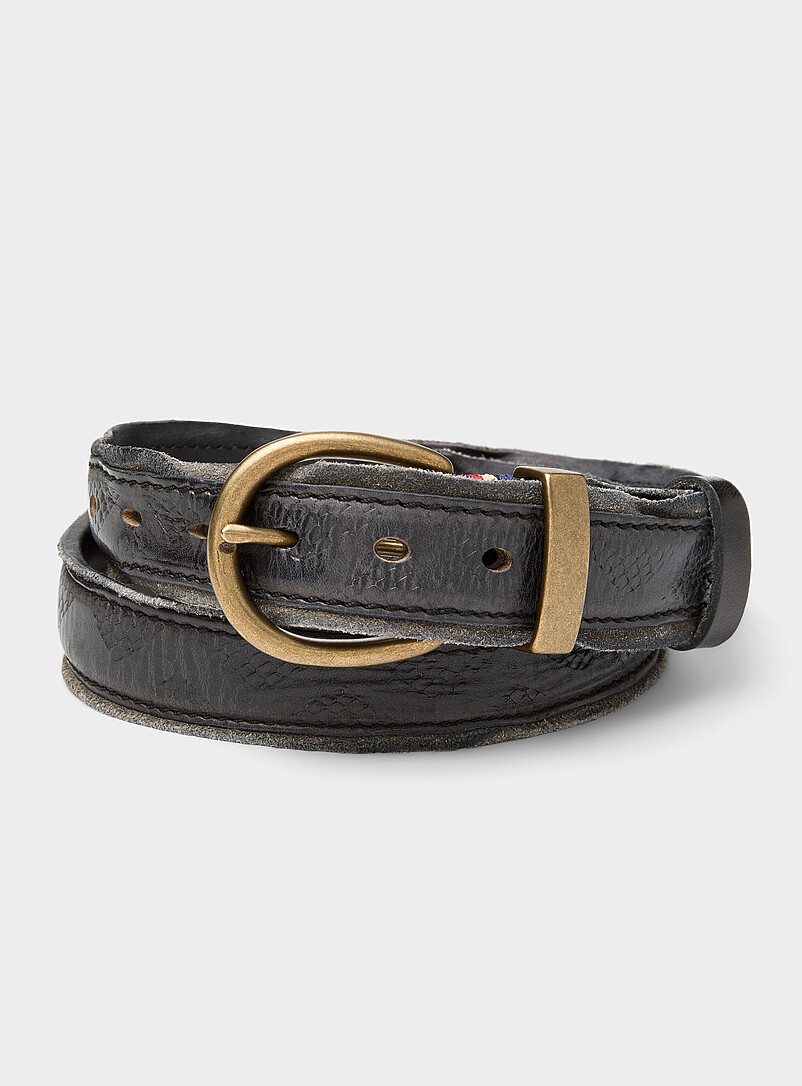
The Raw-Leather-Edge Belt from Le 31 by Simons is a genuine leather belt with a rounded metal buckle, designed for everyday use to secure trousers. It features a width of 35 mm and an exposed raw leather edge with stitched detailing. For optimal fit, the belt length corresponds to the labeled measurement, and it is recommended to select a size two inches larger than your pants size.
- Material
- Genuine leather with metal buckle
- Gender
- unisex
- Category
- Apparel & Accessories > Clothing Accessories > Belts
Color
Specifications
Genuine leather belt with rounded metal buckle and raw leather edge.
Genuine leather, rounded metal buckle, 35 mm width.
- Material
- Genuine leather with metal buckle
- Secondary
- metal
- Gender
- unisex
- Age Group
- adult
- Condition
- new
- Category
- Apparel & Accessories > Clothing Accessories > Belts
Additional Attributes
- genuine leather
- rounded metal buckle
- 35 mm width
- raw leather edge
- designed in Canada
Product Insights
Le 31's Raw-Leather-Edge Belt offers a 35 mm wide genuine leather belt that evolves with wear: the raw edge burnishes smooth, darkens with moisture, and molds to the wearer's hips over 2-3 weeks, reducing waist gap, while the light brown develops a honey-to-sienna patina or black shifts to a silvery semi-gloss. The rounded designer buckle sets it apart from generic hardware, and the belt fits jeans and dress trousers alike. At $99 CAD, it promises value comparable to $130–$150 belts. The main tradeoff: to prevent brittleness and build patina, beeswax conditioning every 3-6 months is required, and the belt can be shortened by a cobbler from the tail end, keeping the raw edge consistent.
Verified claims
- Patina
- Light Brown develops a honey-to-sienna gradient; Black shifts to a silvery semi-gloss patina.
- Edge evolution
- Raw edge burnishes smooth, forms a soft buckle roll, and darkens when wet; the leather molds to the wearer's hips over 2-3 weeks, reducing waist gap.
- Body heat molding
- Leather molds to hips under body heat, reducing waist gap after 2-3 weeks.
- Break-in
- The belt conforms to the wearer's hips over 2-3 weeks, and repeated bending at the buckle fold gradually creates a permanent soft roll instead of a sharp crease.
- Raw edge
- Raw edge burnishes to a smooth dark border, gradually darkens, and develops faint rippling from moisture.
- Maintenance
- Apply beeswax conditioner every 3-6 months to prevent brittleness and build patina.
- Value
- $99 CAD delivers a raw-edge, 35 mm belt with designer buckle and Canadian design, equaling $130–$150 belts.
- Longevity
- Raw edge enables faster break-in, shortening, and patina development with simple beeswax care.
- Buckle design
- Rounded metal buckle departs from generic flat-rectangle hardware.
- Width
- 35 mm width fits both jeans and dress trousers, replacing two belts.
- Leather grade
- This genuine leather belt's raw edge indicates a higher hide quality than the label suggests.
- Wear behavior
- Over weeks of wear, the leather conforms to the wearer's hips while the raw edge compresses into a smooth, dark border.
- Adjustability
- A cobbler can shorten this belt from the tail end; the cut edge remains raw.
- Moisture
- The raw edge darkens and swells when wet but dries naturally without compromising structure.
- Leather grade
- The manufacturer does not disclose a specific leather grade; the belt is identified only as genuine leather, which can encompass full-grain, top-grain, or split leather.
- Design origin
- The belt is designed in Canada, within a local design ethos that favors rugged, natural materials and weather-appropriate style.
- Stretch and fit stability
- The genuine leather relaxes and softens with body heat, but the 35 mm strap is sturdy enough that any length give stays minor and does not change your size or require sizing down.
Product record
- Title
- Raw-Leather-Edge Belt
- Brand
- Le 31
- Price
- 99 CAD
- Availability
- In stock
Buying Guide
1 comparison · 4 sourcesProduct comparison
Compared within this brand.
| Raw-Leather-Edge Belt: Choose this if you want a genuine leather casual belt with a distinct raw-edge look — it features an exposed lighter raw edge along both sides of the strap, stitched edges, and an oval metal buckle with an antiqued brass finish. The 35 mm strap comes in Black and Light Brown, in sizes 32 through 40, and Simons recommends sizing up two inches from your pants size for an optimal fit (for example, a size 34 belt for size 32 pants). Note that composition and care instructions are not provided on the product page.[1,2] | Textured Leather Belt Made In Canada: Choose this if you want a made-in-Canada casual belt in genuine Italian leather, offered in Black or Brown with a rounded metal buckle and a 30 mm width in sizes 30 through 42. Reviewers describe it as excellent quality, and the dark green-style color options are said to stand out subtly while pairing with both casual and dress outfits. Note that sizing feedback is mixed — one reviewer felt it runs small — so follow the retailer's advice to pick a size two inches larger than your pants size, consider sizing up if between sizes, and check the size chart carefully since Brown is not offered in size 34.[3] | Square Buckle Leather Belt: Choose this if you want a genuine leather, Canada-made casual belt with a distinctive square metal buckle and embossed logo; the 38 mm wide strap works with jeans or chinos, and reviewers praise its thick, durable construction and the patina it develops over time. Note that the stated size refers to the belt's total length, not your waist size, so follow the retailer's advice to order two inches larger than your pants size (and be aware some reviewers found sizing ran small despite this). It also arrives stiff and new-looking rather than matching the worn-in product photo, so plan for a break-in period.[4] |
Image Analysis
1 images- 01
Product
Coiled black leather belt with visible oval antiqued brass buckle, rectangular brass keeper, stitched edges and raw lighter edge showing. Three buckle holes visible on top layer and textured leather grain across the strap.
- Overall shapeBelt is shown coiled in a flat spiral with the buckle and strap end resting on top of the coil, presenting the front face of the strap and buckle.
1 region
x 0.08 · y 0.46 · w 0.84 · h 0.34 (high) - Buckle styleOval single-prong metal buckle with an antiqued brass finish, prong inserted through the top visible hole.
1 region
x 0.29 · y 0.50 · w 0.30 · h 0.20 (high) - KeeperRectangular fixed metal keeper in the same antiqued brass finish positioned to the right of the buckle.
1 region
x 0.56 · y 0.54 · w 0.10 · h 0.18 (high) - Strap materialBlack textured leather strap with visible grain and faint irregular surface pattern; strap shows slight sheen on raised grain.
1 region
x 0.10 · y 0.52 · w 0.80 · h 0.26 (high) - Raw edgeExposed raw edge along both sides of the strap that appears lighter grey compared with the black top surface.
1 region
x 0.10 · y 0.64 · w 0.80 · h 0.10 (high) - StitchingSingle line of black stitching running close to the strap edges visible along the top layer of the belt.
1 region
x 0.20 · y 0.50 · w 0.60 · h 0.12 (high) - Buckle holesAt least three round buckle holes visible on the top strap layer, one of which is occupied by the prong.
1 region
x 0.36 · y 0.52 · w 0.20 · h 0.12 (high) - Strap tipStrap end visible on the right with a squared rounded tip and a separate small dark loop to hold the tail.
1 region
x 0.74 · y 0.52 · w 0.16 · h 0.20 (high)
Other
Studio photograph with neutral light gray background, soft shadow below the belt, centered composition showing front-facing detail of buckle area.
- Background and surfaceEven light gray seamless background with a soft diffuse shadow below the belt indicating overhead studio lighting.
1 region
x 0.00 · y 0.00 · w 1.00 · h 1.00 (high) - Shot compositionLow-angle front view focused on the buckle and top coil of the belt, leaving negative space above the product.
- Image qualitySharp focus on belt details with even lighting and minimal glare; no visible packaging or props.
Colors
black· strap top surface#221D1Cantique brass· buckle and keeper#6A6563light grey· strap raw edge#9B9B9C- Overall shapeBelt is shown coiled in a flat spiral with the buckle and strap end resting on top of the coil, presenting the front face of the strap and buckle.
Variants
10 SKUs| SKU | Title | Price | Avail |
|---|---|---|---|
| 4681244 | Raw-Leather-Edge Belt - Black - 32 | CA$99.00 | Yes |
| 4681245 | Raw-Leather-Edge Belt - Black - 34 | CA$99.00 | Yes |
| 4681246 | Raw-Leather-Edge Belt - Black - 36 | CA$99.00 | Yes |
| 4681247 | Raw-Leather-Edge Belt - Black - 38 | CA$99.00 | Yes |
| 4681248 | Raw-Leather-Edge Belt - Black - 40 | CA$99.00 | Yes |
| 4681249 | Raw-Leather-Edge Belt - Light Brown - 32 | CA$99.00 | Yes |
| 4681250 | Raw-Leather-Edge Belt - Light Brown - 34 | CA$99.00 | Yes |
| 4681251 | Raw-Leather-Edge Belt - Light Brown - 36 | CA$99.00 | Yes |
| 4681252 | Raw-Leather-Edge Belt - Light Brown - 38 | CA$99.00 | Yes |
| 4681253 | Raw-Leather-Edge Belt - Light Brown - 40 | CA$99.00 | Yes |