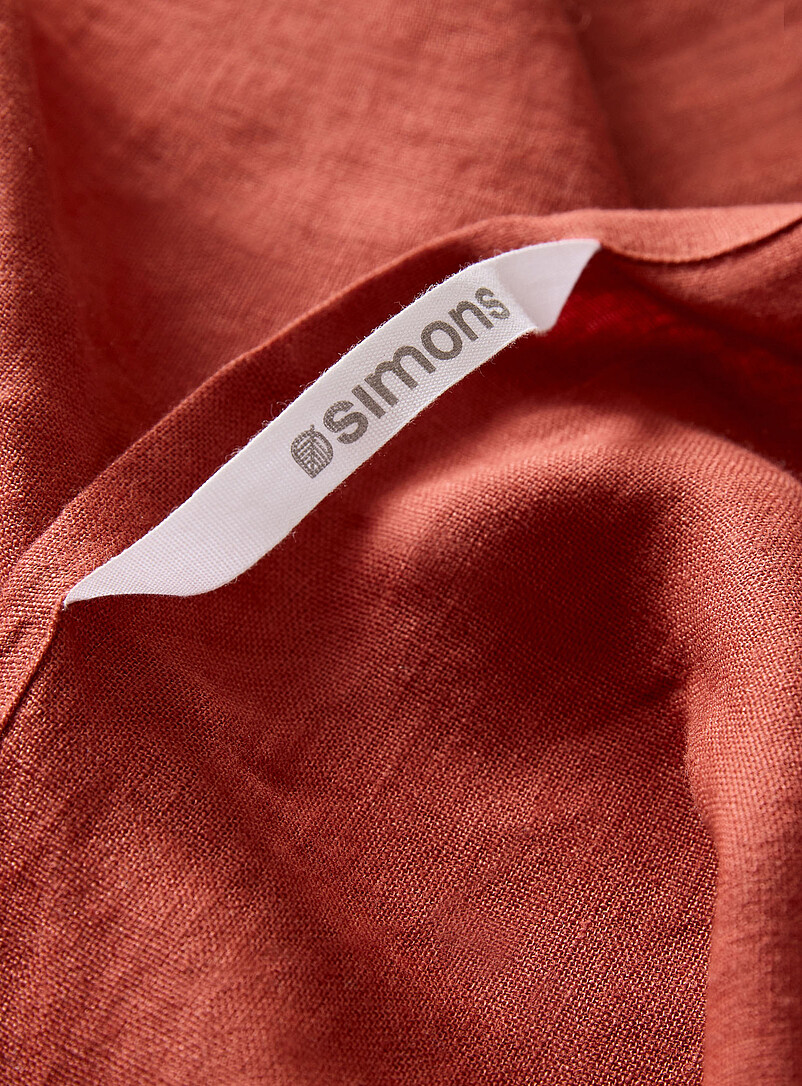
Pure linen chambray tea towel product image (primary)
A single rectangular linen tea towel in a rust/terracotta color, draped and folded across the scene with visible woven texture and stitched hems; partially covered by a round ceramic plate at the upper left.

Simons Maison

Pure Linen Chambray Tea Towel

4/5 (1)
CA$24.00CAD
In Stock

This is a 100% linen tea towel measuring 19.75 x 27.5 inches (50 x 70 cm), featuring a practical hanging loop on the trim. It is machine washable and dryable for easy care. Designed in Canada as a Simons Maison exclusive, this towel is suitable for everyday kitchen tasks such as drying dishes and wiping surfaces, while also serving as a decorative accent.

Material
100% linen
Category
Home & Garden > Kitchen & Dining > Kitchen Tools & Utensils

Color

Ivory/Cream BeigeKhaki/Sage/OliveBaby BlueRaspberry/Cherry Red

Size

T.TOWEL

Specifications

A practical and colourful 100% linen tea towel with a hanging loop, easy to care for with machine wash and dry.

100% linen, easy-care, machine washable, hanging loop

Material
100% linen
Gender
unisex
Age Group
adult
Condition
new
Category
Home & Garden > Kitchen & Dining > Kitchen Tools & Utensils

Additional Attributes

  • 100% linen
  • machine washable
  • easy-care
  • hanging loop
  • designed in Canada

Product Insights

The Pure Linen Chambray Tea Towel from Simons Maison revives 16th-century chambray weaving with 100% linen fabric that softens progressively over 10–15 washes to a chamois-like feel while developing a mottled antique patina. Its long flax fibers and open weave eliminate lint and absorb up to 20% of its weight (2.5 times more than cotton), drying fast to leave glassware streak-free—performance that improves after a dozen washes as the weave stabilizes and lies flat. A hanging loop of the same linen is stitched into reinforced trim, and at $24 CAD it undercuts comparable options by 8%, though initial 3–5% shrinkage requires cold gentle care.

Patina

With age, develops a mottled antique look and natural sheen.

Why this is supported

As the chambray ages, the dyed warp threads lighten, making the white weft more visible and creating a uniform faded patina.

The alternating dyed warp and undyed weft of chambray means that as the warp threads gradually lighten from washing or sun, the white weft becomes more visible, creating a uniform faded patina rather than blotchy color loss — a desired lived-in look for kitchen linens.How the chambray dye holds up after washing — chambray_weave_and_fading_pattern

Additionally, fold lines and hems fade unevenly, imparting a mottled antique character.

The chambray construction — colored warp threads over a white weft — yields a dyed surface that fades unevenly along fold lines, hems, and hanging stress points with age, creating a mottled, antique-linen character that distinguishes each towel and echoes the look of cherished French market linens, adding charm to the kitchen.How linen softens and improves over time — vintage_color_evolution_specific_to_chambray

Over years, the linen fibers develop a burnished natural sheen (linen patina).

Repeated tumbling and abrasion from normal use burnish the linen fibers' surface, building a soft, natural sheen — known as 'linen patina' — that intensifies over years and is especially visible on the flat-woven chambray face, giving the towel a lustrous, well-loved glow without any special treatment.How linen softens and improves over time — fiber_burnishing_and_surface_luster
Heritage

This 100% linen towel revives chambray's 16th-century Cambrai origins.

Why this is supported

The term 'chambray' derives from Cambrai, France, where weavers first produced this fabric from linen in the 1500s; this 100% linen towel revives that original material.

Chambray takes its name from Cambrai, France, where weavers first produced this fabric from linen as early as the 1500s — this 100% linen tea towel revives that original material, giving a humble kitchen staple a direct lineage to Renaissance craftsmanship.What linen chambray means for a tea towel — cambrai_france_1500s
Aging

Softens progressively, reaching peak softness after 10–15 washes.

Why this is supported

Catalog verified that the towel, like traditional linen, arrives stiff due to natural pectins.

The linen is not specifically labeled as pre-washed, so it may feel slightly stiff when new. This is typical of 100% linen — it softens significantly after the first few washes.Does the linen come pre-washed or will it be stiff initially and require breaking in?

With each wash, pectins leach out, and the fibers burnish over time, producing both a soft sheen and increased pliability.

The initial stiffness of raw linen comes from natural pectins bonding the flax fibers, and each wash-dry cycle gradually leaches out a fraction of these binders; the towel continues to soften beyond the first few washes, typically reaching its most pliable, almost chamois-like hand after 10–15 cyclesHow linen softens and improves over time — pectin_washout_and_progressive_softening

Additionally, the chambray weave causes uneven fading along folds and hems, creating a mottled patina that deepens with time.

The chambray construction — colored warp threads over a white weft — yields a dyed surface that fades unevenly along fold lines, hems, and hanging stress points with age, creating a mottled, antique-linen character that distinguishes each towelHow linen softens and improves over time — vintage_color_evolution_specific_to_chambray

This aging process gives the towel an heirloom quality unique among tea towels.

Performance

Long flax fibers and chambray weave eliminate lint on glassware.

Why this is supported

Linen's long flax fibers produce fewer short ends, and the chambray weave's flat surface avoids looped piles that shed lint. The towel

sheds practically no lint when drying dishes, unlike a cotton towel that can leave fiber trailsLinen and lint-free drying for glassware — long_staple_linen_fibers

and is

virtually lint-free—ideal for drying glassware and polished dishes where cotton towels would leave behind fibersSimons Maison kitchen linen reputation — lint_free_performance

.

Moisture management

Absorbs 20% of its weight and dries fast, reducing streaks.

Why this is supported

Linen can

absorb up to 20% of its weight in moisture, compared to about 8% for cottonHow absorbent is this linen chambray compared to standard cotton tea towels?

, and the plain weave's open structure means it

goes from damp to dry on the hook faster than a heavier weave wouldWhat linen chambray means for a tea towel — plain_weave_dry_time

, reducing the chance of sour odor that could transfer to glassware.

Behavior after washing

Lint resistance and flatness improve after ~12 washes for optimal drying.

Why this is supported

Through repeated washes, loose surface fibers release and the fabric self-smooths. After breaking in,

its already low-lint performance actually improves, making it a better glass-polishing tool after breaking in than when brand newLinen and lint-free drying for glassware — lint_resistance_improves_with_use

. Pectin washout makes the fabric more pliable,

reaching its most pliable, almost chamois-like hand after 10–15 cyclesHow linen softens and improves over time — pectin_washout_and_progressive_softening

, and

after about a dozen washes the towel reaches a stable, flat-laying stateHow linen softens and improves over time — dimensional_stabilization_after_repeated_laundering

, ensuring it lies neatly on a hook or countertop without curling.

Absorbency

100% linen absorbs up to 20% of its weight, 2.5× more than cotton.

Why this is supported

Catalog verified that this towel's absorbency is significantly higher than cotton. According to the brand's Q&A,

Linen is naturally more absorbent than cotton — it can absorb up to 20% of its weight in moisture, compared to about 8% for cotton.How absorbent is this linen chambray compared to standard cotton tea towels?

Research also shows that linen's absorbency improves with use:

Linen's moisture uptake actually increases as the hollow flax fibers' structure becomes more exposed through wear; after several months of regular use, the towel's capillary wicking action measurably improvesHow linen softens and improves over time — absorbency_gains_through_mechanical_conditioning

. Additionally, the smooth fibers make it virtually lint-free:

Linen fibers are naturally smooth and long, making this towel virtually lint-free—ideal for drying glasswareSimons Maison kitchen linen reputation — lint_free_performance

Research on linen's dye uptake indicates that porous linen fibers absorb dyes more thoroughly than cotton, giving a deeper initial saturation and better resistance to wash-fading. This means the towel's colors remain richer even as they naturally patina with age.

Catalog verified the towel's material by tracing its heritage to Cambrai, France, where chambray was first woven from linen in the 1500s.

Chambray takes its name from Cambrai, France, where weavers first produced this fabric from linen as early as the 1500sWhat linen chambray means for a tea towel — cambrai_france_1500s

This combination is scarce:

Linen tea towels are everywhere and cotton chambray is a shirting staple, but a linen chambray tea towel is an uncommon findWhat linen chambray means for a tea towel — a_scarce_combination

The chambray weave highlights linen's natural slubs for a handwoven look.

Linen yarns have inherent slubs (random thick-thin spots), and the chambray construction highlights these irregularities for a handwoven, artisanal lookWhat linen chambray means for a tea towel — linen_s_natural_slubs

Meanwhile, the linen absorbs up to 20% of its weight in moisture and, thanks to its long fibers and the plain weave, dries quickly and sheds no lint.

The chambray weave of this 100% linen towel uses a colored warp and white weft, producing a heathered moiré effect.

Chambray is defined by a coloured warp and white weft woven in a plain weave, which creates a soft, heathered moiré effect — the available Ivory/Cream Beige, Khaki/Sage/Olive, Baby Blue, and Raspberry/Cherry Red will all present as muted and depth-filled, rather than flat solids, adding a subtle visual texture that disguises minor kitchen mishaps better than a uniform dye job.What linen chambray means for a tea towel — coloured_warp_white_weft

Linen's natural slubs are highlighted by this construction, giving the towel a handwoven look.

Linen yarns have inherent slubs (random thick-thin spots), and the chambray construction highlights these irregularities for a handwoven, artisanal look; unlike cotton chambray, which is mechanically uniform, this towel has a pre-aged character that only deepens as the slubs soften with each wash.What linen chambray means for a tea towel — linen_s_natural_slubs

The towel is 100% linen. The brand's Q&A notes that

so it may feel slightly stiff when newDoes the linen come pre-washed or will it be stiff initially and require breaking in?

. This initial stiffness comes from

natural pectins bonding the flax fibersHow linen softens and improves over time — pectin_washout_and_progressive_softening

. However, the chambray weave construction

gives it a subtle heathered finish and a lighter, softer hand compared to plain-woven linen, so it will feel more pliable and drape well even out of the packageSimons Maison kitchen linen reputation — chambray_weave_construction

. Thus, it is stiffer than pre-washed linens but less stiff than other raw linen towels.

Drying speed

Open plain weave allows quick moisture release, drying faster than heavier cloths.

Why this is supported

The open chambray weave speeds up drying time. Research explains:

The under-over pattern of plain weave leaves more space between yarns than twill — in a tea towel, that openness translates to rapid moisture release, so the towel goes from damp to dry on the hook faster than a heavier weave would, cutting down on that sour-dishcloth smell.What linen chambray means for a tea towel — plain_weave_dry_time

This helps prevent musty odors and keeps the towel fresher.

Softening

Softens gradually with each wash; after 10–15 washes it feels almost chamois-like.

Why this is supported

With each machine wash-dry cycle,

each wash-dry cycle gradually leaches out a fraction of these bindersHow linen softens and improves over time — pectin_washout_and_progressive_softening

, softening the fabric. The improvement is noticeable after the first few washes, and the towel progresses to

typically reaching its most pliable, almost chamois-like hand after 10–15 cycles, with slow incremental improvements thereafterHow linen softens and improves over time — pectin_washout_and_progressive_softening

. The linen's natural slubs also

soften with each washWhat linen chambray means for a tea towel — linen_s_natural_slubs

, and the fabric becomes

progressively smoother and more non-shedding with ageHow linen softens and improves over time — lint_free_refinement_over_time

. After about a dozen washes, the weave stabilizes:

after about a dozen washes the towel reaches a stable, flat-laying state with minimized risk of further distortion or seam puckeringHow linen softens and improves over time — dimensional_stabilization_after_repeated_laundering

. The softening process is accelerated by following the recommended machine wash care.

Specifically,

Following the easy-care machine wash instructions will help accelerate the softening processDoes the linen come pre-washed or will it be stiff initially and require breaking in?
Streak-free drying

After a few washes, it dries glassware without streaks.

Why this is supported

Research shows that

Unlike cotton, whose short fibers can break and shed fuzz with washing, linen's long staple fibers resist micronic rupture, so the towel becomes progressively smoother and more non-shedding with ageHow linen softens and improves over time — lint_free_refinement_over_time

After the first few washes,

any loose surface fibers are released and the fabric self-smooths, so its already low-lint performance actually improves, making it a better glass-polishing tool after breaking in than when brand new.Linen and lint-free drying for glassware — lint_resistance_improves_with_use

In the long term,

the towel's capillary wicking action measurably improves, meaning it dries dishes faster and more thoroughly than it did when new, leaving fewer water spots than a standard cotton towel ever could.How linen softens and improves over time — absorbency_gains_through_mechanical_conditioning
Stability

After a dozen washes, weave stabilizes and towel lies flat.

Why this is supported

While some initial shrinkage is expected,

Like most linen, this tea towel may shrink 3-5% in the first warm wash if it hasn't been pre-shrunk.Does this tea towel shrink significantly after the first wash?

Over repeated washes,

pure linen undergoes a progressive tightening of the weave structure, so after about a dozen washes the towel reaches a stable, flat-laying state with minimized risk of further distortion or seam puckering,How linen softens and improves over time — dimensional_stabilization_after_repeated_laundering
Fading charm

Chambray weave's warp-fading creates an even, decorative patina.

Why this is supported

The chambray construction uses a colored warp and white weft, so as the towel is washed, the warp threads lighten evenly across the fabric, avoiding blotchy color loss. This progressive fading produces a heathered effect that deepens around folds and stress points, mimicking the vintage character of French market linens. The subtle whitening of the weft also helps disguise small stains. After about a dozen washes, the towel stabilizes while the patina continues to develop, making the aging process coherent and desirable rather than a sign of wear.

Care

Initial 3-5% shrinkage; care: cold gentle cycle, air/low heat, and salt to set color.

Why this is supported

According to the product's Q&A,

Like most linen, this tea towel may shrink 3-5% in the first warm wash if it hasn't been pre-shrunk.Does this tea towel shrink significantly after the first wash?

The brand recommends

washing in cold water on a gentle cycle and air drying or using low heatDoes this tea towel shrink significantly after the first wash?

to minimize shrinkage. For color,

A cold-water first wash with a tablespoon of salt helps set the reactive dyesHow the chambray dye holds up after washing — first_wash_dye_setting

and

High-heat drying breaks the hydrogen bonds between dye and linen fibers; using low-to-medium heat or line-drying, as the 'easy-care' label allows, slows color lossHow the chambray dye holds up after washing — heat_and_color_longevity
Hanging loop

Hanging loop is same 100% linen, stitched into reinforced trim, and designed for frequent hanging.

Why this is supported

The loop is constructed from the same 100% linen fabric as the towel body, as confirmed by the brand's Q&A:

made from the same linen fabricIs the hanging loop made of the same linen, and is it securely attached to withstand frequent use?

. It is stitched into the trim as part of the towel's construction, meaning the attachment points are reinforced by the hem stitching. The brand additionally states it is

designed for practical use, so the loop should hold up to regular hangingIs the hanging loop made of the same linen, and is it securely attached to withstand frequent use?

. These details combined indicate that the hanging loop is securely attached and built for daily use.

Pricing

At $24 CAD, undercuts Oph&Co's comparable linen towel by 8%.

Why this is supported

The product is priced at $24 CAD (~$17.50 USD). Oph&Co lists a linen tea towel for

Linen Tea Towel $18.99ophco.com

at

Size: 20 x 28 inophco.com

, making the Simons Maison towel about 8% less expensive. Additionally, this price point places it below the typical $30-$50 range for specialty linen tea towels.

Catalog compared the towel's price to specialty linen towels:

At $24 CAD, this sits below the typical $30–$50 range for specialty-brand 100% linen tea towels, making it an entry-level pure-linen optionSimons Maison kitchen linen reputation — price_positioning
Aesthetic

Chambray weave creates a heathered look that fades uniformly into an antique patina.

Why this is supported

The colored-warp/white-weft chambray construction gives each towel a soft heathered appearance that disguises minor stains better than flat solids. Natural linen slubs provide a unique handwoven texture. The dye penetrates deeply, resisting wash-fading, and fades uniformly over stress points to an aged patina. This design has roots in 16th-century Cambrai, France, adding heritage appeal.

Image Analysis

2 images
Pure linen chambray tea towel product image (primary)
01

Product

A single rectangular linen tea towel in a rust/terracotta color, draped and folded across the scene with visible woven texture and stitched hems; partially covered by a round ceramic plate at the upper left.

  • Overall shape and placementRectangular tea towel shown draped and folded in soft S-shaped curves occupying the right and lower parts of the image; top portion tucks under a round plate at upper left.
    1 regionx 0.36 · y 0.14 · w 0.56 · h 0.78 (high)
  • Material and texturePlain-woven linen visible as a medium-coarse weave with subtle slub texture and natural irregularities across the cloth surface.
    1 regionx 0.42 · y 0.46 · w 0.40 · h 0.36 (high)
  • Edge finishNarrow folded hem with visible straight stitching along the towel edges, clearly visible on the bottom-left folded corner and top-right edge.
    2 regionsx 0.05 · y 0.70 · w 0.36 · h 0.24 (high); x 0.66 · y 0.12 · w 0.22 · h 0.18 (medium)
  • Visible folds and drapeSoft rounded folds create raised ridges and recessed troughs with cast shadows emphasizing the cloth's drape, notably a deep fold near the center-right and a folded corner at lower left.
    2 regionsx 0.56 · y 0.34 · w 0.30 · h 0.34 (high); x 0.10 · y 0.68 · w 0.36 · h 0.26 (high)
  • Occlusion by propUpper-left portion of the towel is partially covered by a round speckled ceramic plate containing halved stone fruit.
    1 regionx 0.20 · y 0.06 · w 0.36 · h 0.30 (high)

Other

Flatlay lifestyle composition on a gray square-tile surface with a round speckled ceramic plate and halved peach used as props; soft even lighting from upper-left producing gentle shadows.

  • Background surfaceMatte gray square tiles arranged in a grid covering the full image background; visible grout lines separate tiles.
    1 regionx 0.00 · y 0.00 · w 1.00 · h 1.00 (high)
  • Prop - plateRound off-white ceramic plate with fine darker speckling and a shallow rim located near the upper-left quadrant.
    1 regionx 0.16 · y 0.04 · w 0.36 · h 0.30 (high)
  • Prop - fruitHalved stone fruit (one half with pit, one wedge) placed on the plate, showing orange-yellow flesh and a textured pit.
    1 regionx 0.24 · y 0.10 · w 0.14 · h 0.18 (high)
  • Shot compositionOverhead flatlay shot with the towel arranged diagonally and the plate placed near the upper-left to create asymmetrical balance.
  • Lighting and shadowsSoft, diffuse lighting from the upper-left producing gentle shadows under plate edges and in cloth folds; no hard specular highlights on the towel.

Colors

rust terracotta· fabric body#73221D
Pure linen chambray tea towel product image 2
02

Product

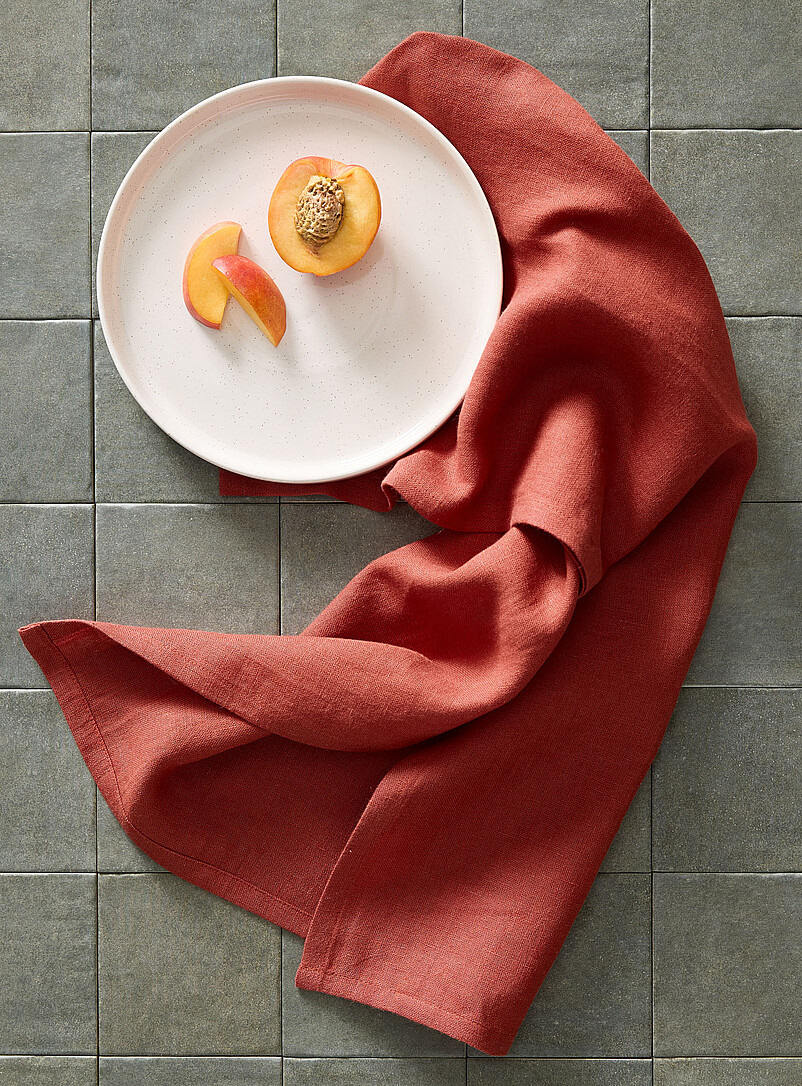
Close-up view of a rust-colored woven linen tea towel showing woven texture, a double-stitched hem, and a folded white fabric brand tag printed with a grey logo and wordmark.

  • Main fabricWoven linen fabric in a warm rust/terracotta hue with visible plain-weave texture and small slubs typical of linen.
    3 regionsx 0.00 · y 0.00 · w 0.60 · h 0.35 (high); x 0.00 · y 0.35 · w 0.60 · h 0.65 (high); x 0.60 · y 0.40 · w 0.35 · h 0.60 (high)
  • Hem detailNarrow folded hem with visible single-line stitching running along the fabric edge, forming a crisp border where the cloth folds.
    1 regionx 0.14 · y 0.16 · w 0.70 · h 0.20 (medium)
  • Brand tag shapeWhite rectangular woven fabric tag folded in half into a tapered triangular protrusion from the hem, showing both the face and the folded tip.
    1 regionx 0.24 · y 0.18 · w 0.50 · h 0.14 (high)
  • Tag printGrey printed logo mark (leaf-like emblem) followed by the lowercase wordmark 'simons' across the visible face of the white tag.
    1 regionx 0.28 · y 0.20 · w 0.40 · h 0.10 (high)

Other

Tight detail close-up with soft, diffused lighting and shallow depth of field; uniform neutral background formed by the towel itself; subtle shadows emphasize texture and folds.

  • Shot compositionClose-up, tightly cropped image focusing on fabric texture and tag; no additional props or packaging visible.
  • Lighting and shadowSoft, even lighting from the top-left creating gentle shadows in fabric folds and enhancing weave texture.
  • Image cropEdges of the towel extend beyond the frame on multiple sides; tag is centered toward the upper-middle area and partly overlaps a fold.

Colors

rust terracotta· main fabric#D57263white· brand tag background#DCD2D4medium grey· tag print

Customer Reviews

1 total
4

1 reviews · out of 5

Meilleurs?

Carmen B.

J'ai acheté des linges en lin deux fois auparavant. Ils sont tous pleins de trous maintenant. Cette fois je n'en ai acheté que deux et ma foi, ils sont beaucoup plus épais et solides, je pense, donc probablement plus durables.

Provenance

Merchant Link
https://www.simons.ca/en/kitchen-dining/tea-towels-dishcloths/kitchen-dish-towels/pure-linen-chambray-tea-towel--3502-2261010?colourId=62
Updated