Beams
Red Logo Tablespoon
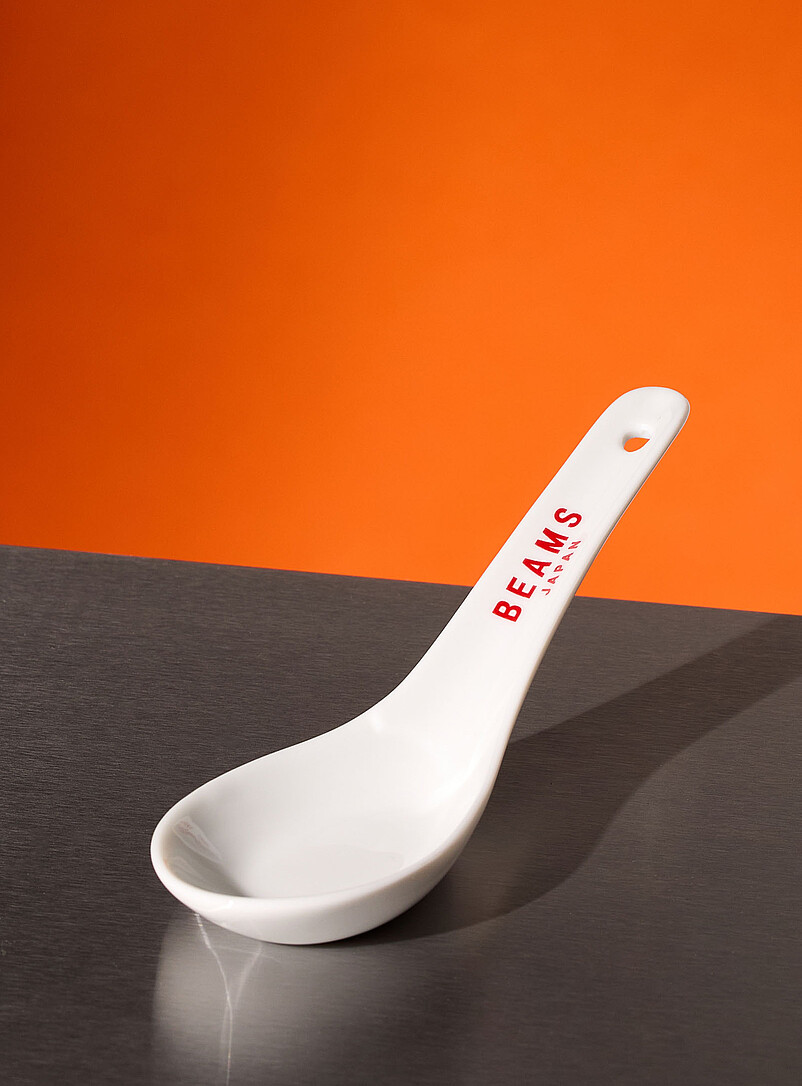
The Red Logo Tablespoon by BEAMS is a ceramic tablespoon intended for use with soups and other hot dishes. It has a glossy white ceramic body, a deep oval bowl, and a long handle featuring a red printed BEAMS logo and a hanging hole near the tip. The spoon is dishwasher safe, microwave safe, and made in Japan.
- Color
- Red
- Material
- Shiny ceramic
- Category
- Home & Garden > Kitchen & Dining > Kitchen Tools & Utensils
Specifications
A shiny ceramic tablespoon, perfect for soups, dishwasher and microwave safe, made in Japan.
Dishwasher and microwave safe. Shiny ceramic. Made in Japan.
- Color
- Red · red
- Material
- Shiny ceramic
- Condition
- new
- Category
- Home & Garden > Kitchen & Dining > Kitchen Tools & Utensils
Additional Attributes
- Shiny ceramic
- Dishwasher safe
- Microwave safe
- Made in Japan
Product Insights
Beams' Red Logo Tablespoon marries American style with Japanese precision in a high-fired, double-glazed ceramic spoon that stays cool to the touch while retaining soup heat, creating a flavor-neutral and weighty eating experience. Priced at 24 CAD, it competes with design brands like Hasami and Kinto, but demands careful handling: hand washing to preserve the printed red logo, pre-warming to prevent thermal shock, avoiding metal-rimmed containers in microwaves, and storing in soft-lined drawers to prevent chips. The tradeoff is a spoon that signals quality through heft and thermal performance, yet requires deliberate care to maintain its aesthetic and structural integrity.
Verified claims
- Design
- Beams' half-century blend of American style and Japanese precision in a spoon.
- Positioning
- 24 CAD positions it against Hasami and Kinto, not commodity setware.
- Logo durability
- The printed red logo may fade with repeated dishwasher use.
- Logo care
- Hand wash with soft sponge and mild detergent to preserve the logo.
- Eating experience
- Heavier than stainless steel, flavor-neutral, and stays cool—enhancing soup eating.
- Thermal performance
- Ceramic stays cool to the touch and retains soup heat without scalding.
- Ceramic process
- High-fired ceramic, double-glazed for a dense, glossy finish
- Safety
- Meets Japan's strict lead and cadmium limits and the inert glaze preserves food flavor
- Feel
- Ceramic stays cool in hot soup and its heft signals quality in hand
- Thermal shock
- Pre-warm spoon under warm water before using in boiling soup to prevent glaze cracks.
- Microwave care
- Avoid stirring in metal-rimmed containers or heating empty; this prevents glaze stress.
- Storage
- Store in a soft-lined drawer or utensil crock with separators to prevent chips and scratches.
- Dishwasher and microwave safety
- The Beams Red Logo Tablespoon is dishwasher and microwave safe.
- Spoon shape
- The Beams spoon is shaped as a Western utilitarian tablespoon rather than an Asian-style soup spoon.
Product record
- Title
- Red Logo Tablespoon
- Brand
- Beams
- Price
- 24 CAD
- Availability
- In stock
Buying Guide
0 comparisons · 1 sourceUses
Savouring hot, comforting soups
Beams describes this Red Logo Tablespoon as the perfect size for enjoying hot, comforting soups — a serving spoon for soup at the table.[1]
Image Analysis
2 images- 01
Product
A single white ceramic tablespoon photographed at an angle showing the bowl and the full length of the handle with a red vertical logo printed on the top side of the handle.
- Overall shapeOne-piece tablespoon with a deep, rounded oval bowl that tapers smoothly into a long, gently curved handle; the handle ends in a rounded tip with a single circular hole for hanging.
1 region
x 0.06 · y 0.56 · w 0.74 · h 0.36 (high) - Material and finishGlossy, non-porous white ceramic or porcelain surface with specular highlights visible on bowl and handle.
1 region
x 0.06 · y 0.56 · w 0.74 · h 0.36 (high) - Logo on handleRed vertical printed text in uppercase letters running along the handle's length.
1 region
x 0.60 · y 0.30 · w 0.26 · h 0.40 (high) - Handle holeRounded oval hole near the handle tip, centered close to the narrow end of the handle.
1 region
x 0.79 · y 0.18 · w 0.08 · h 0.07 (high) - Bowl interiorDeep concave interior with smooth curved walls and visible glossy reflection at the lower left interior surface.
1 region
x 0.06 · y 0.64 · w 0.36 · h 0.26 (high) - Printed small secondary textSmaller vertical text printed beneath the main logo along the handle.
1 region
x 0.66 · y 0.44 · w 0.10 · h 0.18 (medium) - Legible text: main“BEAMS”
1 region
x 0.62 · y 0.33 · w 0.18 · h 0.28 (high) - Legible text: secondary“JAPAN”
1 region
x 0.68 · y 0.46 · w 0.08 · h 0.14 (medium)
Other
Product photographed on a reflective metal surface with a bright orange vertical background; visible cast shadow and reflection of the spoon; even studio lighting with specular highlights.
- Background colorSolid bright orange vertical backdrop occupying the upper portion of the image.
1 region
x 0.00 · y 0.00 · w 1.00 · h 0.58 (high) - Supporting surfaceFlat metallic or brushed steel tabletop occupying lower portion of the image, showing the spoon's reflection.
1 region
x 0.00 · y 0.58 · w 1.00 · h 0.42 (high) - Cast shadow and reflectionSoft directional shadow cast to the right of the spoon and a faint reflection of the bowl visible on the metallic surface beneath it.
1 region
x 0.50 · y 0.66 · w 0.40 · h 0.30 (high) - Shot compositionThree-quarter angled close-up view with the handle pointing toward the upper right corner and the bowl toward the lower left.
Colors
gloss white· spoon body#F6F1EEbright red· handle printed logo#FC6E16- Overall shapeOne-piece tablespoon with a deep, rounded oval bowl that tapers smoothly into a long, gently curved handle; the handle ends in a rounded tip with a single circular hole for hanging.
- 02
Product
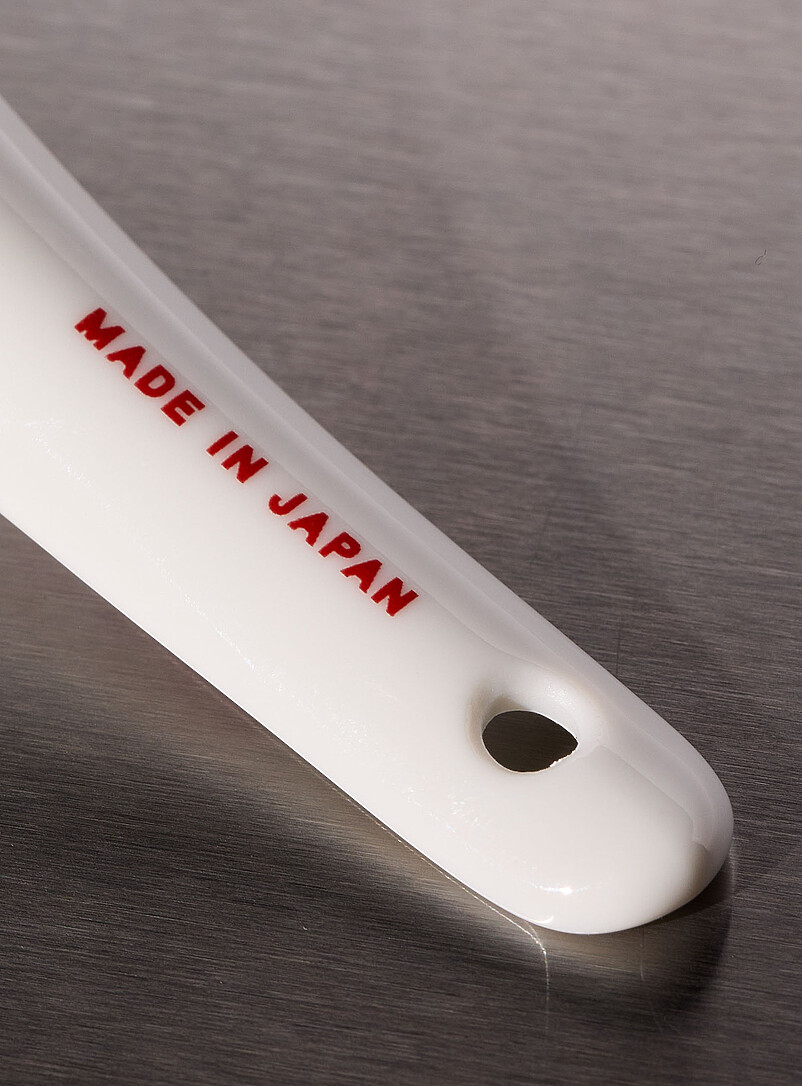
Close-up of the white plastic handle end of a tablespoon showing a rounded tip with a hanging hole, a faint central seam, glossy surface, and a red printed 'MADE IN JAPAN' legend along the shaft.
- Handle shapeTapered rounded handle end with a smooth, slightly upturned tip and integrated oval hanging hole close to the tip.
1 region
x 0.62 · y 0.60 · w 0.33 · h 0.33 (high) - Hanging hole detailSingle oval hole through the handle with slightly beveled inner edge visible, centered near the tip.
1 region
x 0.74 · y 0.64 · w 0.12 · h 0.14 (high) - Surface finishSmooth glossy plastic finish with specular highlights and small reflected streaks visible along the shaft and tip.
1 region
x 0.02 · y 0.46 · w 0.96 · h 0.44 (medium) - Mold seamFaint longitudinal seam line running along the center of the handle shaft, visible as a subtle raised ridge.
1 region
x 0.30 · y 0.18 · w 0.60 · h 0.70 (medium) - Printed textRed printed text on the upper face of the handle reading MADE IN JAPAN.
1 region
x 0.03 · y 0.26 · w 0.62 · h 0.22 (high) - Text transcription“MADE IN JAPAN”
1 region
x 0.03 · y 0.26 · w 0.62 · h 0.22 (high) - Visible portionOnly the handle portion of the utensil is visible in this image; the bowl or working end is out of frame.
Other
Product photographed on a brushed metal surface with directional lighting that creates soft reflections and a shadow; tight close-up crop focusing on the handle.
- Background surfaceBrushed metallic surface with horizontal grain visible across the image behind the handle.
1 region
x 0.00 · y 0.00 · w 1.00 · h 1.00 (high) - Shot compositionDiagonal close-up crop of the handle filling most of the frame, with the handle running from upper-left to lower-right.
- Lighting and reflectionsDirectional light from above-left producing specular highlights on the glossy handle and a faint reflected line on the metal surface below the tip.
- Image qualitySharp focus on the handle details with shallow depth of field; no visible people or props.
Colors
gloss white· handle body#F1EBE9bright red· printed text#8B0202- Handle shapeTapered rounded handle end with a smooth, slightly upturned tip and integrated oval hanging hole close to the tip.