Danica
Olive Wood Salt Spoon
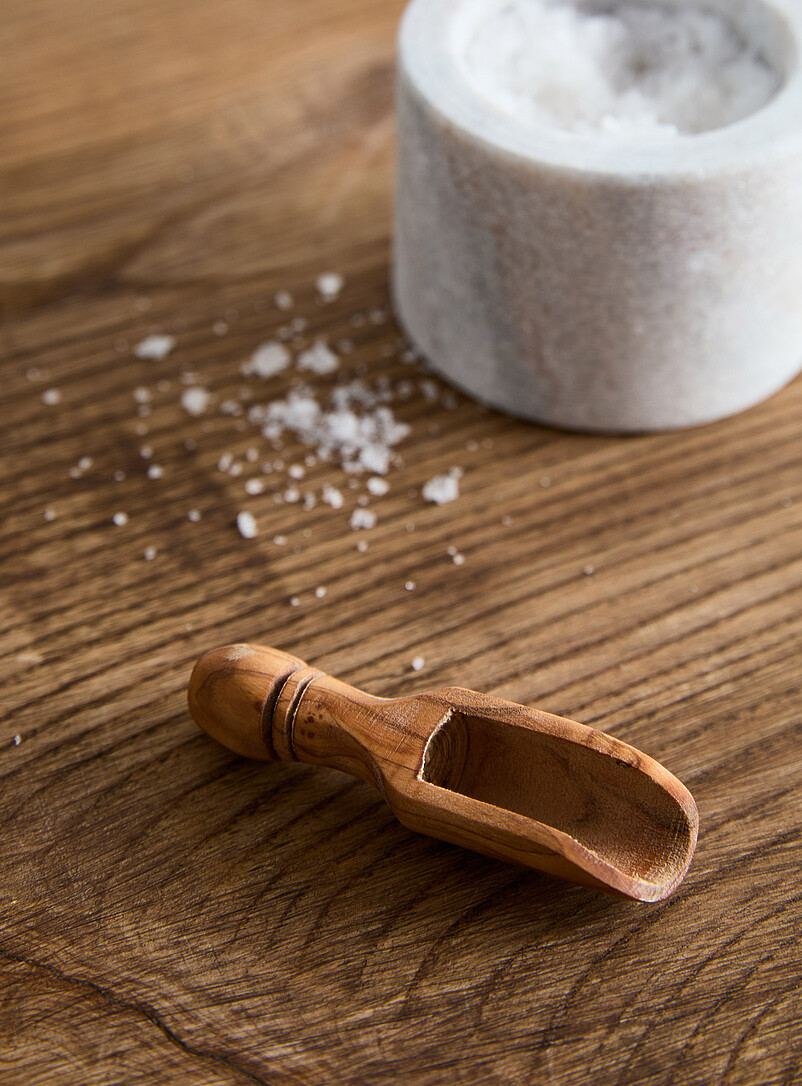
The Olive Wood Salt Spoon is a small hand-carved kitchen utensil crafted from genuine natural wood, designed for scooping and serving salt or other dry spices. It measures 2.75 inches (7 cm) in length and features a short turned handle with decorative rings and a shallow rectangular bowl that showcase the unique olive wood grain. Care instructions: hand wash only; do not immerse in water.
- Material
- Genuine natural wood
- Category
- Home & Garden > Kitchen & Dining > Kitchen Tools & Utensils > Measuring Cups & Spoons
Color
Size
Specifications
A simple and elegant salt spoon made from genuine olive wood.
Hand wash only; do not immerse. Measures 2.75 inches (7 cm) long.
- Material
- Genuine natural wood
- Gender
- unisex
- Age Group
- adult
- Condition
- new
- Category
- Home & Garden > Kitchen & Dining > Kitchen Tools & Utensils > Measuring Cups & Spoons
Additional Attributes
- simple
- elegant
- natural materials
- genuine natural wood
- hand wash only
- 2.75 inches long
Product Insights
The Danica Olive Wood Salt Spoon, at $15 CAD, offers a value 30% less than comparable spoons while providing a compact 2.75-inch, 1 mL bowl that fits salt cellars and measures ~0.25 tsp per scoop. Crafted from olive wood with a Janka hardness of 1390 lbf, it resists denting from coarse salt, moisture, odors, and won't scratch non-stick surfaces. However, the unsealed wood requires immediate conditioning with food-grade mineral oil before first use and monthly re-oiling, with new spoons needing 2-3 treatments in the first month and sanding with 240- and 400-grit to restore smoothness if roughened.
- Sizing
2.75 inches and 1 mL bowl match classic salt spoon dimensions
Why this is supported
Historical salt spoons are typically
They are usually about 2 to 3 inches (5 to 7.5 cm) long.
kids.kiddle.coand this spoon's 2.75 inches precisely fits that range. Its bowl holds
ensuring a controlled pinch. The spoon is compact enough to store directly inside a salt cellar, as salt spoons are designed as
a very small utensil used to serve salt from an open dish called a salt cellar.
kids.kiddle.co. Compared to typical olive wood spoons
Measuring approx 3.5″ in length
naturallymed.comthe Danica spoon is shorter and truer to the classical silhouette.
- Durability
Olive wood's 1390 lbf hardness resists dents from coarse salt
Why this is supported
Olive wood's Janka hardness rating confirms it is
Janka Hardness | 1390 lbf | Harder than cherry (995), softer than maple (1450)
asayasculpture.com, meaning the spoon resists dents from repeated salt scooping.
- Value
$15 CAD, roughly 30% less than a comparable olive wood spoon ($24)
Why this is supported
The Danica salt spoon is priced at $15 CAD, while a comparable olive wood salt measuring spoon from Olivarts is listed at
$22.00$24.00
olivarts.comCAD, making the Danica roughly 30% less expensive.
- Material
Olive wood (Janka 1390) resists denting, moisture, odors, and won't scratch non-stick.
Why this is supported
The Janka hardness rating is 1390 lbf (
Janka Hardness | 1390 lbf | Harder than cherry (995), softer than maple (1450)
asayasculpture.com), confirming dent resistance. The wood's natural density and low moisture content make it
Olive wood is naturally dense with a low moisture content, making it resistant to moisture absorption and bacterial growth
Will the wood absorb salt or moisture over time, potentially causing cracking or bacterial growth?. It also
naturally resistant to absorbing odors and stains, so using this spoon with pepper, spices, or other dry ingredients won't cause flavor transfer
Can this spoon be used with other dry ingredients like pepper or spices without flavor transfer?, and the smooth finish is
safe for use with non-stick cookware
Is the surface smooth enough to avoid scratching delicate bowls or non-stick coatings?.
The brand's Q&A explains that
it comes from the pruned branches and non-producing trees of olive orchards [1][2].
Is the wood sustainably sourced or certified (e.g., FSC)?and adds that
While it does not carry FSC certification, this sourcing practice is regenerative and waste-reducing.
Is the wood sustainably sourced or certified (e.g., FSC)?Together, these confirm the spoon is made from agricultural byproducts rather than felled trees.
- Care
No pre-applied oil; apply food-grade mineral oil before first use and monthly; sanding restores smoothness.
Why this is supported
The spoon is made of genuine natural olive wood with
no pre-applied oil or sealant. We recommend treating it with food-safe mineral oil before first use
Has the wood been treated with any oil or sealant, and if so, is it food-safe?. For new pieces,
oil it 2-3 times in the first month
oricrafts.combecause new pieces are thirstier.
Food-grade mineral oil is the gold standard for wooden spoon care. Unlike vegetable oils that turn rancid, mineral oil provides long-lasting protection, penetrates deep into wood grain, and maintains food safety.
asayasculpture.comTo check if oiling is needed,
Sprinkle a few drops of water on the surface: - If the water beads up → the wood's oils are in good shape, no need to oil yet - If the water absorbs immediately → it's time to oil
oricrafts.com. If the surface roughens,
Sand the surface with 240-grit sandpaper, always going in the direction of the grain (not across it). This smooths out the surface. Then progress to 400-grit for a fine finish. Rinse off the dust, let dry, and oil thoroughly.
oricrafts.com- Oiling
Unsealed; condition with food-grade mineral oil before use.
Why this is supported
Catalog verified that the spoon arrives without any pre-applied oil or sealant. New olive wood pieces are
thirstier than seasoned ones
oricrafts.comand the manufacturer recommends oiling 2–3 times in the first month. The only suitable oil is food-grade mineral oil—asayasculpture.com notes,
Unlike vegetable oils that turn rancid, mineral oil provides long-lasting protection, penetrates deep into wood grain, and maintains food safety.
asayasculpture.comAfter initial conditioning, a water bead test—sprinkle drops on the surface: if they absorb immediately, it is time to re-oil; if they bead, the wood is still protected—prevents over- or under-oiling.
- Resurfacing
Roughened surface can be renewed by sanding with 240- then 400-grit and re-oiling.
Why this is supported
If the spoon becomes roughened from repeated use, it can be restored by sanding:
This process renews the surface, unlike plastic or metal spoons.
- Portion control
Compact 2.75-inch spoon fits salt cellars and measures ~0.25 tsp per scoop.
Why this is supported
The Danica spoon is 2.75 inches long, which is shorter than typical olive wood spoons, measuring
Measuring approx 3.5″ in length
naturallymed.com. Traditional salt spoons are
usually about 2 to 3 inches (5 to 7.5 cm) long.
kids.kiddle.coIts capacity is
~1 mL
anzhucraft.comwhich corresponds to
about 0.25 of a teaspoon
kids.kiddle.coper scoop, and the compact size allows it to fit inside a standard salt cellar.
- Maintenance
New spoon needs 2-3 oil treatments in first month, then oiling every 4-6 weeks.
Why this is supported
The spoon arrives unsealed, with
no pre-applied oil or sealant
Has the wood been treated with any oil or sealant, and if so, is it food-safe?The manufacturer
recommend treating it with food-safe mineral oil before first use and periodically thereafter
Has the wood been treated with any oil or sealant, and if so, is it food-safe?. Artisans advise to
oil it 2-3 times in the first month
oricrafts.com. To monitor, a simple water test can be used:
If the water beads up → the wood's oils are in good shape, no need to oil yet - If the water absorbs immediately → it's time to oil
oricrafts.com.
Image Analysis
2 images- 01
Product
A small carved olive wood salt scoop with a short turned handle and a shallow rectangular bowl; visible wood grain and tool-carved interior surfaces.
- Overall shapeSingle-piece carved scoop with a shallow rectangular bowl section that tapers to a rounded outer end and a short cylindrical turned handle.
1 region
x 0.12 · y 0.66 · w 0.76 · h 0.24 (high) - Handle detailShort rounded handle with three shallow decorative ring grooves near the neck where it meets the bowl.
1 region
x 0.14 · y 0.68 · w 0.22 · h 0.18 (high) - Bowl interiorShallow hollowed interior with visible carving marks and a smooth but textured surface; inner corners are rounded.
1 region
x 0.44 · y 0.70 · w 0.40 · h 0.20 (high) - Wood grain and colorationDistinct olive wood grain with light to medium brown tones and darker streaks following the grain lines across the handle and bowl.
1 region
x 0.12 · y 0.66 · w 0.76 · h 0.24 (high) - Edge wear and tool marksSlightly darker, smoother wear along the rim of the bowl and small tooling irregularities visible at the carved edges.
1 region
x 0.56 · y 0.70 · w 0.30 · h 0.20 (medium)
Other
Product shot on a wood surface with a marble salt cellar and scattered coarse salt; soft directional lighting and shallow depth of field.
- Background surfaceHorizontal wooden tabletop with prominent linear grain running roughly left-right across the image.
1 region
x 0.00 · y 0.30 · w 0.98 · h 0.70 (high) - Salt cellarCylindrical light-colored marble or stone salt container visible near the top-right with coarse salt inside.
1 region
x 0.60 · y 0.05 · w 0.36 · h 0.36 (high) - Salt spillScattered coarse white salt crystals between the cellar and the spoon, some crystals in sharp focus and others blurred.
1 region
x 0.36 · y 0.26 · w 0.40 · h 0.22 (high) - Depth of fieldShallow depth of field with the spoon in focus and the salt cellar and distant background softened and slightly out of focus.
- Lighting and shadowSoft directional light from upper left creating gentle highlights on the spoon's upper surfaces and soft shadows below and to the right.
Colors
warm olive wood brown· spoon bodycoarse white· salt inside cellarPackaging#E5EAEDlight marble gray· salt cellar exteriorPackaging#D3D3D4- Overall shapeSingle-piece carved scoop with a shallow rectangular bowl section that tapers to a rounded outer end and a short cylindrical turned handle.
- 02
Product
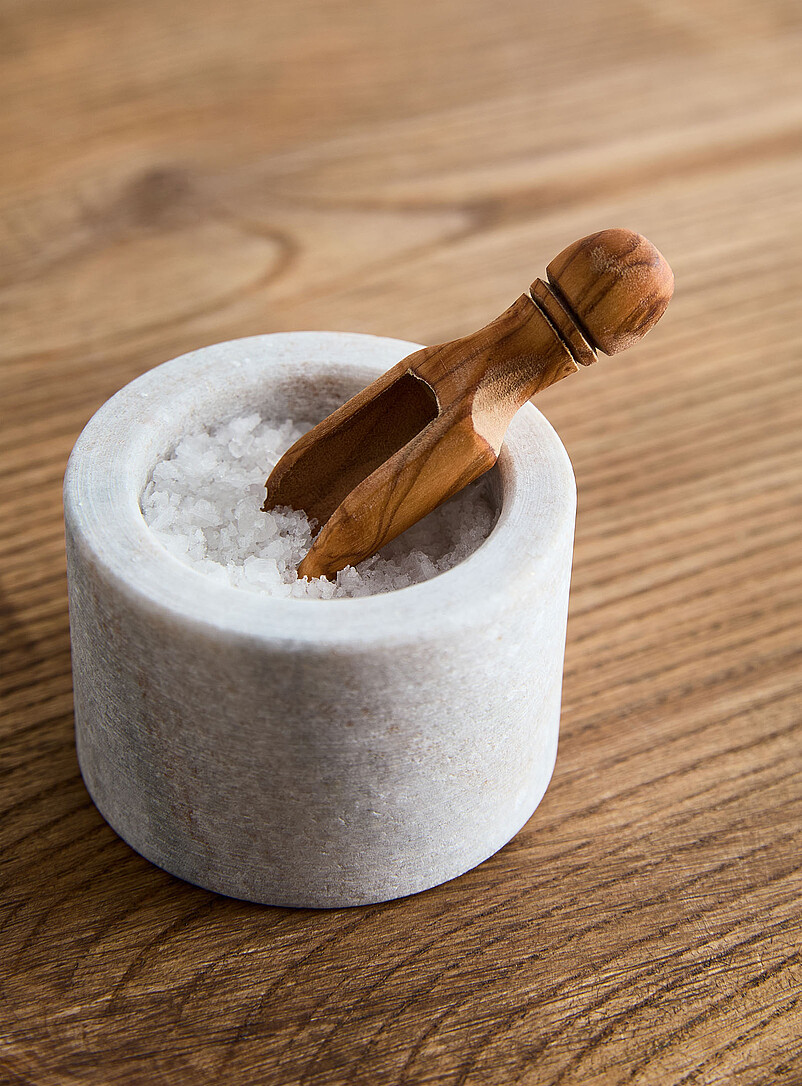
A small carved olive-wood salt scoop with a rounded knob handle is photographed resting inside a short cylindrical white stone salt cellar filled with coarse salt; the scoop is angled handle-up and partially inserted into the salt.
- Scoop overall shapeShort single-piece carved scoop with a rounded knob handle, a narrow neck, and a shallow rectangular bowl with squared sides and a scooping cut at the tip.
1 region
x 0.48 · y 0.12 · w 0.42 · h 0.45 (high) - Handle detailRounded spherical knob at the end of the handle with two shallow decorative rings carved near the neck.
1 region
x 0.78 · y 0.06 · w 0.18 · h 0.16 (high) - Wood grain and finishVisible olive-wood grain with alternating light and darker brown streaks and a smooth, satin polished surface.
1 region
x 0.54 · y 0.18 · w 0.36 · h 0.30 (high) - Scoop orientationScoop is angled with bowl inserted into the salt and handle resting above the rim toward the image top-right, showing interior of the bowl and cut edges.
- Salt residue on scoopSmall coarse white salt crystals adhere inside and around the tip of the scoop bowl.
1 region
x 0.42 · y 0.34 · w 0.20 · h 0.12 (high)
Other
Image shows the scoop inside a cylindrical stone salt cellar on a wood tabletop; soft natural lighting from upper-left creates gentle shadows and a shallow depth of field with the background wood surface blurred.
- Salt cellar geometryShort cylindrical white stone container with a wide circular opening and an inner cavity filled with coarse salt; exterior shows subtle surface texture.
1 region
x 0.08 · y 0.36 · w 0.60 · h 0.52 (high) - Coarse saltCoarse crystalline salt filling the cellar, visible as irregular white granules with some crystals piled higher along the scoop.
1 region
x 0.18 · y 0.38 · w 0.38 · h 0.28 (high) - Supporting surfaceFlat wooden tabletop with visible straight and wavy grain lines running approximately left-to-right, occupying the full background.
1 region
x 0.00 · y 0.40 · w 1.00 · h 0.60 (high) - Lighting and depth of fieldSoft directional light from upper-left producing gentle highlight on the knob and subtle shadowing under the cellar; background wood grain is progressively out of focus.
- Image crop and orientationVertical crop showing the cellar and scoop off-center toward lower-left and upper-right respectively; upper background area shows blurred wood surface.
Colors
warm olive brown· scoop body and handle#74431Bsalt white· salt crystals#E4EAECpale stone white· salt cellar exterior#E2E3E4- Scoop overall shapeShort single-piece carved scoop with a rounded knob handle, a narrow neck, and a shallow rectangular bowl with squared sides and a scooping cut at the tip.