Riedel
Ouverture White Wine Glasses Set Of 2
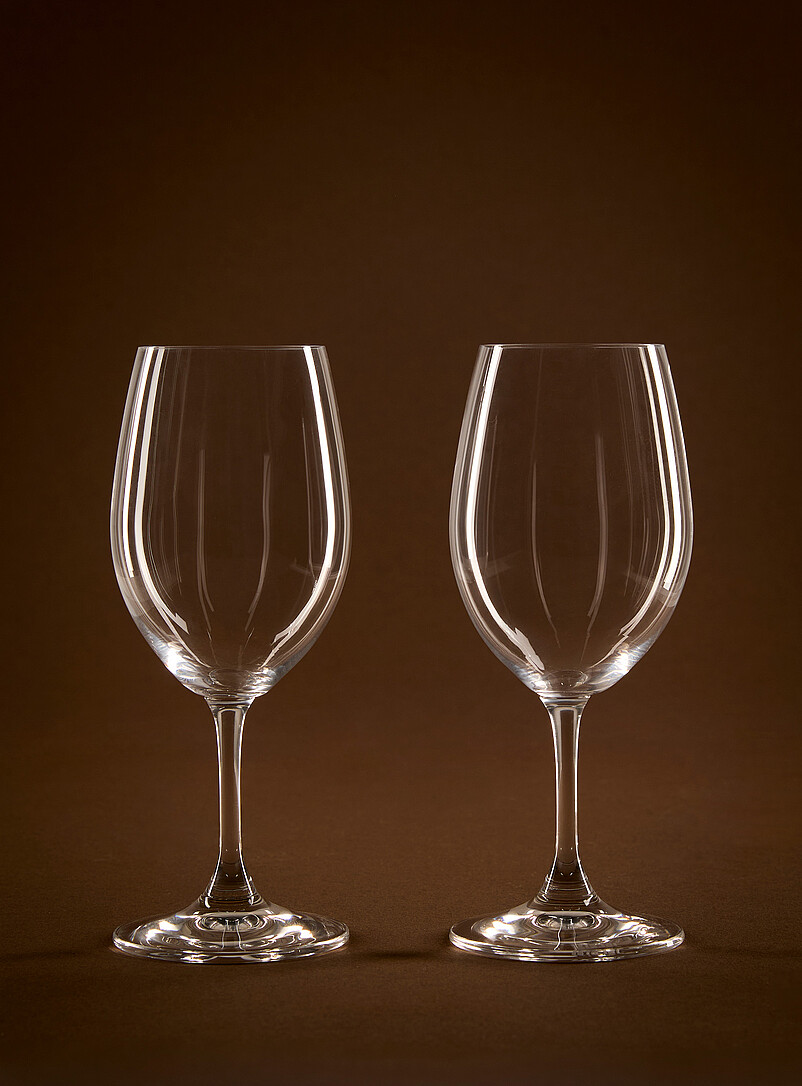
Riedel Ouverture white wine glasses, set of 2, are stemmed glasses made of pure crystal glass, crafted in Germany. Designed for white wine tasting, the bowl shape releases aroma and balances fruit and sugar in wine. Each glass has a 250 ml (8 oz.) fill capacity, measures 2 inches in diameter by 7.25 inches high, and is dishwasher safe.
- Material
- Pure crystal glass
- Category
- Home & Garden > Kitchen & Dining > Tableware > Drinkware > Stemware
Color
Size
Specifications
Set of two pure crystal white wine glasses by Riedel, crafted in Germany, with 250 ml capacity.
Dishwasher safe; 250 ml (8 oz.) fill capacity; enhances aroma and balances fruit and sugar.
- Material
- Pure crystal glass
- Gender
- unisex
- Age Group
- adult
- Condition
- new
- Dimensions
- 2x2x7.25 in
- Category
- Home & Garden > Kitchen & Dining > Tableware > Drinkware > Stemware
Additional Attributes
- Dishwasher safe
- Crafted in Germany
- 250 ml (8 oz.) fill capacity
- Pure crystal glass
- Set of 2
Product Insights
Riedel's Ouverture White Wine Glasses offer an entry into the brand's 260-year glassmaking legacy with machine-made, lead-free crystal from Bavaria, designed as a universal white wine glass with a tapered bowl for all white styles. At $45 for two, they provide thin walls and fine rim for clarity and a clear ringing tone, but this thinness reduces chip resistance and requires careful handling; while dishwasher safe with a softened water setting, hand washing is recommended, and any limescale clouding can be removed with vinegar.
Verified claims
- Dishwasher care
- Set the dishwasher's water softener to 3–4°dH to prevent glass corrosion.
- Safety
- DIN EN certified dishwasher safe, but hand washing recommended.
- Aesthetics
- Lighter than leaded crystal with identical clarity.
- Universal design
- Universal white wine glass with tapered bowl works for all white wine styles.
- Heritage
- Machine-made in Bavaria, the Ouverture carries Riedel's 260-year glassmaking legacy into an entry-level line.
- Shape
- Designed as a universal white wine glass for Chardonnay, Sauvignon Blanc, Riesling, and other whites.
- Provenance
- Machine-blown in Bavaria; stamped Riedel trademark confirms authenticity.
- Crystal quality
- Lead-free crystal glass with thin walls, fine rim, and clear ringing tone.
- Value
- 45 CAD for two Riedel crystal glasses, far less than hand-blown.
- Design versatility
- Universal white wine glass suits any varietal.
- Durability
- Thin crystal walls and fine rim provide superior clarity but reduce chip resistance.
- Clouding
- Clouding from limescale or detergent deposits can be removed with a vinegar soak.
- Stamped RIEDEL mark
- Stamped RIEDEL on base identifies machine-made tier and authenticity.
Product record
- Title
- Ouverture White Wine Glasses Set Of 2
- Brand
- Riedel
- Price
- 45 CAD
- Availability
- In stock
Deep Research
How the Ouverture compares to other entry-level crystal glasses
- Riedel has been producing crystal since 1756 and pioneered varietal-specific wine glass design in 1961, and the Ouverture line distills that expertise into a machine-made, lead-free glass that costs a fraction of the brand's hand-blown series, making it a low-risk entry into the Riedel ecosystem with a genuine piece of that history.
- Brand-level comparisons show that Schott Zwiesel's Tritan crystal emphasizes high resistance to chipping and breakage, while Riedel — across both hand- and machine-blown lines — is prized for exceptional brilliance and a more delicate aesthetic; the Ouverture inherits that Riedel emphasis on visual appeal, making it the choice for buyers who value crystal clarity and design over maximum impact resistance.
Dishwasher proofing standard and long-term care strategies
- Riedel recommends rinsing the glasses immediately after use so that no beverage or wine residues dry on the surface, because dried-on residues alter the rinsing liquid composition in the dishwasher and compromise wash quality, indirectly contributing to surface damage over time.
- Washing these glasses together with aluminum utensils (like garlic presses or pots with aluminum handles) triggers a chemical reaction that leads to glass corrosion within a very short time — making it one of the fastest ways to permanently damage the crystal.
- Riedel specifies that dishwasher water should be softened to 3–4° German hardness (°dH) when washing these glasses, because excessively soft water attacks the glass surface and accelerates corrosion — matching the water softener to your household hardness is the single most actionable step to prevent irreversible clouding.
- After a dishwasher cycle, Riedel advises opening the door to let moisture evaporate, because trapped steam can attack the crystal surface and increase glass corrosion — a small habit that preserves the glass's brilliance between washes.
- For hand-drying, Riedel specifies two microfiber polishing cloths rather than a tea towel, because tea towels can scratch the crystal surface; their branded cloths are designed to dry lint-free and should be washed at 60°C without fabric softener to avoid a greasy film transferring onto the glass.
- Although the EN 12875-1 test runs at 60°C wash and 65°C rinse, Riedel's care guide recommends selecting a low temperature program (50–55°C) or a special glass program for everyday use — so the glass is engineered to survive higher test temperatures, but gentler cycles extend its optical clarity over time.
- Not all clouding is permanent: deposits from limescale or detergent residues can be removed by soaking in citric acid or white vinegar, whereas true glass corrosion — where components are washed out of the glass structure — is irreversible, so identifying the type of haze directly determines whether the glasses can be restored to clarity.
The Ouverture series and its place in Riedel's range
- Riedel introduced the Ouverture collection in 1989 as an uncomplicated, beginner-focused series for everyday wine enjoyment—unlike the company's varietal-specific lines, Ouverture was built for value and ease, making it the entry point for new Riedel buyers who want the shape advantage without the investment in a specialized set.
- The Ouverture White Wine glass reflects the line's original core of just three shapes—a red wine glass, a larger red wine glass, and a single white wine glass—giving buyers a straightforward, all-purpose option for any white variety rather than the dozen-plus varietal-specific glasses found in Riedel's Vinum line.
How machine-blown crystal affects quality and consistency
- Made from lead-free crystal, the glass matches the brilliance and clarity of traditional lead crystal while avoiding the added weight and potential health concerns — and its non-porous surface resists the etching that can dull leaded crystal after repeated dishwasher cycles.
- As a machine-made Riedel glass, the Ouverture’s base carries a stamped (rather than hand-engraved) RIEDEL trademark — a detail that immediately distinguishes it from the brand’s hand-blown Sommeliers and Superleggero lines, yet still serves as the same mark of authenticity that dates back to the Art Nouveau period.
- Blown by machine in Riedel’s Bavarian facility — a glassmaking hub for over 270 years — the Ouverture channels the company’s multi-generational expertise into a uniform, lightweight design that feels more polished than typical restaurant-supply stemware, while costing far less than a hand-blown Riedel glass.
- The Ouverture is factory-rated dishwasher-proof to the European standard DIN EN 12857-1/2:2005, meaning it has been tested to survive repeated commercial-grade dishwasher cycles without clouding or structural compromise — a practical assurance for anyone who prioritizes low-maintenance stemware.
What 'lead-free crystal' actually means for your wine
- Because the mineral substitutes used in lead-free crystal are less dense than lead, the Ouverture glass weighs less than a comparable leaded stem — a difference that becomes meaningful when holding multiple glasses through a tasting or a long meal.
- The density and elasticity of lead-free crystal produce a clear, sustained ring when the rim is tapped — a sonorous quality that enthusiasts use as a quick gauge of crystal quality and that adds a small, pleasing note to the ritual of pouring.
- Because lead-free crystal is often dishwasher safe while leaded crystal tends to dull in the machine, the Ouverture set can be cleaned on a gentle cycle without the immediate clouding that plagues traditional crystal — a practical advantage for those who prioritize convenience over hand washing.
- Wine’s natural acidity (pH 3–4) can leach lead from traditional crystal in minutes; choosing lead-free crystal eliminates this risk entirely, which is why many wine professionals and health-conscious consumers have shifted to glasses like the Ouverture for daily use.
- Lead-free crystal’s mineral structure permits walls that are thinner than soda-lime glass can achieve — on the Ouverture, this translates to a rim that sits almost unnoticed on the lips, so the path from glass to palate feels seamless.
- Modern lead-free crystal formulations are virtually indistinguishable from traditional leaded crystal in clarity and brilliance, so the Ouverture glass renders the wine’s color and legs with the same high-definition sparkle that premium leaded stemware is prized for.
Image Analysis
2 images- 01
Product
A pair of clear stemmed wine glasses shown full-height, each with a rounded bowl, slender stem, and circular flat base; both are transparent with bright linear highlights from studio lighting.
- Pair arrangementTwo identical stemmed wine glasses standing side by side on a flat surface, separated by a small gap and aligned so bases sit on the same horizontal plane.
1 region
x 0.12 · y 0.18 · w 0.76 · h 0.68 (high) - Bowl geometryEach glass has an ovate/rounded bowl that tapers slightly inward toward a thin, even rim; the bowls are vertically elongated with a smooth continuous profile.
2 regions
x 0.14 · y 0.20 · w 0.30 · h 0.48 (high); x 0.56 · y 0.20 · w 0.30 · h 0.48 (high) - Rim detailThin uniform circular rims with clear edge visible against the background; rims appear level and free of chips in the visible view.
2 regions
x 0.14 · y 0.20 · w 0.30 · h 0.04 (high); x 0.56 · y 0.20 · w 0.30 · h 0.04 (high) - Stem constructionEach glass has a straight, slender stem that connects the bowl to the base with a smooth transition at the junctions.
2 regions
x 0.24 · y 0.52 · w 0.10 · h 0.28 (high); x 0.66 · y 0.52 · w 0.10 · h 0.28 (high) - Base shapeFlat circular bases with a slightly raised central punt area and concentric light reflections visible on each base.
2 regions
x 0.18 · y 0.76 · w 0.20 · h 0.14 (high); x 0.62 · y 0.76 · w 0.20 · h 0.14 (high) - Glass material and finishTransparent, clear glass with smooth, glossy finish producing sharp linear highlights and soft internal reflections.
- Studio highlightsBright vertical linear specular highlights run along the outer curves of each bowl and along the stem, indicating directional studio lighting from both sides.
2 regions
x 0.12 · y 0.18 · w 0.36 · h 0.60 (high); x 0.52 · y 0.18 · w 0.36 · h 0.60 (high)
Other
Studio product shot on a warm brown backdrop with even frontal lighting that creates soft shadows beneath the bases and clear specular highlights on the glass surfaces.
- BackgroundUniform warm brown backdrop and tabletop surface with no visible texture or graphics.
1 region
x 0.00 · y 0.00 · w 1.00 · h 1.00 (high) - ShadowsSoft, short shadowing cast directly beneath and slightly outward from each base, consistent across the pair.
2 regions
x 0.16 · y 0.86 · w 0.24 · h 0.06 (high); x 0.60 · y 0.86 · w 0.24 · h 0.06 (high) - CompositionCentered composition with both glasses vertically framed in full; image shows a front-facing view of the glasses.
- Image qualitySharp focus on the glasses with high clarity of edges and reflections; even exposure without blown highlights.
Colors
bright white highlights· glass highlightsvery light gray· glass body- Pair arrangementTwo identical stemmed wine glasses standing side by side on a flat surface, separated by a small gap and aligned so bases sit on the same horizontal plane.
- 02
Product
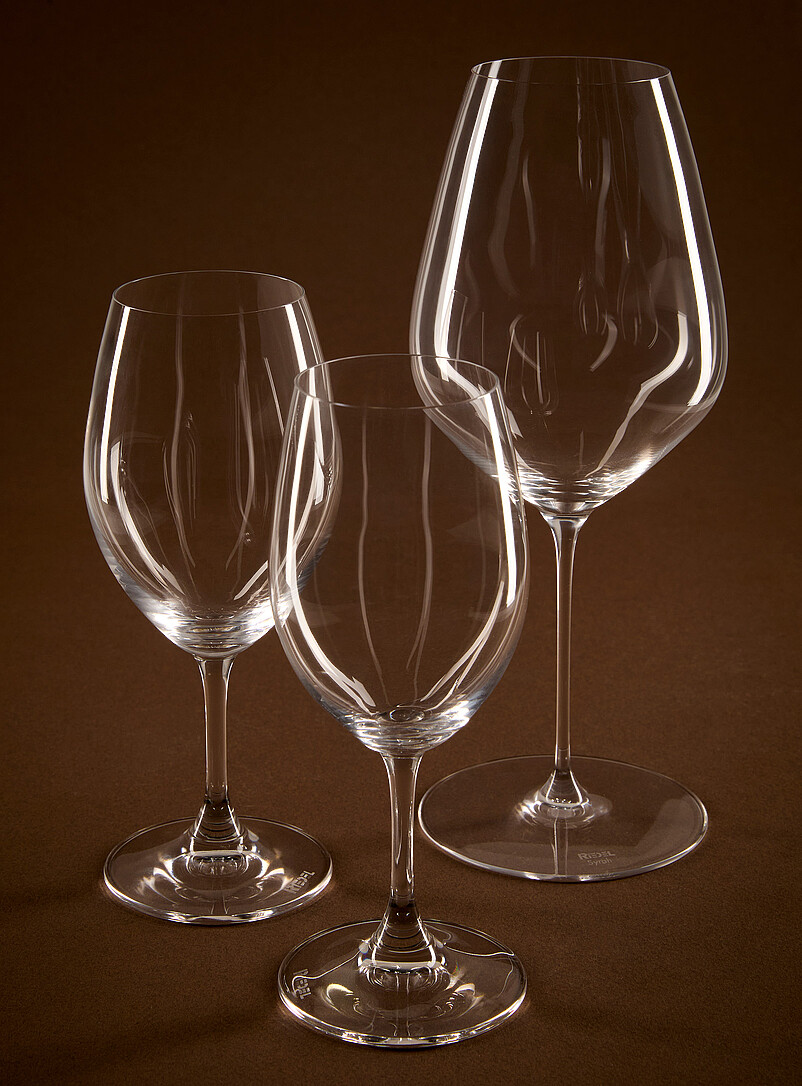
Three clear stemmed wine glasses shown upright; each has a large tapered bowl, a slender stem, and a round flat foot. Strong studio highlights and reflections are visible on the glass surfaces.
- Overall geometryEach item is a stemmed wine glass composed of an ovoid bowl that tapers slightly toward the rim, a slender straight stem, and a circular flat foot; one glass at right is noticeably larger in bowl volume than the other two.
- Right glass bowlTall, elongated ovoid bowl with a narrow rim and a pronounced curve to a deep belly; bowl is taller than the others and sits on a long thin stem.
1 region
x 0.56 · y 0.03 · w 0.38 · h 0.63 (high) - Center glass bowlMedium-height ovoid bowl with a gently rounded belly and slightly narrower profile than the right glass; rim visible near image top center.
1 region
x 0.27 · y 0.22 · w 0.34 · h 0.46 (high) - Left glass bowlShorter ovoid bowl compared with the center and right glasses; rim appears lower in the frame and bowl meets stem at a rounded base.
1 region
x 0.06 · y 0.20 · w 0.30 · h 0.48 (high) - StemsAll three stems are straight, narrow, and transparent with smooth cylindrical profiles and visible transitional knop where stem meets foot.
3 regions
x 0.13 · y 0.54 · w 0.22 · h 0.38 (high); x 0.36 · y 0.58 · w 0.16 · h 0.33 (high); x 0.66 · y 0.52 · w 0.18 · h 0.44 (high) - Feet (bases)Round flat feet with beveled inner rings; reflections and slight embossed markings appear on the foot surfaces.
3 regions
x 0.11 · y 0.75 · w 0.22 · h 0.18 (high); x 0.36 · y 0.80 · w 0.20 · h 0.14 (high); x 0.62 · y 0.72 · w 0.30 · h 0.22 (high) - Foot marking, right base“RIEDEL”
1 region
x 0.72 · y 0.82 · w 0.14 · h 0.08 (medium) - Foot marking, left base“RIEDEL”Partial
1 region
x 0.12 · y 0.86 · w 0.16 · h 0.06 (low) - Surface reflectionsStrong vertical studio highlights and softer curved reflections from lighting fixtures appear across bowls and stems, emphasizing transparency and curvature.
1 region
x 0.20 · y 0.05 · w 0.60 · h 0.85 (high)
Other
Studio product shot on a warm brown background with directional lighting producing distinct reflections and soft shadows beneath each glass. Image is vertically oriented and tightly framed on the group of glasses.
- Background and surfaceSingle-tone warm brown backdrop and flat surface with even texture; no packaging or props visible.
1 region
x 0.00 · y 0.00 · w 1.00 · h 1.00 (high) - Lighting and shadowsDirectional studio lighting from upper left produces vertical highlights on glass and soft shadows beneath and slightly to the right of each foot.
1 region
x 0.00 · y 0.00 · w 1.00 · h 1.00 (high) - Shot compositionThree-glass arrangement with two smaller glasses in front-left and center and one larger glass to the right and rear; image cropped closely so tops of some bowls nearly reach image top.
1 region
x 0.00 · y 0.00 · w 1.00 · h 1.00 (high) - Image qualitySharp, high-resolution studio image with clear glass detail and visible specular highlights; no motion blur.
1 region
x 0.00 · y 0.00 · w 1.00 · h 1.00 (high)
Colors
clear/transparent· glass#53321C
Documents & Data
Customer Reviews
1 total1 reviews · out of 5
Riedel
Le pied est court pour un verre de vin blanc. Plutôt pour rosé pétillant !
Q&A
5 answered- What is the specific shape of the glass (e.g., tulip, flute, or a proprietary design) and how does it enhance white wine aromas?
- The Ouverture White Wine glass features a classic, slightly tapered bowl — not a specific proprietary shape — designed to concentrate aromas at the rim and direct the wine to the front of the palate, balancing fruit and sweetness for structure [1].
- How thick is the crystal and how resistant is it to chipping or breaking during normal use?
- The exact thickness isn't published, but this machine-made crystal is thin-walled, similar to other entry-level Riedel glasses. It's dishwasher safe and resistant to normal use, but like all glassware, it can chip if knocked hard.
- Is the crystal lead-free, and where exactly in Germany is it manufactured?
- Yes, the crystal is lead-free [1]. It is machine-made in Bavaria, Germany [2].
- Which specific styles of white wine (e.g., Chardonnay, Sauvignon Blanc, Riesling) is this glass designed to enhance?
- This glass is designed as a universal white wine glass, not specific to any one varietal. It works well for a wide range including Chardonnay, Sauvignon Blanc, Riesling, and other white wines [1].
- The glass is labeled dishwasher safe, but does the crystal become cloudy or etched after repeated dishwasher cycles?
- While these glasses are labeled dishwasher safe, repeated cycles with harsh detergents may eventually cause cloudiness or etching. Riedel recommends hand washing to preserve the crystal's clarity [1].