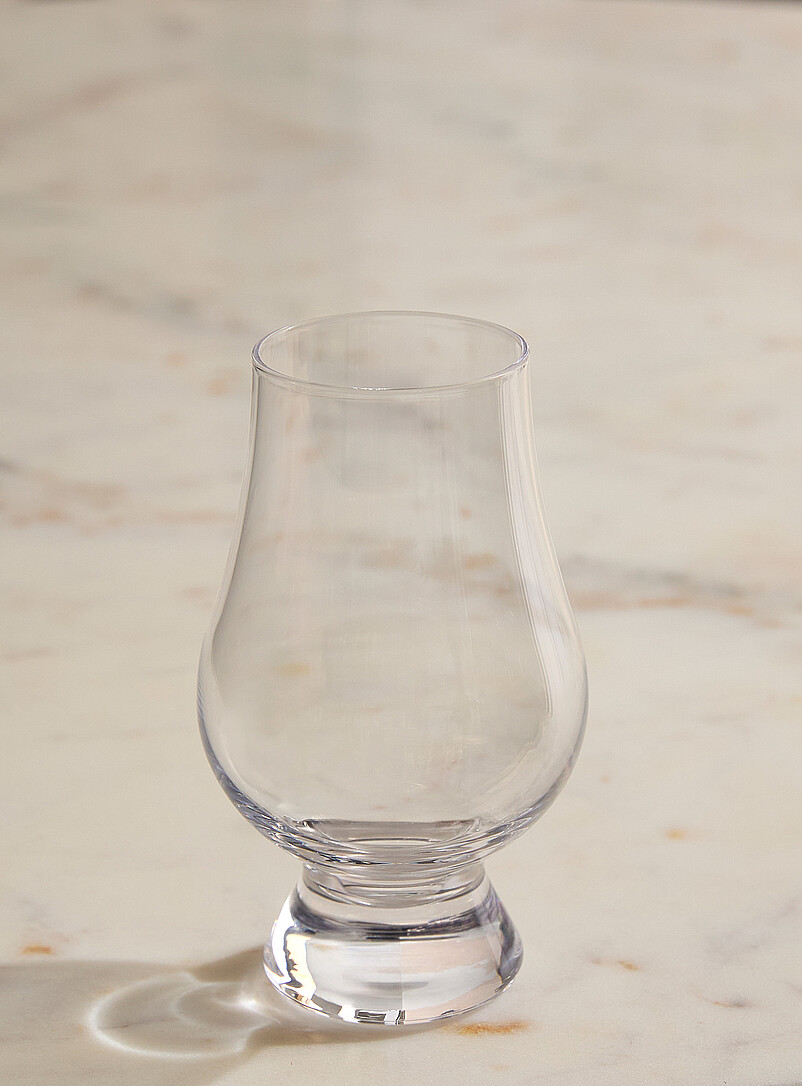
Glencairn
Glencairn Small Whiskey Glass
The Glencairn Small Whiskey Glass is a tulip-shaped, lead-free crystal glass designed for whisky and whiskey tasting, featuring a tapered rim to concentrate aromas for nosing. It measures 1.75 inches (4.5 cm) in diameter and 4.75 inches (12 cm) tall, and requires hand-washing only. Widely recognized as the first official whisky glass, it is commonly used for formal tastings and side-by-side comparisons; however, some users note that its narrow shape makes cleaning difficult and that holding the bowl can warm the spirit.
- Category
- Home & Garden > Kitchen & Dining > Barware
Specifications
- Material
- Crystal glass
- Gender
- unisex
- Age Group
- adult
- Condition
- new
- Dimensions
- 1.75x1.75x4.75 in
- Category
- Home & Garden > Kitchen & Dining > Barware
Product Insights
The Glencairn Small Whiskey Glass, invented in 1982 and refined with master blenders, is the designated official Scotch whisky glass (since 1996) required for international competitions. Its narrow tulip shape concentrates aromas for nosing, making it the best universal nosing glass and Reddit’s top recommended, but this design tradeoff sacrifices sipping comfort, causes ethanol burn in high-proof spirits, and requires a 10–15 minute rest with a shoulder-level pour. Hand-wash only and less impact-resistant, it warms whiskey via the stemless bowl, leading many experienced drinkers to switch to alternatives like a Kentucky Bourbon Trail glass or copita for high-proof bourbon over 100 proof.
Verified claims
- Aroma concentration
- Pour to shoulder for concentrated aromas; high-ABV require rest to reduce ethanol burn.
- Industry and user endorsement
- Master-blender designed and widely adopted as the industry standard nosing glass.
- Official status
- Designated official Scotch whisky glass in 1996 and required for International Whisky Competition judging.
- Design history
- Invented in 1982 by Raymond Davidson; final shape refined with master blenders 1999-2001.
- Nosing focus
- Designed primarily for nosing and aroma evaluation, with a narrow opening that some users find less comfortable for casual drinking.
- Nosing design
- The narrow opening and small pour concentrate aroma, but the tapered mouth can amplify ethanol with high-proof pours and feel less comfortable for casual sipping, so some users prefer wider glasses.
- Cleaning
- The narrow tulip bowl is hand-wash only and is easiest to clean with a soft sponge or bottle brush if needed.
- High-proof handling
- For cask-strength or high-proof spirits, a 10–15 minute rest and a smaller shoulder-level pour help reduce ethanol burn.
- Alternatives
- For high-proof bourbon where the Glencairn amplifies ethanol, popular alternatives include the Kentucky Bourbon Trail glass and copita.
- Maintenance
- Hand-wash with mild soap and air-dry upside-down to prevent clouding.
- Durability
- Less impact-resistant than tempered glass, so it should be handled with care despite being sturdy for everyday use.
- Nosing performance
- Concentrates aromas better than rocks glass; best universal nosing glass.
- Ergonomics
- Stemless bowl warms the whiskey; narrow mouth sacrifices sipping comfort.
- Industry adoption
- Officially adopted as the standard tasting glass by competitions and major distilleries.
- Professional standard
- Required by the International Whisky Competition and used as the standard tasting glass in major distillery tasting rooms.
- Casual sipping
- Narrow mouth and hand heat reduce casual comfort; high-proof bourbon burns.
- Crystal quality
- Lead-free crystal glass safe for high-proof spirits, optically neutral, and solidly built.
- Official geometry
- This 70 ml Small version replicates the exact geometry of the official Glencairn nosing glass required for International Whisky Competition judging.
- Capacity
- The glass holds 70 ml (about 2.5 oz), with the shoulder marking a natural 25–35 ml fill for consistent nosing.
- Color and legs
- The neutral, colorless crystal bowl reveals the whiskey's true hue and makes the legs more pronounced for visual evaluation.
Product record
- Title
- Glencairn Small Whiskey Glass
- Brand
- Glencairn
- Price
- 14 CAD
- Availability
- In stock
Buying Guide
1 comparison · 10 sourcesUses
Nosing whisky aromas before sipping
The Glencairn whisky glass is built for nosing: its tapered brim concentrates aromas and its crystal-clear bowl lets you appreciate the whisky's colour. Whisky fans on r/bourbon describe it as a go-to universal nosing glass that concentrates scent notes more than a rocks glass, though one reviewer found it better suited to smelling than drinking, since sipping pulls the rim away from the nose. One commenter also noted the narrow rim can crowd a larger nose.[1,2,3,4,5]
Nosing whisky aromas before you sip
One r/Scotch commenter describes the Glencairn as a nosing glass that is perfect for smelling whisky. The same reviewer notes trade-offs when drinking from it: the rim sits away from the nose while sipping, and a natural grip puts your palm on the bowl and can warm the whisky.[2]
Appreciating your whisky's colour
The Glencairn Small Whiskey Glass has a crystal-clear design that lets you fully appreciate the colour of your whisky. Described by the retailer as the world's first official whisky glass, it's made for close-up appreciation of what's in the glass.[5]
Product comparison
Compared within this brand.
| Glencairn Small Whiskey Glass: Choose this if you want a dedicated whisky nosing and tasting glass: it's a small, tulip-shaped lead-free crystal glass (about 1.75 inches in diameter by 4.75 inches tall) with a tapered rim that, per the retailer, focuses the aroma while the crystal-clear design lets you appreciate the whisky's colour. Enthusiasts describe it as a widely relied-upon workhorse nosing glass, though one commenter notes it's best for smelling whisky rather than drinking, and it's hand-wash only.[1,2,5,6] | Diamond Pattern Tasting Glass: Choose this if you want a whisky tasting glass with a decorative twist: it is a lead-free 100% crystal glass with a tulip-shaped bowl, a diamond-cut pattern etched into the lower half, and a short flared pedestal base. The design is stated by the retailer to be crafted to enhance the whisky tasting experience, and the glass holds 7 oz (200 ml), measures about 1.75 inches in diameter and 4.5 inches tall, is dishwasher safe, and is made in Germany. Note that this is a single glass sold in one size.[7,8] | Rounded Whisky Glasses Set Of 2: Choose this if you want dedicated nosing glasses for appreciating whisky's colour and aroma: the large clear crystal bowl shows the spirit while the tapered brim focuses aroma toward your nose, and one reviewer calls Glencairns the gold standard for whiskey of any sort. Each of the two lead-free crystal glasses holds 7 oz (200 ml), measures about 2.5 inches in diameter by 4.5 inches tall, is dishwasher safe, and arrives in a gift box. Be aware that some drinkers find the shape less comfortable in hand—with the palm resting on the bowl it can warm the whisky—and one reviewer found it better suited to smelling whisky than to sipping it.[2,9,10] |
Image Analysis
3 images- 01
Product
A single clear tulip-shaped whiskey glass with a narrow rim, rounded bulbous bowl and a thick short pedestal foot, photographed upright from the front.
- Overall silhouetteTapered tulip shape: narrow cylindrical opening at the top that widens into a rounded bulbous bowl then transitions to a short, thick pedestal foot.
1 region
x 0.24 · y 0.18 · w 0.52 · h 0.66 (high) - Rim detailThin, slightly rounded glass rim visible at the top opening, with a subtle highlight around the lip.
1 region
x 0.39 · y 0.18 · w 0.22 · h 0.06 (high) - Bowl surfaceClear smooth glass bowl with faint vertical reflection lines and subtle internal reflections; bowl is free of printed markings or etching in this view.
1 region
x 0.28 · y 0.24 · w 0.45 · h 0.45 (high) - Pedestal footShort, solid, cylindrical/rounded pedestal foot with visible layered thickness and a polished flat base that produces a bright reflection on the surface below.
1 region
x 0.38 · y 0.66 · w 0.24 · h 0.20 (high) - Interior base detailConcentric stepped thickness visible where bowl meets pedestal, creating a ringed interior profile at the bottom of the bowl.
1 region
x 0.36 · y 0.60 · w 0.28 · h 0.18 (high)
Other
Studio-style product shot on a light marble or stone surface with soft, diffused lighting and a soft shadow/reflection cast by the glass.
- Background surfaceLight-colored marble or stone surface with faint warm beige and gray veining visible across the frame.
1 region
x 0.00 · y 0.00 · w 1.00 · h 1.00 (high) - Shadow and reflectionSoft circular shadow and a light reflected halo directly beneath and slightly left of the pedestal foot, indicating overhead/directional soft lighting.
1 region
x 0.28 · y 0.78 · w 0.30 · h 0.14 (high) - Shot compositionCenter-framed, vertical composition with the full upright glass visible and modest vertical negative space above the rim.
- Image qualitySharp focus on the glass with soft background bokeh; no visible text or logos elsewhere in the image.
Colors
clear / transparent· glass bodyclear with warm specular highlights· pedestal foot- Overall silhouetteTapered tulip shape: narrow cylindrical opening at the top that widens into a rounded bulbous bowl then transitions to a short, thick pedestal foot.
- 02
Product
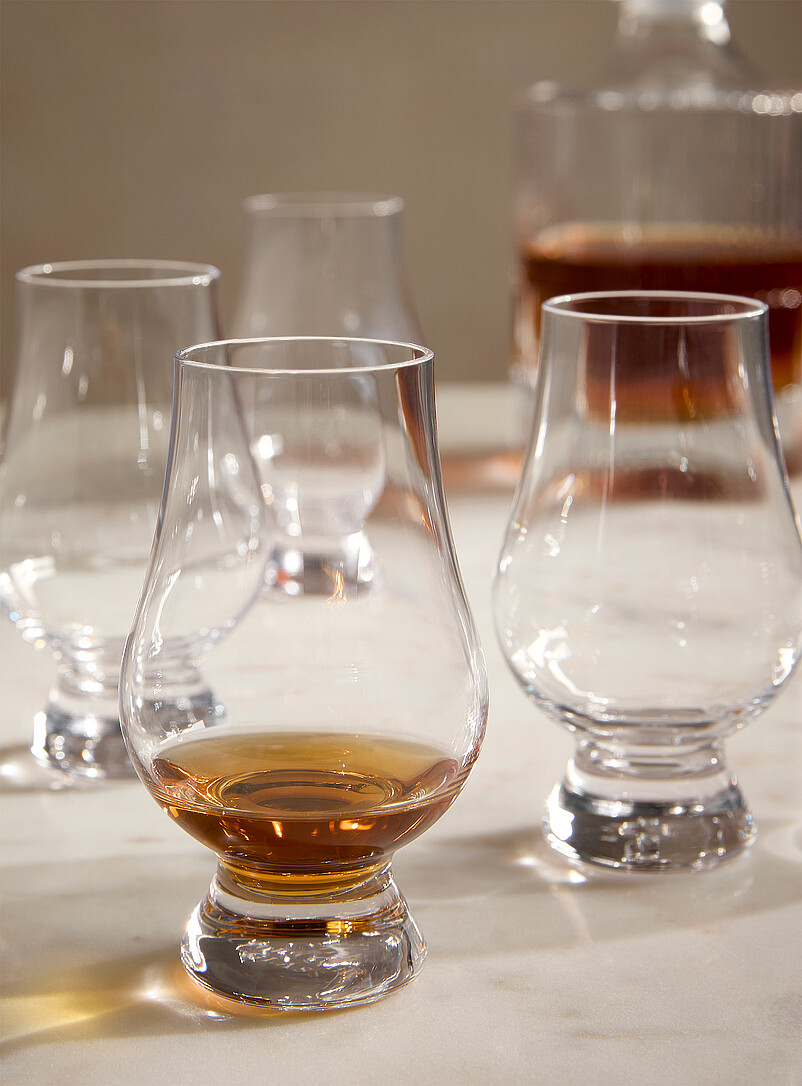
Several clear tulip-shaped whiskey glasses (Glencairn style) are shown; the foreground glass contains an amber liquid and sits on a short thick faceted stem/base. Other identical glasses are placed behind it, some empty and some partially filled.
- Foreground glass shapeSingle tulip-shaped whiskey glass in foreground with a wide rounded bowl that tapers to a narrower rim and sits on a short, thick, faceted pedestal base.
1 region
x 0.18 · y 0.18 · w 0.48 · h 0.66 (high) - Liquid in foreground glassWarm amber-brown liquid filling the lowest section of the foreground glass; liquid level is low and clearly visible against the base.
1 region
x 0.27 · y 0.60 · w 0.32 · h 0.14 (high) - Glass rim detailThin smooth circular rim with bright specular highlights visible on the near edge of the foreground glass rim.
1 region
x 0.28 · y 0.20 · w 0.32 · h 0.06 (high) - Pedestal base constructionShort, thick pedestal base with a faceted cylindrical form and visible interior reflections and refractions where it meets the bowl.
1 region
x 0.30 · y 0.68 · w 0.24 · h 0.18 (high) - Background glassesAt least three additional Glencairn-style glasses visible behind the foreground glass; two are empty and one at the far right contains a similar amber liquid at a higher level.
2 regions
x 0.02 · y 0.20 · w 0.28 · h 0.62 (medium); x 0.58 · y 0.22 · w 0.36 · h 0.58 (medium) - Surface contactGlasses rest on a light-colored, slightly reflective stone or marble surface showing soft reflections and contact shadows beneath each base.
1 region
x 0.00 · y 0.72 · w 1.00 · h 0.28 (high)
Other
Studio-style lifestyle shot with soft directional lighting from upper right, shallow depth of field and warm neutral background; visible highlights and shadows create reflections in the glass.
- Shot compositionClose-up lifestyle arrangement with foreground glass centered-left and other glasses placed behind at varying depths, creating layered bokeh.
1 region
x 0.00 · y 0.00 · w 1.00 · h 1.00 (low) - Lighting and highlightsWarm directional lighting from the upper right produces bright specular highlights on rims and bowls and subtle shadowing to the lower left of bases.
1 region
x 0.40 · y 0.05 · w 0.50 · h 0.30 (medium) - Depth of fieldShallow depth of field: the foreground glass is sharply in focus while background glasses and a decanter are softly blurred.
- Reflections and distortionVisible internal reflections and light distortion through the curved glass walls, producing small bright flares and magnified background shapes.
1 region
x 0.20 · y 0.40 · w 0.60 · h 0.40 (medium)
Colors
clear glass· glass body#EBE3DAamber· liquid inside glass#B47B34- Foreground glass shapeSingle tulip-shaped whiskey glass in foreground with a wide rounded bowl that tapers to a narrower rim and sits on a short, thick, faceted pedestal base.
- 03
Product
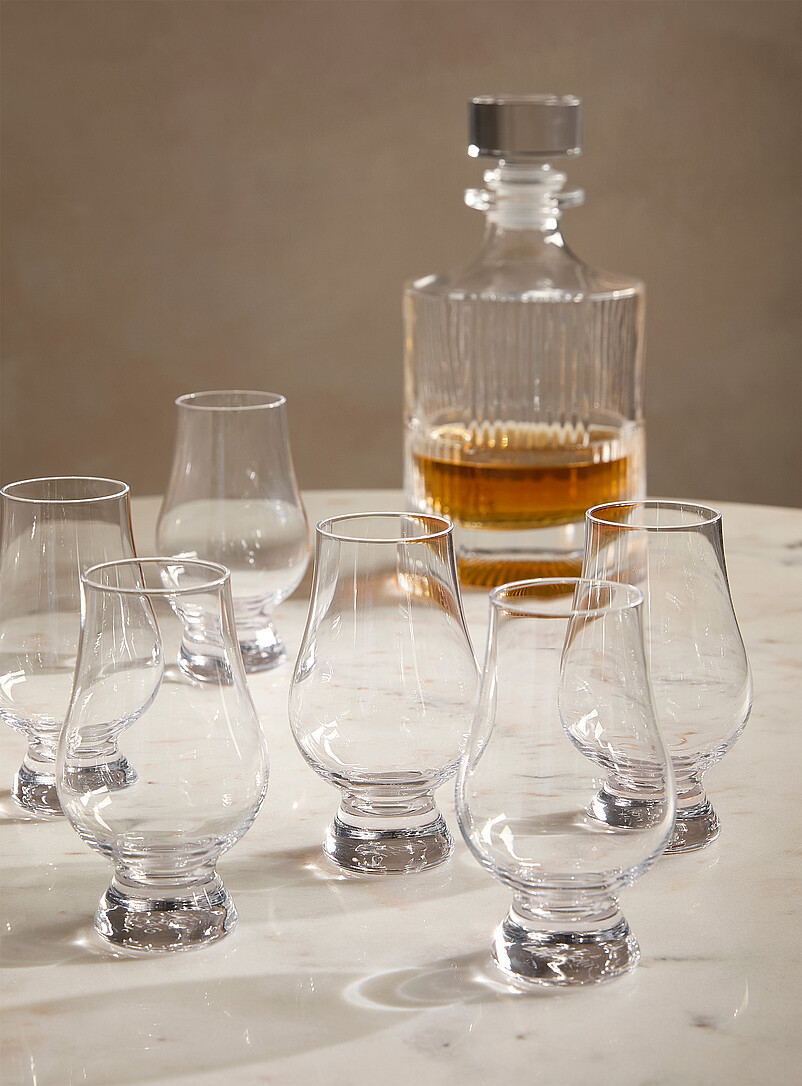
Multiple clear tulip-shaped whiskey glasses with short thick pedestal feet are arranged on a light marble surface; bowls taper inward to a narrow rim and show strong specular highlights and internal reflections.
- Overall shapeTulip-shaped bowl that tapers inward toward a narrow rim, sitting on a short, thick cylindrical pedestal foot with a flat base, visible on every glass
3 regions
x 0.20 · y 0.48 · w 0.23 · h 0.44 (high); x 0.42 · y 0.40 · w 0.22 · h 0.52 (high); x 0.65 · y 0.52 · w 0.22 · h 0.43 (high) - Foot detailSolid, round, thick glass foot with a distinct step where the pedestal meets the bowl; the foot shows circular internal reflections
2 regions
x 0.42 · y 0.80 · w 0.20 · h 0.12 (high); x 0.66 · y 0.82 · w 0.18 · h 0.12 (high) - Material and finishColorless, clear glass with smooth glossy finish producing sharp specular highlights and visible internal reflections
- ArrangementSeveral identical glasses arranged in staggered group on a flat marble tabletop with three glasses prominent in the foreground and others behind
2 regions
x 0.08 · y 0.50 · w 0.30 · h 0.40 (medium); x 0.42 · y 0.40 · w 0.50 · h 0.60 (medium) - Rim profileThin, slightly rounded rim visible as a continuous circular edge on each glass
2 regions
x 0.43 · y 0.41 · w 0.20 · h 0.08 (high); x 0.66 · y 0.48 · w 0.18 · h 0.08 (high)
Other
Lifestyle studio shot showing a marble surface, a faceted decanter with amber liquid in the background, and soft warm studio lighting producing cast shadows and reflections.
- Background objectTall glass decanter with vertical ribbing and a stopper, containing amber liquid, positioned behind the glasses
1 region
x 0.55 · y 0.04 · w 0.30 · h 0.50 (high) - SurfaceLight-colored marble tabletop with faint veining and glossy surface that reflects glasses and highlights
1 region
x 0.00 · y 0.62 · w 1.00 · h 0.38 (high) - Lighting and shadowsSoft warm directional studio lighting from upper left producing soft shadows below and to the right of the glasses and bright specular highlights on glass edges
- Shot compositionThree-quarter view, slightly elevated camera angle showing multiple glasses in foreground and decanter centered in background; image cropped at top of decanter stopper
Colors
clear transparent· glass body#E3DCD3- Overall shapeTulip-shaped bowl that tapers inward toward a narrow rim, sitting on a short, thick cylindrical pedestal foot with a flat base, visible on every glass
Brand PDP Lookup
- Brand
- Glencairn
The Whisky Glass Made Famous: Glencairn Glass
Documents & Data
Customer Reviews
3 total3 reviews · out of 5
Très satisfaite
Parfait pour un digestif.
Perfect size
Lead free and perfect size.
Stylish and functional
Very nice glasses. I would recommend these.
Reddit Insights
6 threads · r/bourbon, r/ScotchReddit’s overall sentiment on the Glencairn glass is mixed, with strong praise for its nosing capabilities but frequent criticism of its ergonomics and ethanol concentration, leading many to prefer alternative glassware for casual drinking or high-proof bourbon.
The Glencairn is widely regarded as the gold standard for whiskey nosing and tasting, with many users claiming it enhances aroma detection. However, a substantial number of users find it uncomfortable to drink from, difficult to clean, and overly ethanol-forward with high-proof spirits, prompting recommendations for alternatives like the copita or Kentucky Bourbon Trail glass.
Themes
Use Cases
- Formal whiskey tasting and nosing
- Side-by-side spirit comparisons and reviews
- Everyday drinking (often replaced by rocks glass for casual use)
Watch Out For
Compared To
vs Kentucky Bourbon Trail Glass
Frequently recommended for higher-proof bourbons, with a wider bowl that reduces ethanol intensity while maintaining some nosing benefits.
vs Copita Glass
A stemmed alternative that many find superior for nosing concentration, though it is more fragile and requires careful handling.
vs Rocks Glass / Tumbler
Preferred for casual drinking due to comfort and ease of use, but generally considered inferior for nosing and detecting subtle aromas.
Source Threads
History and use of Glencairn vs other glasses
If you look up the history of the Glencairn glass, it was first made in 2001. It is based on the copita which I’m sure goes back further. That the Glencairn is the first and final word in tasting whiskey does not have the history some might suppose.
u/dustin_poorer/bourbonView thread →
Complaints about Glencairn: hard to wash and nose room
Glencairns are a PITA to wash and my giant schnoz gets in the way.
u/mckinneymr/bourbonView thread →
How Glencairn improves nosing compared to other glasses
A glencairn is specifically designed to optimize this experience. If you end up getting one, get someone to help you do a blind test to prove it's not just subconscious bias. The smells will be stronger and more distinguished.
u/[deleted]r/bourbonView thread →
Review conclusion: Glencairn as the workhorse universal nosing glass
I can see why the glen is the workhorse – it’s probably the best universal nosing glass if you average out everyone’s quirks, but a different glass might be best specifically for you, for whatever subjective reason.
u/OrangePaperBiker/bourbonView thread →
Comparison and rating of Glencairn vs Norlan and others
Top place is a tie between the Glen Cairn and the Norlan. Glen Cairn is an 8/10. Minus one point because the natural way you hold it puts the palm of your hand on the bowl and introduces heat. Minus one more because when you sip the whisky the mouth of the glass isn’t near your nose so you miss the scent which is a major component of taste. Note also that the proper name of the glass is Glen Cairn Nosing Glass. It is perfect for just that; smelling the whisky; not drinking.
u/Red__M_Mr/ScotchView thread →
Glencairn concentrates scent notes effectively
I’ve always thought the shape of the glencairn concentrates all the scent notes more effectively than a rocks glass. As long as you’re letting your bourbon rest, most of those volatile alcohol vapors should evaporate off.
u/diccballsr/bourbonView thread →