Simons Maison
Amber Wine Glasses Set Of 2
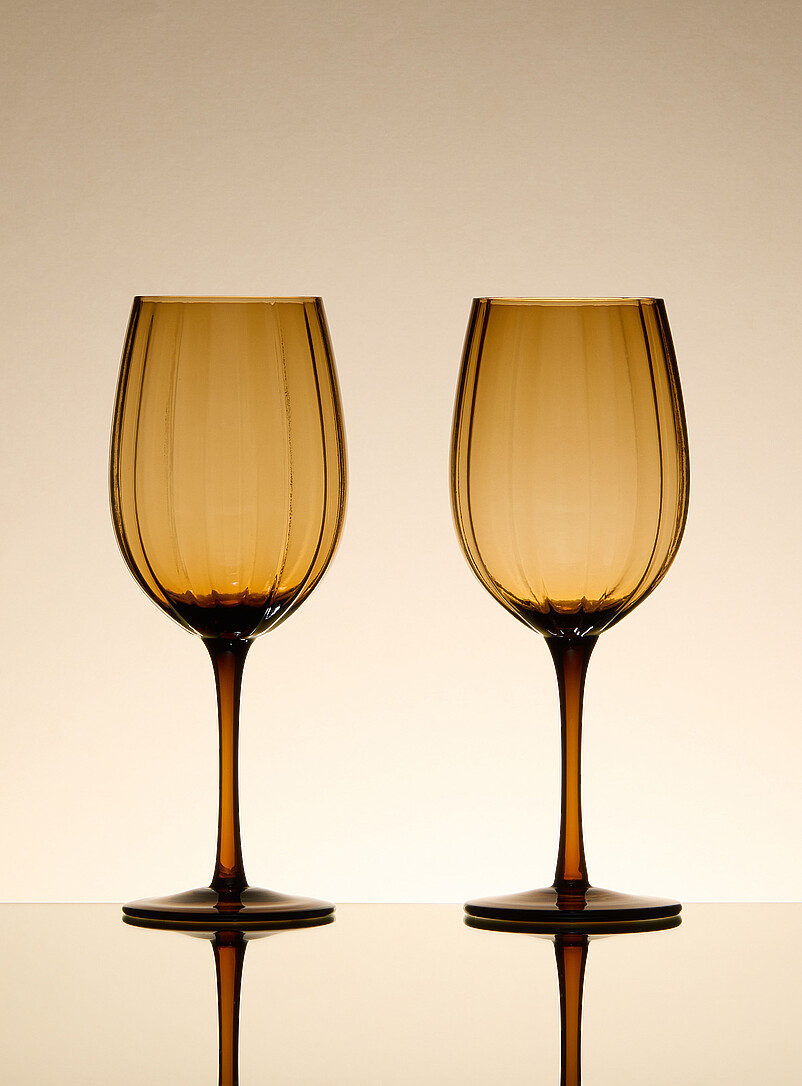
These amber-tinted wine glasses are made of soda-lime glass and sold as a set of two. Each glass has a 480 mL (16 oz.) fill capacity, measures 3.25 inches (8.5 cm) in diameter by 8.75 inches (22 cm) tall, and features a ribbed bowl. They are dishwasher safe but should not be used in the microwave.
- Color
- Amber
- Material
- Soda-lime glass
- Category
- Home & Garden > Kitchen & Dining > Barware
Specifications
A set of two amber wine glasses with a warm hue, made from soda-lime glass, dishwasher safe.
Dishwasher safe, do not microwave, 480 ml capacity.
- Color
- Amber · orange
- Material
- Soda-lime glass
- Gender
- unisex
- Age Group
- adult
- Condition
- new
- Dimensions
- 3.25x3.25x8.75 in
- Category
- Home & Garden > Kitchen & Dining > Barware
Additional Attributes
- bright and warm amber hue
- soda-lime glass
- dishwasher safe
- do not microwave
- set of 2
- matching pieces sold separately
- 480 ml fill capacity
- 3.25 inch diameter x 8.75 inch tall
Product Insights
These amber wine glasses offer a bright warm hue that complements linens and candlelight while resisting fading and masking stains. Their lightweight soda-lime glass and wide 480ml bowl enable vigorous swirling and blind tasting by concealing visual cues. However, the material is prone to thermal shock, requiring avoidance of microwaving and aluminum cookware, and demanding a low-alkalinity detergent and rinse aid to prevent etching and film. Priced at $25 CAD for two, they deliver artisanal-stemware aesthetics with the practicality of dishwasher safety and endless recyclability.
Verified claims
- Amber hue
- Bright warm amber hue leans orange and complements linens and candlelight.
- Design benefits
- Through-colored amber tint resists fading and masks stains; lightweight soda-lime glass and the wide 480 ml bowl make vigorous swirling easy.
- Care
- Reduce the risk of hard-water film and etching by using a low-alkalinity, phosphate-free detergent and a rinse aid.
- Material
- Soda-lime glass is lead-free, lightweight at 2.5 g/cm³, and prone to thermal shock.
- Capacity
- Each glass holds 480 ml (16 oz.) at fill capacity and measures 3.25 in (8.5 cm) diameter by 8.75 in (22 cm) tall; the bowl leaves ample airspace for swirling a 150 ml pour.
- Tasting experience
- Amber tint masks stains and visual cues for blind tasting, and the 480ml bowl allows vigorous swirling for aroma release.
- Loading and drying
- Use top rack only and air-dry setting for best longevity.
- Aluminum avoidance
- In the dishwasher, keep aluminum cookware on the bottom rack and rinse acidic food residues to avoid a cloudy film on the glasses.
- Stain masking
- Amber tint conceals red-wine stains and lipstick marks.
- Microwave safety
- Avoid microwaving; soda-lime glass can crack from thermal stress.
- Recyclability
- Endlessly recyclable soda-lime glass reduces waste.
- Dishwasher safe
- Dishwasher safe; do not microwave. Hard water and high-pH detergents can still cause film or etching without proper care.
- Value
- At $25 CAD for two, these glasses match artisanal stemware aesthetics.
- Lead-free
- These glasses are made from soda-lime glass that uses soda ash and limestone instead of lead oxide, so they avoid lead-leaching concerns.
- Microwave use
- Do not microwave these glasses; rapid, uneven heating of soda-lime glass can build internal stress until the glass cracks.
- Thermal shock
- These are annealed soda-lime glass, not tempered, and are more susceptible to thermal shock than borosilicate; skip hot beverages and hot dishwasher cycles in addition to the microwave.
- Matching pieces
- The matching piece in the bright amber range is the Amber Cocktail Glasses Set of 2, sold in the same amber tint; matching pieces are sold separately.
- Season positioning
- The merchant styles this bright warm amber as summery, color-forward drinkware, not as an autumnal or vintage piece.
Product record
- Title
- Amber Wine Glasses Set Of 2
- Brand
- Simons Maison
- Price
- 25 CAD
- Availability
- In stock
Buying Guide
1 comparison · 5 sourcesProduct comparison
Compared within this brand.
| Amber Wine Glasses Set Of 2: Choose this if you want a set of 2 stemmed wine glasses in a bright, warm amber tone with subtle vertical fluted ridges on large rounded bowls. Each glass has a 480 ml (16 oz.) fill capacity, measures about 8.75 inches tall and 3.25 inches in diameter, and is made of soda-lime glass that is dishwasher safe. Note that the manufacturer instructs not to put them in the microwave.[1,2] | Tortoiseshell Wine Glasses Set Of 2: Choose this if you want a fashionable touch for everyday meals: a set of two stemmed wine glasses in soda-lime glass with a mottled amber-and-brown tortoiseshell pattern running through the translucent bowl walls. Each glass holds 450 ml (15 oz.), measures about 3.5 inches in diameter by 9 inches tall, and is dishwasher safe, though it should not go in the microwave. Note that the two glasses share a similar but not identical pattern, so expect some variation between them.[3,4] | Grooved Wine Glasses Set Of 2: Choose this if you want decorative stemmed wine glasses with a pink tint and fine vertical grooves that catch the light, sold as a set of 2. Each glass stands 8.5 inches (21.5 cm) tall and 3.75 inches (9.5 cm) in diameter, sized for a standard wine pour, and is made of soda-lime glass that is dishwasher safe but should not go in the microwave. Reviewers found them sturdier than their delicate look suggests, and the set's presentation makes it a popular gift for a wine enthusiast, per the reviews analysis.[5] |
Image Analysis
2 images- 01
Product
Two identical stemmed wine glasses made from translucent amber-tinted glass, shown upright with visible bowls, stems, and round flat bases; subtle vertical ribbing visible on the bowls.
- Pair compositionTwo upright stemmed wine glasses positioned side by side with a narrow gap, both fully visible from rim to base and shown straight-on.
2 regions
x 0.10 · y 0.06 · w 0.36 · h 0.86 (high); x 0.54 · y 0.06 · w 0.36 · h 0.86 (high) - Bowl shape and rimLarge rounded bowls with a slightly tapered top and thin straight rim, bowls are taller than they are wide.
2 regions
x 0.14 · y 0.06 · w 0.28 · h 0.50 (high); x 0.58 · y 0.06 · w 0.28 · h 0.50 (high) - Vertical ribbingSubtle evenly spaced vertical ribs or molded grooves run down the exterior of each bowl from rim toward the base of the bowl.
2 regions
x 0.14 · y 0.10 · w 0.28 · h 0.40 (high); x 0.58 · y 0.10 · w 0.28 · h 0.40 (high) - Stem detailLong slender stems that narrow slightly in the middle and join a flared round base; stems are the same amber-tinted glass as the bowls.
2 regions
x 0.28 · y 0.46 · w 0.10 · h 0.36 (high); x 0.72 · y 0.46 · w 0.10 · h 0.36 (high) - Base and reflectionFlat circular bases sit on a glossy reflective surface that creates a clear vertical reflection of each stem and base below them.
2 regions
x 0.18 · y 0.74 · w 0.22 · h 0.16 (high); x 0.62 · y 0.74 · w 0.22 · h 0.16 (high) - Glass translucency and highlightsTranslucent amber glass shows even internal shading with vertical gradient highlights along the curved surfaces and darker amber near the bowls' base and stems.
Other
Studio shot with warm backlighting on a neutral beige gradient background and a reflective surface beneath the glasses; even soft lighting produces clear silhouettes and reflections.
- Background and lightingSmooth warm beige gradient background with stronger illumination behind the glasses creating silhouette effect and soft even front illumination on the glass surfaces.
- Shot compositionCentered symmetrical composition with both glasses vertically aligned and spaced evenly horizontally; image cropped with small margins around the glasses.
- Reflective surfaceGlossy horizontal surface creates a clear mirror reflection of each glass that is vertically aligned under the base.
1 region
x 0.00 · y 0.82 · w 1.00 · h 0.18 (medium)
Colors
amber· glass bowls, stems and bases#A46C13- Pair compositionTwo upright stemmed wine glasses positioned side by side with a narrow gap, both fully visible from rim to base and shown straight-on.
- 02
Product
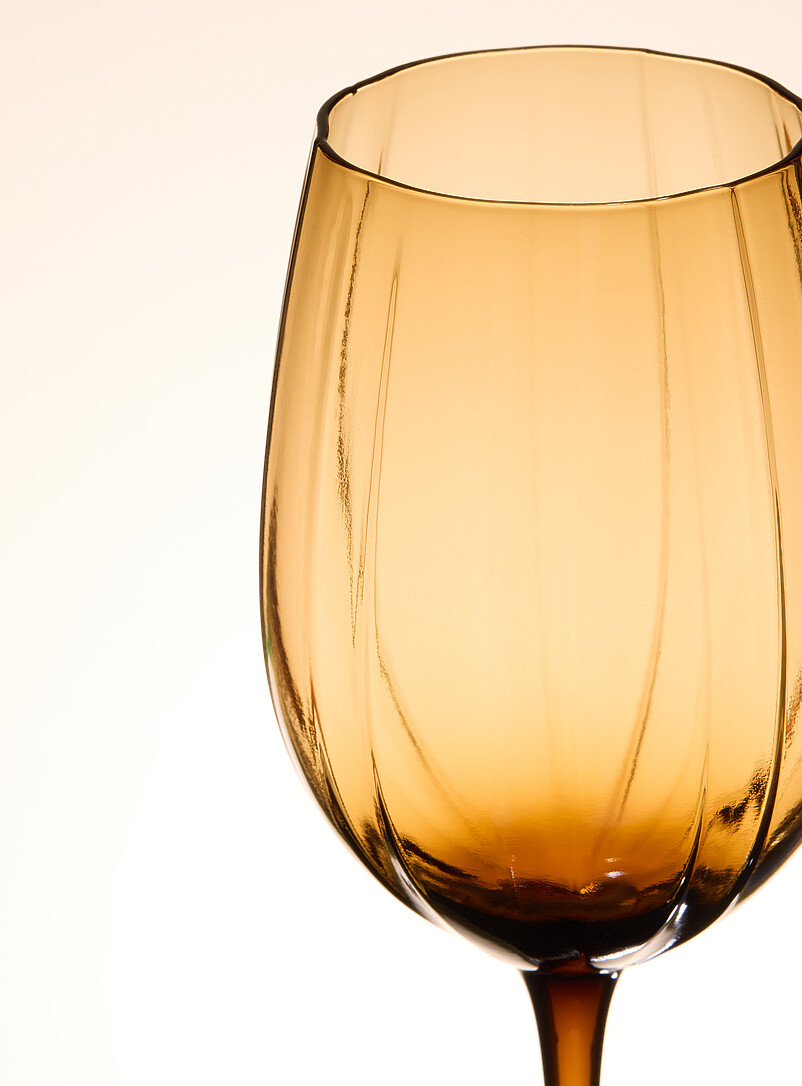
Close-up view of the upper and mid portions of a single amber-tinted wine glass showing the bowl with vertical fluted panels, rim, lower bowl curve, and the upper part of the stem.
- Bowl shapeLarge rounded bowl with a gently tapering upper lip visible from a near-frontal angle; the rim is circular but the top edge appears slightly scalloped by the vertical paneling.
1 region
x 0.15 · y 0.02 · w 0.70 · h 0.70 (high) - Vertical fluted panelsEvenly spaced vertical fluted ridges run from the rim down toward the base of the bowl, creating subtle vertical seams and faint shadow lines.
1 region
x 0.18 · y 0.05 · w 0.64 · h 0.78 (high) - Material and finishTranslucent colored glass with a smooth glossy finish; highlights and reflections are visible on the curved surfaces.
1 region
x 0.20 · y 0.03 · w 0.60 · h 0.90 (high) - Lower bowl and partial stemLower curvature of the bowl transitions to the upper part of a slender stem that is visible at the bottom center of the image.
1 region
x 0.44 · y 0.72 · w 0.18 · h 0.26 (high) - Surface detailSmall textures and slight waviness in the glass surface are visible along some vertical seams, producing thin darker lines.
1 region
x 0.26 · y 0.20 · w 0.40 · h 0.65 (medium)
Other
Studio close-up with a light neutral gradient background, soft even lighting, and the product cropped on the right side of the frame.
- Shot compositionTight close-up crop framing the glass off-center toward the right, showing primarily the front and right side of the bowl.
1 region
x 0.00 · y 0.00 · w 1.00 · h 1.00 (high) - BackgroundPlain light background with a warm neutral gradient from left to right, no visible props or packaging.
1 region
x 0.00 · y 0.00 · w 0.60 · h 1.00 (high) - Lighting and reflectionsSoft studio lighting produces smooth highlights and long vertical reflections on the glass surface, with a brighter area toward the left background.
1 region
x 0.10 · y 0.05 · w 0.80 · h 0.90 (high) - Image limitationsOnly part of the glass is visible; base and full stem are cropped out of the frame.
1 region
x 0.00 · y 0.60 · w 1.00 · h 0.40 (high)
Colors
warm amber· bowl and stem#ECB364- Bowl shapeLarge rounded bowl with a gently tapering upper lip visible from a near-frontal angle; the rim is circular but the top edge appears slightly scalloped by the vertical paneling.