Appareil Atelier
Elsie Oak Hybrid Side Table
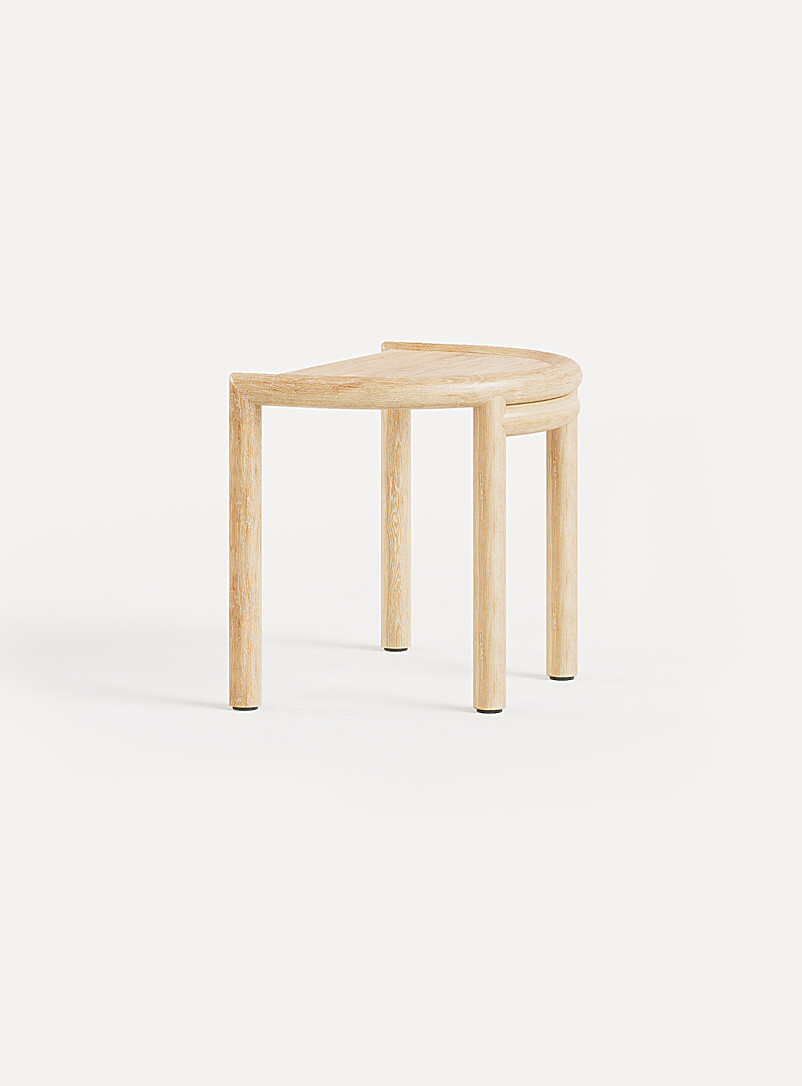
The Elsie Oak Hybrid Side Table is a multifunctional piece that serves as both a side table and a small stool, featuring a minimalist half-moon shaped top with three integral legs. It is constructed from solid oak wood, handmade in Montreal, and measures 15 inches in depth, 13.25 inches in width, and 18.5 inches in height (38 x 33.5 x 47 cm). Each piece is crafted to order, so individual items may exhibit slight variations from the product image.
- Material
- Solid oak wood
- Category
- Furniture > Tables > Accent Tables > End Tables
Size
Specifications
A minimalist solid oak hybrid side table with a half-moon silhouette, handcrafted in Montreal and versatile as a side table or stool.
Half-moon silhouette, versatile as side table or stool, handcrafted solid oak.
- Material
- Solid oak wood
- Age Group
- adult
- Condition
- new
- Dimensions
- 15x13.25x18.5 in
- Category
- Furniture > Tables > Accent Tables > End Tables
Additional Attributes
- solid oak wood
- handmade in Montreal
- minimalist design
- half-moon silhouette
- hybrid piece (side table or stool)
- multifunctional
- unique piece may vary
Product Insights
Appareil Atelier's Elsie Oak Hybrid Side Table embodies an architect-founded studio's philosophy of structural purity—every detail serves function, not decoration. Handmade in Montreal from solid red oak (Janka 1290 lbf), its half-moon silhouette doubles as a wall-flush side table and a standard-height stool. The dense oak resists skidding and denting, while the oiled finish develops a patina that evolves from straw to honey to amber over five years. The tradeoff: maintaining the wood demands blotting spills, controlling humidity between 30–60%, and periodic re-oiling for the oiled version, but the result is a durable, aging piece that burnishes with use.
Verified claims
- Design origin
- Architect-founded studio with a timeless, functional, beautiful design philosophy.
- Craftsmanship
- Handmade in Montreal from solid oak, with natural variation between units.
- Function
- Half-moon side table and stool; sits flush against a wall.
- Material
- Red oak with Janka ~1,290 lbf and a patina that darkens from straw to honey.
- Stool dimensions
- Dimensions of 15x13.25x18.5 in. match standard stool height and seat size.
- Stability
- Dense oak resists skidding and maintains its shape with minimal seasonal movement.
- Durability
- Solid red oak's Janka hardness of about 1290 lbf resists dents, and its solid-oak construction provides structural strength for seated use.
- Maintenance
- Blot spills immediately and maintain indoor humidity at 30–60% to preserve the wood.
- Color evolution
- Oak color shifts from pale straw to warm honey within six months to a year, and amber deepening is unmistakable by the three-year mark.
- Patina
- Frequent use burnishes the grain to a soft luster, and solid oak's hardness resists dents, so the surface develops a pronounced patina rather than wearing through.
- Cleaning
- Blot spills and dust along the grain to avoid permanent damage on oak.
- Finish care
- If the light-brown wood variant has an oiled finish, it needs periodic re-oiling; the black variant, if painted, needs only a damp cloth.
- Humidity
- Maintain 30–60% humidity and avoid heat sources to prevent oak cracking.
- Space-saving design
- Half-moon design saves space by fitting flush against walls and serving as a stool.
- Craft narrative
- Handmade in Montreal by a collaborative atelier that began as the furniture wing of an architecture firm.
- Design philosophy
- The half-moon silhouette is stripped of superfluous decoration; the shape itself provides the visual detail.
- Seat height
- The Elsie's 18.5-inch height matches the common 18-inch seat height of task stools, placing a seated adult at an ergonomic position for brief, occasional use.
- Seat surface
- The 15 x 13.25-inch top is comparable to a 14-inch utility stool seat, giving an adult a stable perch without feeling too small while staying compact enough to slide under a desk.
- Cleaning product restrictions
- Avoid bleach, ammonia-based sprays, and silicone polishes, which can strip oak's protective layer and permanently discolor the wood; for routine cleaning, use a barely damp microfiber cloth with a drop of pH-neutral soap.
- Heat ring prevention
- White heat rings and condensation marks can form within minutes on the oak top, so keeping a coaster under every drink is the most effective way to keep the surface unblemished.
Product record
- Title
- Elsie Oak Hybrid Side Table
- Brand
- Appareil Atelier
- Price
- 375 CAD
- Availability
- In stock
Image Analysis
2 images- 01
Product
A light natural oak semi-circular side table with three cylindrical legs and a raised curved rim on the rounded edge; visible black small foot caps on each leg.
- Top shapeSemi-circular flat tabletop with a gently rounded outer edge and a raised rim that follows the curved perimeter on the visible side.
1 region
x 0.30 · y 0.28 · w 0.40 · h 0.18 (high) - LegsThree evenly spaced vertical cylindrical legs with rounded profiles; legs appear integrated under the tabletop and extend straight to the floor.
3 regions
x 0.18 · y 0.45 · w 0.14 · h 0.35 (high); x 0.42 · y 0.44 · w 0.10 · h 0.36 (high); x 0.62 · y 0.45 · w 0.15 · h 0.35 (high) - Apron detailA rounded double-rail apron or decorative band runs beneath the curved edge of the tabletop, following the outer semicircle.
1 region
x 0.48 · y 0.30 · w 0.36 · h 0.10 (high) - Foot capsSmall dark circular caps on the bottom of each leg, slightly visible against the floor.
3 regions
x 0.20 · y 0.76 · w 0.06 · h 0.04 (high); x 0.46 · y 0.78 · w 0.04 · h 0.03 (high); x 0.68 · y 0.78 · w 0.06 · h 0.03 (high) - Surface textureVisible wood grain pattern across the tabletop and legs with a light matte finish and subtle streaking characteristic of oak.
1 region
x 0.30 · y 0.28 · w 0.40 · h 0.40 (high)
Other
Studio product shot on a uniform off-white background with soft diffuse lighting and a faint shadow beneath the table slightly offset to the left.
- BackgroundUniform off-white neutral backdrop with no visible props or packaging.
- Lighting and shadowEven diffuse lighting from above and slightly right, producing a soft shadow on the floor mainly to the left of the legs.
1 region
x 0.18 · y 0.70 · w 0.64 · h 0.20 (medium) - CompositionTable centered in frame, occupying lower half of image with generous negative space above and around.
Colors
light natural oak· tabletop and legs#DCC4A3- Top shapeSemi-circular flat tabletop with a gently rounded outer edge and a raised rim that follows the curved perimeter on the visible side.
- 02
Product
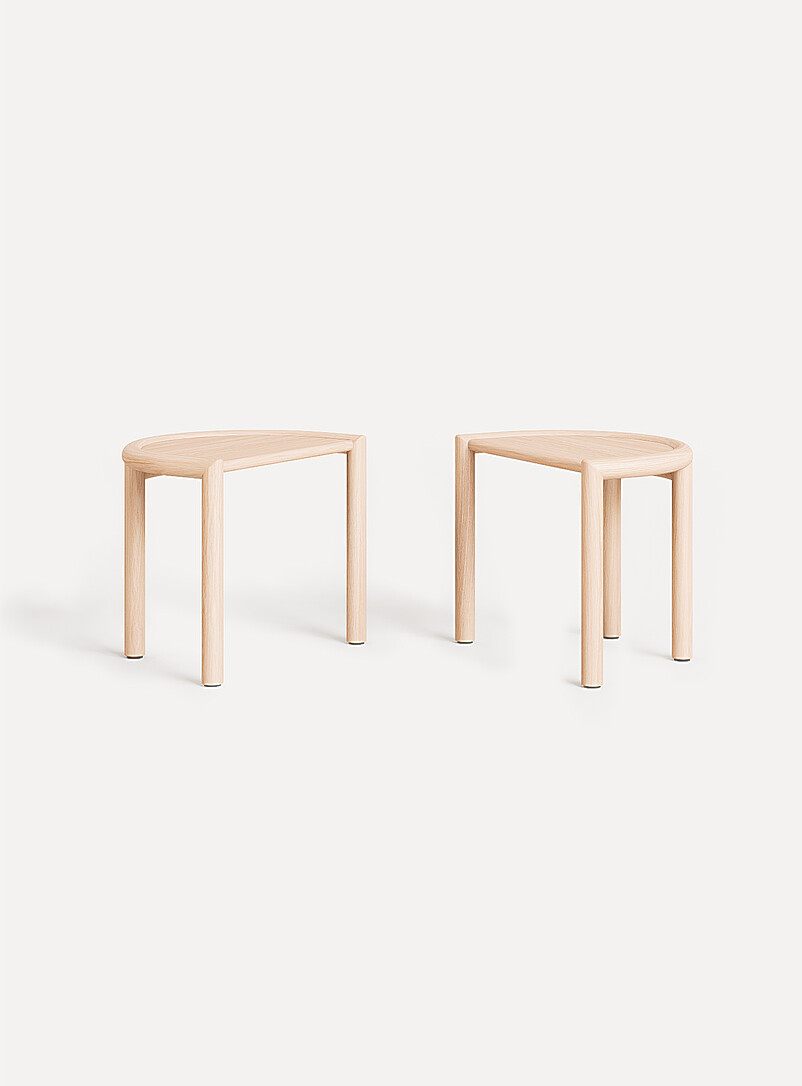
Two identical small side tables shown from a front/three-quarter view; each has a three-legged tapered rounded triangular top and cylindrical legs in a light natural wood finish.
- General formEach unit is a small table with a rounded triangular top (three-sided top with gently rounded corners) supported by three vertical cylindrical legs positioned near the corners of the top.
2 regions
x 0.10 · y 0.52 · w 0.32 · h 0.28 (high); x 0.50 · y 0.52 · w 0.36 · h 0.28 (high) - Top construction and edgeTable tops are slightly raised with a visible edge profile that follows the rounded triangular shape; wood grain runs across the top surface.
2 regions
x 0.14 · y 0.46 · w 0.26 · h 0.12 (high); x 0.56 · y 0.46 · w 0.26 · h 0.12 (high) - LegsLegs are straight vertical cylinders with a consistent diameter and a smooth wood-grain finish matching the top; each table shows three legs with one leg visible near the front corner.
2 regions
x 0.16 · y 0.56 · w 0.06 · h 0.24 (high); x 0.60 · y 0.56 · w 0.06 · h 0.24 (high) - Leg base detailEach leg ends in a small circular base detail: a dark thin outer ring and a lighter pad visible at the very bottom of the leg.
2 regions
x 0.18 · y 0.78 · w 0.03 · h 0.03 (high); x 0.63 · y 0.78 · w 0.03 · h 0.03 (high)
Other
Studio-style product photograph on a pale neutral background with soft shadows beneath each table; two units are spaced side by side and centered horizontally.
- Background and stagingPlain very light neutral background with subtle floor plane and soft cast shadows beneath the tables.
- CompositionTwo identical tables shown side by side with even spacing and both fully visible; image crops include ample negative space above the products.
- Shadows and lightingSoft, diffused lighting from above creates faint diffuse shadows under and slightly to the left of each table, indicating even studio illumination.
Colors
light natural oak· table surface and legs#ECD4C3dark gray· leg base outer ringoff-white· leg base pad#F3F2F0- General formEach unit is a small table with a rounded triangular top (three-sided top with gently rounded corners) supported by three vertical cylindrical legs positioned near the corners of the top.
Brand PDP Lookup
- Brand
- Appareil Atelier
Table à Café Elsie