Blomus
Sukoya Oak Shelving Unit
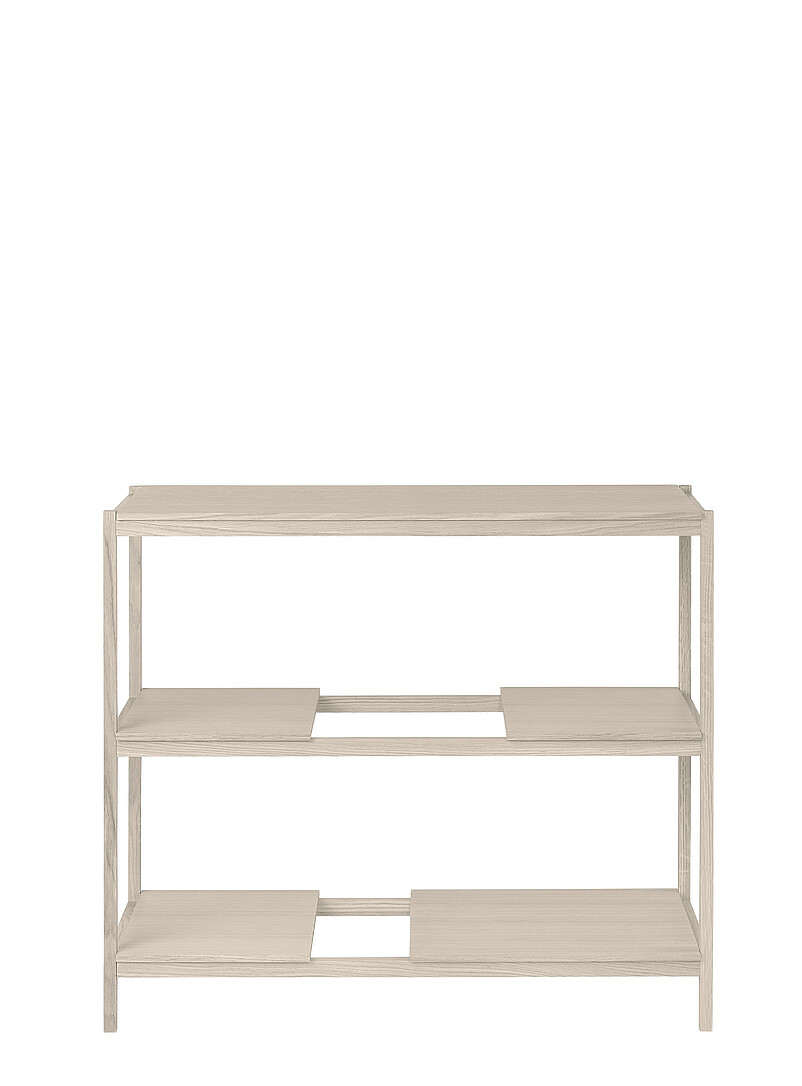
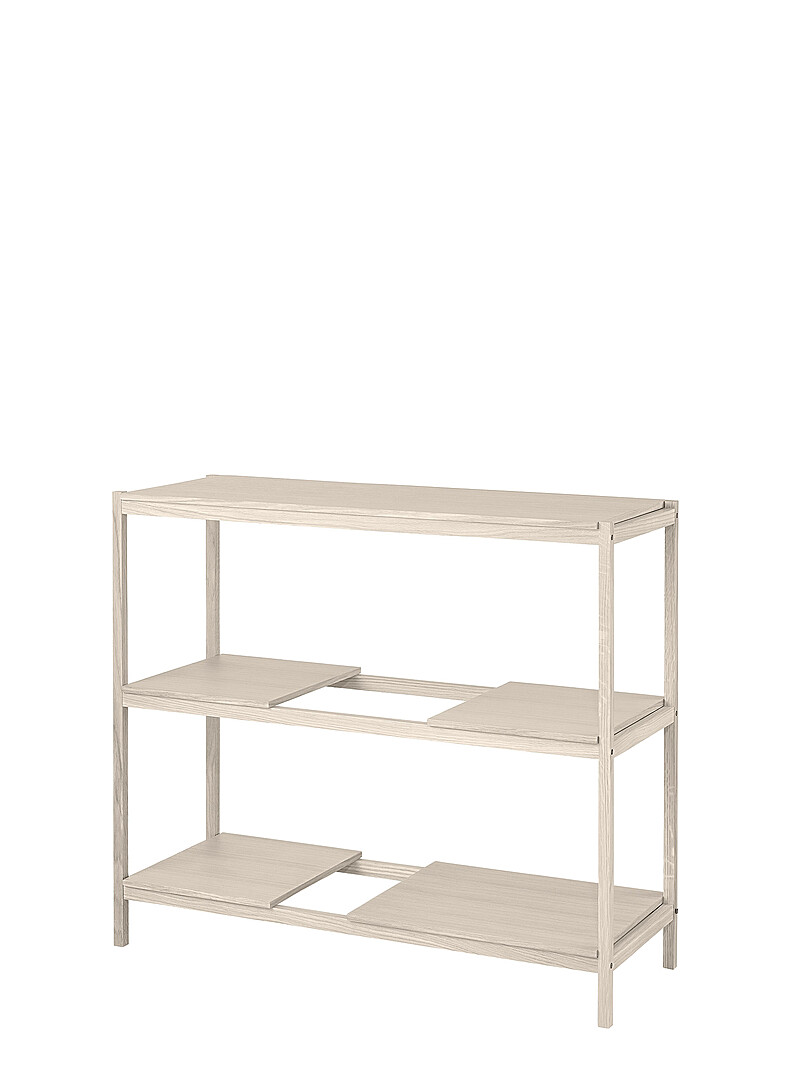
The Sukoya Oak Shelving Unit is a three-tier shelving unit made from oak wood, designed for storage and display in residential or office spaces. It features a fixed top shelf and two lower shelves that can be adjusted or rearranged to suit different organizational needs. The unit measures 41.5 inches (105 cm) wide, 15.75 inches (40 cm) deep, and 36.5 inches (92.75 cm) high, and requires some assembly upon delivery.
- Material
- Oak wood
- Category
- Furniture > Shelving > Bookcases & Standing Shelves
Size
Specifications
Fine structured shelving unit with oak wood and two sliding lower shelves, offering timeless elegance and functionality.
Two lower shelves can be slid and arranged however you like.
- Material
- Oak wood
- Condition
- new
- Dimensions
- 41.5x15.75x36.5 in
- Category
- Furniture > Shelving > Bookcases & Standing Shelves
Additional Attributes
- oak wood
- three shelves
- sliding shelves
- timeless elegance
- practical
- some assembly required
- finely structured
Product Insights
The Blomus Sukoya Oak Shelving Unit combines a solid oak frame with lacquered oak-veneer shelves that resist dents, moisture, and warping, thanks to an engineered core that ensures dimensional stability across humidity cycles. The SUKOYA line's precise joinery and warp-resistant shelves enable easy assembly and tool-free sliding repositioning of the two lower shelves, allowing reconfigurable display layouts. However, the asymmetrical sliding design increases tip-over risk, and the unit does not include anti-tip hardware, requiring generic straps drilled into the oak. Additionally, the Hazelnut variant uses oiled veneer that needs re-oiling and offers less water resistance than the lacquered finish.
Verified claims
- Durability
- Solid oak frame and lacquered veneer shelves resist dents, moisture, and warping.
- Build quality
- Blomus's SUKOYA line benefits from dedicated tooling and repeat manufacturing, which typically results in tighter joinery and consistent shelf fit.
- Material
- European oak frame with lacquered oak-veneer shelves resists dents, moisture, and warping.
- Surface protection
- Lacquer seals the oak veneer, blocking liquid and UV stains.
- Variant finish
- Hazelnut variant uses oiled veneer, requiring re-oiling and less water resistance.
- Dimensional stability
- Oak veneer over an engineered core resists warping and prevents binding across humidity cycles.
- Sliding mechanism
- Tool-free sliding relies on the dimensional stability of the engineered core.
- Frame stability
- Oak frame's medullary rays resist splitting and maintain alignment over years.
- Sliding shelves
- Two lower shelves slide manually without tools, enabling reconfigurable display layouts.
- Sliding quality
- Oak veneer over an engineered core and precise joinery keep the sliding shelves smooth and prevent binding over time.
- Tip-over risk
- Asymmetrical sliding may increase tipping risk without anti-tip hardware.
- Frame grain
- Solid oak frame with natural medullary rays shows distinctive grain; shelves are lacquered veneer.
- Shelf finish
- Oak veneer shelves have sealed lacquer blocking moisture and UV, with engineered core for stability.
- Hazelnut finish
- The Hazelnut variant's exact finish is not specified, but it is likely an oiled oak veneer that shows the natural wood grain.
- Tip-over safety
- The product information does not mention pre-drilled holes or wall-anchoring hardware; use generic anti-tip furniture straps for safety.
- Assembly quality
- Some assembly is required, and the SUKOYA line's consistent joinery and warp-resistant shelves support accurate fit.
- Shelf adjustability
- Lower shelves can be slid and repositioned after assembly without tools.
- Collection system
- Part of the SUKOYA collection, which Blomus manufactures across multiple furniture pieces with dedicated tooling and consistent joinery.
- Frame hardness
- The solid oak frame is made from European oak rated around 1,120 lbf on the Janka hardness scale, roughly 70% harder than pine, so it resists dents and scratches from everyday contact better than softwood shelving.
Product record
- Title
- Sukoya Oak Shelving Unit
- Brand
- Blomus
- Price
- 1299 CAD
- Availability
- In stock
Buying Guide
1 comparison · 6 sourcesUses
Adding a touch of elegance to your space
This finely structured oak shelving unit from Blomus is designed to bring a timeless, elegant look to a room while staying practical for everyday storage. Its two lower shelves can be slid and arranged however you like, letting you adapt the unit to your space.[1]
Product comparison
Compared within this brand.
| Sukoya Oak Shelving Unit: Choose this if you want a compact, open three-tier oak unit (41.5 inches long, 15.75 inches deep, 36.5 inches high) whose two lower shelves slide so you can arrange them however you like, in a light, matte wood-grain look the retailer describes as stylish and timeless. It comes in one size with White and Hazelnut color options and is made of oak wood and oak veneer. Note that some assembly is required.[1,2,3] | Modo Steel Wall Shelf: Choose this if you want a small, multi-purpose wall shelf for compact spaces like a bathroom corner, where its slim 20-inch-long, 4.25-inch-deep tray profile with a rear lip and rounded front ledge can hold small toiletries. It is made of titanium-coated stainless steel in a powder-coated black finish, with built-in recessed compartments including a dark wood insert for contrast. Note it comes in a single size, so it suits those who need one narrow accent shelf rather than larger storage.[4,5,6] |
Image Analysis
2 images- 01
Product
Front-facing three-tier open shelving unit made from light-toned oak with a rectangular frame, full top shelf and two lower shelves split into left and right panels with centered rectangular gaps and thin horizontal support slats.
- Overall geometryRectangular open-frame shelving unit with vertical square-section posts at each corner and three horizontal shelf levels.
1 region
x 0.06 · y 0.08 · w 0.88 · h 0.84 (medium) - Top shelfSingle continuous top shelf panel spanning full width with visible straight edges and exposed wood-grain surface.
1 region
x 0.08 · y 0.06 · w 0.84 · h 0.12 (high) - Middle shelf splitMiddle shelf consists of two rectangular panels left and right with a rectangular open gap at center and two thin horizontal slats crossing the gap.
3 regions
x 0.08 · y 0.30 · w 0.36 · h 0.14 (high); x 0.56 · y 0.30 · w 0.36 · h 0.14 (high); x 0.44 · y 0.34 · w 0.12 · h 0.06 (high) - Bottom shelf splitLower shelf similarly split into two offset rectangular panels with a central rectangular opening and visible wood-grain on panels.
3 regions
x 0.08 · y 0.58 · w 0.36 · h 0.20 (high); x 0.56 · y 0.58 · w 0.36 · h 0.20 (high); x 0.44 · y 0.66 · w 0.12 · h 0.08 (high) - Frame postsFour narrow vertical posts at corners with square cross-section showing the same light wood grain and finish as shelves.
2 regions
x 0.06 · y 0.06 · w 0.04 · h 0.86 (high); x 0.90 · y 0.06 · w 0.04 · h 0.86 (high) - Surface textureVisible linear wood-grain pattern across all visible shelf panels and posts, matte finish without high gloss.
1 region
x 0.20 · y 0.20 · w 0.60 · h 0.60 (medium)
Other
Product centered on plain white background with even diffuse lighting and minimal shadowing; image shows full front view with slight empty space above unit.
- Background and stagingPlain white background with no props or visible packaging, product centered horizontally and positioned toward lower half of image.
- LightingEven diffuse lighting producing soft minimal shadows beneath lower shelf and no strong highlights.
- Shot compositionStraight-on front view composed to show three shelf levels and central cutouts; ample white space above product.
Colors
light bleached oak· shelves and frame#D5C9BC- Overall geometryRectangular open-frame shelving unit with vertical square-section posts at each corner and three horizontal shelf levels.
- 02
Product
Open three-tier rectangular shelving unit made from light oak-colored wood with square vertical posts at the corners and two inset square shelf panels on the middle and bottom shelves leaving central rectangular openings.
- Overall geometryRectangular open-frame shelving unit with three horizontal shelf planes (top, middle, bottom) supported by four vertical square-section posts at the corners.
1 region
x 0.06 · y 0.27 · w 0.88 · h 0.66 (high) - Top shelfFull-width flat top shelf with visible wood grain and squared edges forming the unit's top plane.
1 region
x 0.10 · y 0.29 · w 0.80 · h 0.12 (high) - Middle shelf configurationMiddle shelf consists of two separate square panels located left and right with a rectangular open gap in the center showing the supporting rails underneath.
3 regions
x 0.10 · y 0.44 · w 0.24 · h 0.10 (high); x 0.66 · y 0.44 · w 0.24 · h 0.10 (high); x 0.35 · y 0.48 · w 0.30 · h 0.06 (high) - Bottom shelf configurationBottom shelf mirrors the middle shelf with two square panels left and right and a central rectangular opening between them.
3 regions
x 0.10 · y 0.66 · w 0.28 · h 0.12 (high); x 0.56 · y 0.66 · w 0.34 · h 0.12 (high); x 0.36 · y 0.72 · w 0.20 · h 0.06 (high) - Vertical postsFour straight square-section vertical posts at each corner with visible grain matching the shelves; posts extend from floor to top shelf.
2 regions
x 0.08 · y 0.28 · w 0.04 · h 0.60 (high); x 0.88 · y 0.28 · w 0.04 · h 0.60 (high) - Joinery and fastenersSmall dark round fasteners or screws are visible at several corner joints on the right-side posts near shelf intersections.
2 regions
x 0.89 · y 0.63 · w 0.02 · h 0.07 (medium); x 0.89 · y 0.47 · w 0.02 · h 0.06 (medium) - Surface textureWood grain texture visible across shelves and posts, appearing as a light, bleached oak finish with linear grain patterns.
1 region
x 0.12 · y 0.30 · w 0.76 · h 0.44 (high) - Visible underside railsParallel supporting rails run lengthwise beneath the middle and bottom shelf panels and are visible through the central openings.
1 region
x 0.34 · y 0.49 · w 0.32 · h 0.12 (high)
Other
Product photographed on a plain white background with even lighting and minimal shadows; image shows the shelving unit from a slight front-right angle centered in the frame.
- Shot compositionUnit centered in image with substantial white space above and around; visible from a slight front-right three-quarter angle showing depth of shelves.
- BackgroundUniform plain white background without props or environment context.
- Shadows and lightingSoft even lighting with faint shadowing beneath and slightly behind the unit, minimal specular highlights.
1 region
x 0.20 · y 0.86 · w 0.60 · h 0.12 (medium) - Image qualityHigh resolution with crisp edges and visible wood grain detail; no visible cropping artifacts.
Colors
light bleached oak· shelves and posts#E1D5C6- Overall geometryRectangular open-frame shelving unit with three horizontal shelf planes (top, middle, bottom) supported by four vertical square-section posts at the corners.
Brand PDP Lookup
- Brand
- Blomus
SUKOYA Shelf White Oiled Oak, modern | blomus