Devialet
Phantom Ii 98 Db Matte Black Wireless Speaker
The Devialet Phantom II 98 dB is a compact wireless speaker that delivers high-fidelity audio with 400W peak power, a 98 dB SPL maximum, and an 18 Hz–21 kHz frequency response, using one aluminum full-range and two aluminum bass drivers in a 157 x 168 x 219 mm, 4.3 kg enclosure. It supports AirPlay, Bluetooth, Spotify Connect, and analog/optical inputs, and can be stereo-paired via the Devialet App. Reviews highlight its powerful bass and small footprint, but also note occasional connectivity and software issues and the lack of wireless surround support.
- Color
- Matte Black
- Material
- Aluminum drivers
- Style
- modern, minimalist
- Category
- Electronics > Audio > Audio Components > Speakers
Specifications
Ultra-compact wireless speaker delivering high-fidelity sound with 400W peak power and 98 dB SPL maximum sound level.
Touch controls, stereo pairing via Devialet App, connectivity including Airplay, UPnP, Bluetooth (A2DP/AVRCP), Spotify Connect, analog/optical input, 400W peak power, 98 dB SPL, 18Hz-21kHz frequency response.
- Color
- Matte Black · black
- Material
- Aluminum drivers
- Style
- modern, minimalist
- Occasion
- everyday, travel
- Gender
- unisex
- Age Group
- adult
- Condition
- new
- Dimensions
- 219x157x168 mm
- Category
- Electronics > Audio > Audio Components > Speakers
Additional Attributes
- 98 dB SPL maximum sound level
- 400 Watts peak power
- 18Hz to 21kHz frequency response
- Aluminum Full-Range driver
- Aluminum Bass drivers
- Stereo pairing via Devialet App
- Airplay
- UPnP Renderer
- Bluetooth A2DP and AVRCP
- Spotify Connect
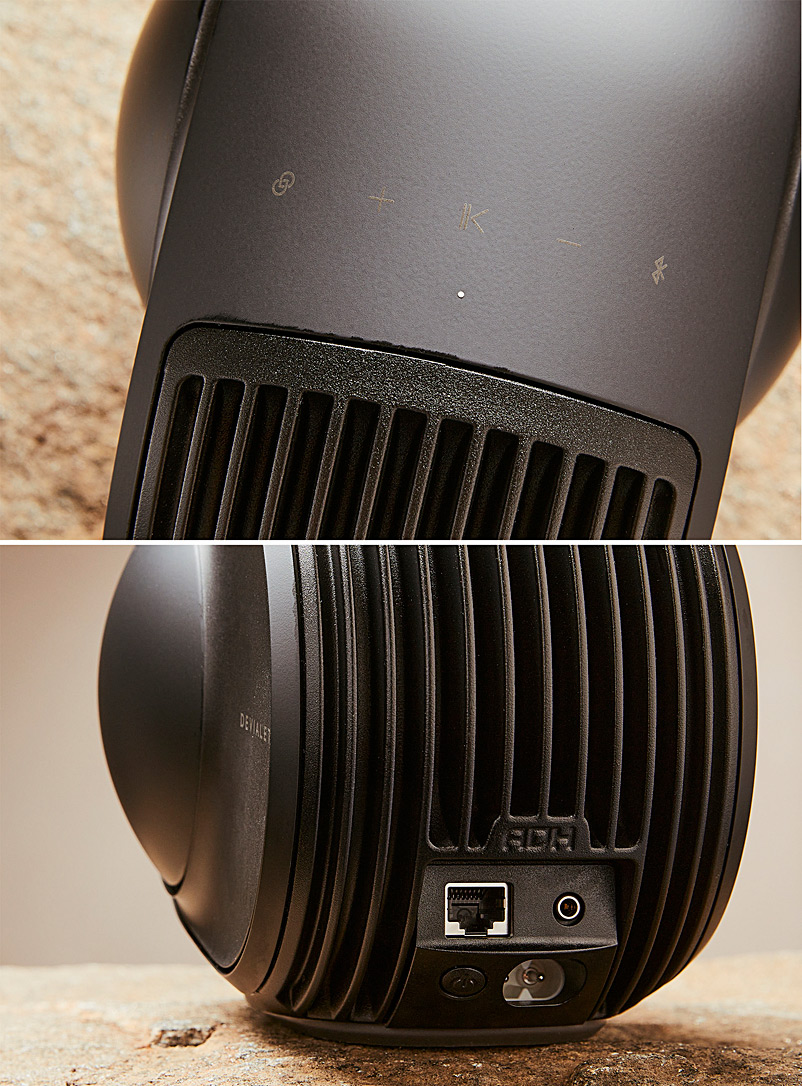
- Analog/Optical jack input
- Touch controls
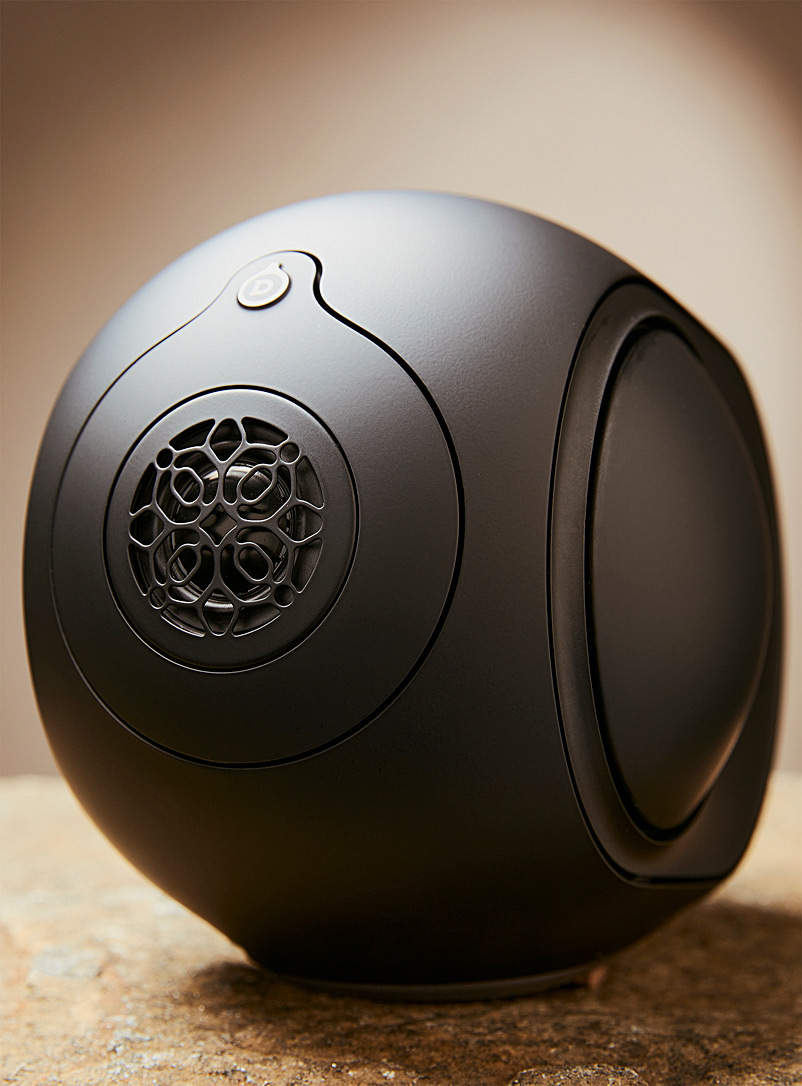
- Spherical design
- Made in France
Product Insights
The Phantom II 98 dB is a factory-calibrated wireless speaker that achieves 0.001% distortion and a 7.0 Harman score with SAM driver protection, delivering stable stereo imaging and 18 Hz bass from an 11.6 L stereo pair that replaces separate components. However, its all-in-one design comes with tradeoffs: Bluetooth supports only AAC/SBC, users report connectivity drops that require wired Ethernet, and wireless surround is not supported, despite firmware updates restoring streaming features and providing Roon Ready high-res playback.
Verified claims
- Calibration
- Devialet's SAM Lab uses laser vibrometry to characterize the Phantom II driver model, capturing over 60 parameters that the onboard SAM processor uses to correct the signal.
- Protection
- SAM continuously monitors each driver's Safe Operating Area to prevent overload.
- Sound quality
- Independent spinorama analysis gives the Phantom II a predicted preference score of 7.0 without subwoofer, and SAM's open-loop processing avoids pre-echo artifacts.
- Distortion
- The ADH amplifier achieves a claimed 0.001% total harmonic distortion plus noise even at full 400W output.
- Stereo imaging
- SAM-calibrated drivers and 0.001% THD deliver stable, precise stereo imaging.
- Preference
- Two Phantom II 98 dB models in stereo are recommended over a single Phantom I 108 dB for superior imaging and spatial audio.
- Connectivity reliability
- Users report Wi-Fi and Bluetooth connectivity problems and occasional audio cutouts; wired Ethernet is the most effective fix, with resets and firmware updates as secondary steps.
- Bluetooth codecs
- Supports only AAC and SBC Bluetooth codecs, not aptX HD or LDAC.
- Footprint
- A stereo pair of Phantom IIs occupies 11.6 L and produces 18 Hz bass.
- Audio sync
- The Devialet App's AV Sync setting reduces audio sync delay for the optical input.
- Surround
- Stereo pair delivers locked dialogue and stable imaging; wireless surround not supported.
- Setup
- Wired Ethernet and ear-level placement optimize connectivity and soundstage.
- Build construction
- Aluminum composite cabinet with zero internal wiring and automotive-grade construction.
- Durability features
- Push-push woofers cancel vibration; sealed chamber avoids port noise; SAM protects drivers.
- Reliability record
- No documented widespread hardware failures; includes 2-year warranty and firmware updates.
- Space
- Stereo pair volume (11.6 L) matches an integrated amp; no subwoofer needed.
- Placement flexibility
- Sealed design and vibration cancellation allow near-wall, shelf, or wall-mount use without boom or buzz.
- Bass
- Produces 18 Hz bass from a compact sealed cabinet without a separate subwoofer.
- Software integrations
- Roon Ready for native hi-res streaming and SAM algorithm for optimized driver control.
- Connectivity placement
- Wired Ethernet or a powerline adapter can improve connectivity stability when Wi-Fi or Bluetooth drops occur.
- High-res streaming
- Roon Ready, UPnP, and optical input deliver lossless high-res audio; AirPlay is also available.
- Network streaming
- Direct streaming endpoint via Roon Ready, UPnP, AirPlay, and Spotify Connect; Roon Ready provides native hi-res playback.
- Network stability
- Wired Ethernet is the most effective fix for frequent Wi-Fi and Bluetooth connectivity drops.
- TV audio
- The optical input enables TV audio, and the Devialet App's AV Sync setting adjusts latency.
- System integration
- The Phantom II is a powered all-in-one speaker that needs no separate amplifier or receiver because amplification, streaming, and speaker drivers are built in, but it does not support wireless surround.
- Dimensions and weight
- The Phantom II measures 157 mm wide × 168 mm tall × 219 mm deep and weighs 4.3 kg (9.5 lb); its desk or shelf footprint is roughly 157 × 219 mm plus side clearance for the outward-firing bass drivers, and a stereo pair occupies about 11.6 L.
- Bass and EQ adjustment
- The Devialet app is where bass and EQ adjustments are made; the Phantom II itself has no hardware EQ control, so low-end adjustments are handled in the app.
Product record
- Title
- Phantom Ii 98 Db Matte Black Wireless Speaker
- Brand
- Devialet
- Price
- 2100 CAD
- Availability
- Out of stock
Buying Guide
1 comparison · 14 sourcesUses
Immersive music listening in any room
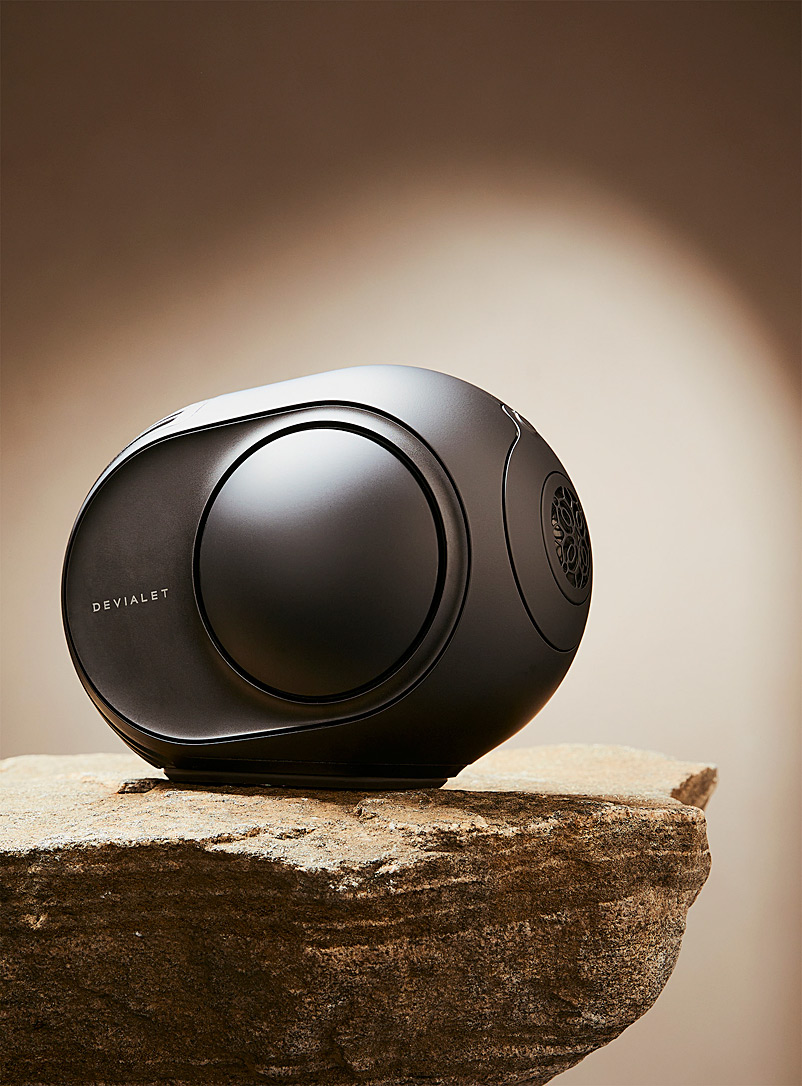
Set the Phantom II 98 dB speaker down anywhere and stream your music, letting its spherical design disperse sound evenly in all directions for an enveloping, immersive listening experience. It is a compact single speaker intended for solo use, with the retailer claiming high-fidelity sound at any listening volume, and one owner reports loving their Phantom 98dB speakers for music and movies.[2,5,7]
Immersive movie and TV sound from a compact speaker
Use the Devialet Phantom II 98 dB as your speaker for movie nights, where its wide sound stage is designed to immerse you in films, music, and games. One long-term owner reports loving the 98 dB Phantom for movies and says watching a film feels like being in a movie theater. Note that in that owner's experience, connecting via an optical cable to their TV produced very low volume compared with Spotify Connect, which they resolved by routing sound through an HDMI audio extractor with their Apple TV — a personal outcome, not a guaranteed fix for every setup.[2,5]
Streaming music over Wi-Fi, Bluetooth, or Ethernet
Stream your favorite music to the Phantom II over Bluetooth, 2.4GHz or 5GHz Wi-Fi, or Ethernet, with support for Airplay 2, Spotify Connect, and Roon, plus an analog/optical jack input for wired sources. One owner of a Phantom II pair reports strong sound quality from a compact speaker but occasional connection dropouts, even over Ethernet, that required restarting or resetting the speakers.[1,4,7,8]
Build a stereo setup with two Phantom II speakers
Pair two Phantom II 98 dB speakers for stereo sound, set up through the Devialet App. For listeners who consider stereo a must, one owner of a stereo setup recommends choosing two 98 dB speakers over a single larger 108 dB model, though that reflects his personal preference rather than a measured comparison.[3,7]
Adjusting the speaker with its touch controls
This Devialet wireless speaker has a row of touch icons on its upper rear surface, including plus and minus symbols and a Bluetooth symbol, so you can manage the speaker at a press of a button without reaching for another device. The retailer describes the touch controls as giving command of the speaker, though that phrasing is promotional.[7,8]
Big bass without giving up shelf space
For small rooms where a separate subwoofer isn't practical, one owner reports that the compact Phantom II delivers powerful bass no other speaker its size could match, saving them the space a subwoofer would take. Its rounded shell sits on a flattened base, so it rests stably on a shelf or table. The same owner notes occasional connection issues that required restarting or resetting the speakers.[4,9]
Product comparison
Compared within this brand.
| Phantom Ii 98 Db Matte Black Wireless Speaker: Choose this if you want an ultra-compact wireless speaker that delivers high fidelity at any volume, with a 98 dB SPL maximum at 1 meter, 400 Watts peak amplification, and an 18Hz to 21kHz frequency response. It suits small spaces: one owner says it saved them from needing an additional subwoofer and couldn't find another compact speaker with bass like the Phantom, and another owner loves the 98dB model for music and movies. Connectivity covers AirPlay, Bluetooth, Spotify Connect, Wi-Fi, Ethernet, and an analog/optical input, with stereo pairing via the Devialet app, though one owner reports occasional connection issues requiring restarts and low volume over a wired optical TV connection.[1,4,5,6,7] | Mania 95 Db Wireless Speaker: Choose this if you want a portable, high-fidelity speaker for smaller indoor spaces: it projects 360-degree sound with deep bass extending to 30 Hz and up to 95 dB SPL at 1 meter, and owners report punchy, balanced sound that impresses listeners around a table. Its integrated handle and 2.3 kg body make it easy to carry, and it connects via Bluetooth, AirPlay, and Spotify Connect with stereo pairing through the Devialet App. Be aware that one long-term owner reports only about 4 hours of battery at moderate volume, and reviewers say it is not loud enough for parties, bigger rooms, or outdoor use.[10,11,12,13,14] |
Image Analysis
3 images- 01
Product
Oblong matte-black wireless speaker with an oval/egg-shaped body, a large circular driver-like panel on the visible face, a decorative circular grille on the right side, and the word DEVIALET printed on the front left face.
- Overall shapeEgg-shaped / horizontally oriented oval enclosure with a flattened base so it sits stably on a surface.
1 region
x 0.12 · y 0.34 · w 0.76 · h 0.44 (high) - Front circular panelLarge circular, slightly recessed disk centered on the visible face, surrounded by a shallow concentric ring and integrated into a slightly indented oval panel.
1 region
x 0.20 · y 0.41 · w 0.46 · h 0.36 (high) - Side grilleSmaller circular grille on the right side with a decorative multi-spoke or petal pattern visible through the round opening.
1 region
x 0.68 · y 0.42 · w 0.14 · h 0.21 (high) - Finish and textureSmooth matte finish across the body with slightly different tonal shading on the central disk versus the surrounding shell caused by lighting; surfaces appear non-reflective and finely textured.
1 region
x 0.18 · y 0.36 · w 0.64 · h 0.44 (high) - Brand text on face“DEVIALET”
1 region
x 0.18 · y 0.57 · w 0.18 · h 0.07 (high) - Base detailNarrow flattened base visible beneath the body that the speaker rests on; base is slightly recessed relative to the shell.
1 region
x 0.31 · y 0.70 · w 0.38 · h 0.06 (medium)
Other
Product photographed on a textured rock surface with warm gradient background and directional studio lighting from above-left producing soft vignette and a soft shadow beneath the speaker.
- Support surfaceRough textured rock slab with visible stratified edges, occupying the lower portion of the frame and supporting the speaker.
1 region
x 0.04 · y 0.70 · w 0.92 · h 0.30 (high) - Background and lightingWarm beige-to-brown gradient background with a lighter halo behind the speaker and soft directional lighting from upper-left creating highlight on the top-left of the enclosure and a soft shadow beneath and to the lower-right.
- Shot compositionThree-quarter front view showing the front disk and the right-side grille; product centered horizontally and placed slightly above the lower third of the frame.
Colors
matte black· main shell#231E19dark charcoal· front circular disk#26211Blight gray· brand text- Overall shapeEgg-shaped / horizontally oriented oval enclosure with a flattened base so it sits stably on a surface.
- 02
Product
A matte black spherical speaker shell with a circular decorative driver grille on the left-facing side, a recessed circular logo button near the top, and a rounded side panel or passive radiator visible on the right side.
- Overall shapeSpherical shell with a flattened base so the sphere rests stably; visible front-left portion of the sphere dominates the image.
- Primary finishUniform matte black finish across the visible shell with a fine, slightly textured surface that diffuses highlights.
- Driver grilleCircular recessed driver opening with a decorative multi-lobed lattice grille that has organic petal-like cutouts and a concentric outer ring.
1 region
x 0.17 · y 0.30 · w 0.36 · h 0.36 (high) - Top button or badge“Small raised circular button or badge near the top of the sphere with a single letter 'D' centered inside the circle.”
1 region
x 0.40 · y 0.12 · w 0.08 · h 0.07 (high) - Side panel / passive radiatorRounded recessed side panel or passive radiator on the right side with a narrow gasket-like seam surrounding it and a slightly more reflective surface than the main shell.
1 region
x 0.66 · y 0.24 · w 0.30 · h 0.54 (high) - Seam linesVisible shallow seam outlines and circular machining lines around the grille and on the sphere that define panels and recessed areas.
- Base contactLower rim of the sphere shows a slight shadowed foot or base contact area where it meets the surface, visible as a thin dark ring at the bottom.
1 region
x 0.28 · y 0.80 · w 0.44 · h 0.12 (medium)
Other
Studio-style photograph showing the product on a textured stone surface against a warm gradient background with soft directional lighting from the upper left producing subtle highlights and soft shadows.
- Shot compositionClose three-quarter view focusing on the front-left and right-side elements of the sphere; product is centered slightly left of image center.
- Supporting surfaceRough textured stone or concrete slab under the speaker visible at the bottom of the frame.
1 region
x 0.00 · y 0.75 · w 1.00 · h 0.25 (high) - Lighting and shadowWarm directional lighting from upper left creates a soft highlight along the left-top curve and a gentle shadow on the lower-right of the sphere.
- BackgroundSmooth warm beige to light brown gradient backdrop that is out of focus and uncluttered.
1 region
x 0.00 · y 0.00 · w 1.00 · h 0.65 (medium)
Colors
matte black· main shell#1A1611charcoal black· driver grille#0E0E0Adark charcoal· side panel / passive radiator#1E1A12- 03
Product
Rear view of a matte black, rounded wireless speaker showing a top control area with touch icons, a central vertical finned heat-sink or grille, and a lower port cluster with an Ethernet-style jack and a circular power/input jack.
- Overall shapeRounded, egg-like outer shell with a curved matte finish visible on the left and right sides; rear center section transitions into a deep vertical finned panel.
1 region
x 0.05 · y 0.05 · w 0.90 · h 0.90 (high) - Top control iconsA horizontal row of small touch icons across the upper rear surface including a chain/link symbol, plus sign, a stylized K or pause/play mark, minus sign, and a Bluetooth symbol; a small circular indicator LED is centered below the icons.
1 region
x 0.28 · y 0.06 · w 0.44 · h 0.18 (high) - Finned grilleTall array of evenly spaced vertical fins forming a rear heatsink or grille with a textured matte surface; fins are recessed into a rectangular surround with rounded top corners.
1 region
x 0.16 · y 0.28 · w 0.68 · h 0.56 (high) - Port clusterLower recessed rectangular port area containing an Ethernet-style RJ45 jack at left of the recess and a circular DC-style jack at right; below the recess is a round recessed button with a power glyph visible inside.
1 region
x 0.40 · y 0.72 · w 0.28 · h 0.22 (high) - Surface finish detailMatte black paint on the curved shell contrasts with a slightly rougher, textured finish on the finned panel and port surround.
1 region
x 0.12 · y 0.05 · w 0.76 · h 0.86 (high) - Side stamped text“Vertical faint text reading DEVIALET on the left rounded side panel.”
1 region
x 0.12 · y 0.56 · w 0.12 · h 0.26 (medium)
Other
Two-panel composite image showing the same product from slightly different vertical crops placed one above the other, photographed on a textured stone surface with warm studio lighting producing soft highlights and mild shadows.
- Image layoutImage is split into an upper and lower panel separated by a thin white divider; upper panel shows the top control area and upper fins, lower panel shows the lower fins and ports.
1 region
x 0.00 · y 0.00 · w 1.00 · h 1.00 (high) - Background and surfaceProduct placed on a coarse, tan-colored stone or concrete surface; out-of-focus neutral warm background behind the speaker.
1 region
x 0.00 · y 0.60 · w 1.00 · h 0.40 (high) - LightingWarm directional studio lighting from the right produces soft highlights on the curved shell and subtle shadowing in the fin recesses.
Colors
matte dark charcoal black· curved outer shell#231C14textured deep black· finned grille and port surround#0E0D09muted gold· touch icons and small indicator#918D8D- Overall shapeRounded, egg-like outer shell with a curved matte finish visible on the left and right sides; rear center section transitions into a deep vertical finned panel.
Brand PDP Lookup
- Brand
- Devialet
Devialet Phantom II 98 dB Stereo - Speaker - Matte Black
Documents & Data
Reddit Insights
5 threads · r/Bluetooth_Speakers, r/devialet, r/StereoAdviceReddit users are generally impressed by the Devialet Phantom II 98 dB's exceptional bass and compact design, but frequently warn about frustrating connectivity issues and software bugs that detract from an otherwise premium experience.
The product receives high praise for its sound quality, bass, and design, but recurring reports of connectivity and software problems, along with concerns about price and surround limitations, result in a mixed overall sentiment.
Themes
Use Cases
- Home theater and TV audio
- Compact living room stereo system
- High-fidelity music streaming
Watch Out For
Compared To
vs Traditional passive speaker systems (e.g., SVS Ultra Evolution Towers)
The Phantom II offers deeper bass and a smaller footprint without needing an external amplifier, but lacks the ability to easily expand into a surround sound setup.
vs Single Phantom I 108 dB
Two Phantom II 98 dB speakers in stereo are generally preferred over a single more powerful Phantom I for a better soundstage.
Source Threads
Phantom sound quality and surround limitations
Those who do have an interest and have asked me to demonstrate the Phantoms against other speakers I had at the time all prefer the Phantoms over the larger floor standing speakers, including new speakers costing over twice the price. Bass, and lots of bass, is impressive. They look good. Spouse approval; which the larger speakers do not have and deliver most of what the bigger speakers do but in a small box. Some say that they need to be driven loud to balance out the bass. I don't find that and can listen to them at length at more modest listening levels. For me they fail on not being upscaled for surround. To go the route of surround I would have to replace with custom Phantoms that use Ethernet for connection. So as surround they are not a wireless solution. I went to WiSA speakers instead.
u/Known_Confusion9879r/Bluetooth_SpeakersView thread →
Recommendation for 2x Phantom II 98 dB over single 108 dB
If you ask in r/Audiophile you’d get some different answers. Personally I’ve never regretted my stereo 105dB setup. For me stereo is a must, so my advice would be rather 2x 98 than just one 108.
u/luclinor/devialetView thread →
Positive experience with Phantom 98 dB and TV connection tip
Great review. I have the phantom 98db’s and I love them for music and movies. I do have a solution for you: I also used the optical cable, wired with my tv. The sound was very low if I compared it to Spotify Connect. I changed the connecting from my tv to a HDMI audio extractor, connected with my Apple TV. This solved the problem for me. If I watch a movie, it’s like you are in a movie theater. I love these things!
u/AstaVistaJokerr/devialetView thread →
Mixed experience: great sound but horrible software and connectivity
I own a pair of Phantom II 95dB, they provide amazing sound quality but the software package is horrible, even i connected both of them via ethernet cable, still encountering connection issue occasionally, one speaker have no sound coming out, you have to restart or even reset to get things solved. But just be frank, i still cannot find any speaker in such compact size which can provide powerful bass like Phantom, they really save me a lot of space from additional subwoofer
u/Every_Control_8383r/devialetView thread →