Tekla
Solid Pure Organic Cotton Percale Pillow Sham See Available Sizes
This Tekla pillow sham is a GOTS-certified 100% organic cotton percale accessory with a 200-thread-count weave and an envelope closure. It is available in Standard/Queen size (19.75 x 35.5 inches) and King size (19.75 x 42 inches), and it is made in Portugal. The sham fits matching pillow inserts and provides a smooth, breathable surface for everyday use.
- Material
- 100% organic cotton percale
- Style
- modern, minimal
- Category
- Home & Garden > Linens & Bedding > Bedding > Pillowcases & Shams
Specifications
Solid organic cotton percale pillow sham from Tekla, featuring 200 thread count, soft touch, and GOTS certification.
200 thread count organic cotton percale, ultra-long threads for softness and color depth, GOTS-certified, made in Portugal.
- Material
- 100% organic cotton percale
- Style
- modern, minimal
- Occasion
- everyday
- Age Group
- adult
- Condition
- new
- Category
- Home & Garden > Linens & Bedding > Bedding > Pillowcases & Shams
Additional Attributes
- organic cotton percale
- 200 thread count
- GOTS-certified
- made in Portugal
- solid
- pillow sham
- soft
- lightweight
- deep pure color
- no pilling
Product Insights
Tekla's Solid Pure Organic Cotton Percale Pillow Sham uses 100% organic extra-long staple cotton, GOTS-certified and made in Portugal, blending immediate stonewashed softness with durable pill resistance and vibrant color retention from even dye absorption. Its 200 thread count keeps sleep cool, but dark shades like blue and pink can fade noticeably over time, and shrinkage is possible with high heat. The $60 CAD price reflects labor-intensive stonewashing, offering a tradeoff between instant comfort and careful maintenance for long-term performance.
Verified claims
- Fabric
- 100% organic extra-long staple cotton resists pilling and stonewashing provides immediate softness.
- Color retention
- Extra-long staple fibers absorb dye evenly, supporting deep, fade-resistant colour through repeated washing; some buyers report that dark shades like blue may discolor over time.
- Breathability
- 200 thread count combined with extra-long staple cotton balances strength and airflow for a cool sleep.
- Competitive position
- Tekla explicitly uses extra-long staple cotton, while comparable organic percale shams use generic long-staple.
- Softness
- Immediately soft and relaxed from lightly stonewashed percale.
- Durability
- Pilling is minimal thanks to extra-long staple cotton and the percale weave that locks threads in place.
- Value
- The $60 CAD price partly reflects labor-intensive stonewashing, unlike competing organic percale.
- Eco-friendliness
- Mechanical stonewashing aligns with GOTS certification, no chemical softeners.
- GOTS certification
- GOTS certifies the 100% organic cotton across the full supply chain.
- Ethical production
- EU‑regulated Portuguese production adds ethical credibility beyond GOTS certification
- Hand feel
- Stonewashed finish gives a soft, lived‑in texture from the first use
- Thread count
- 200 thread count places this percale in the 180-280 breathable sweet spot.
- Ethical manufacturing
- Made in Portugal, GOTS-certified: social audits, banned heavy metals.
- Design
- Copenhagen-based Tekla uses a restrained, modern palette that includes Broken White, Soft Grey, and darker shades like blue and pink; the Standard/Queen sham is European-cut 50x90 cm.
- European pillow fit
- 50×90 cm fits European pillows; envelope closure adapts to US queen.
- Shrinkage
- Shrinkage possible in high heat; low-temp care preserves intended fit.
- Color care
- Buyers report dark shades like blue may discolor; washing separately with mild detergent minimizes fading.
- Care longevity
- Following Tekla's care instructions supports long-term softness, pill resistance, and color retention.
- Fading
- Some buyers report that dark shades like blue and pink may fade or discolor noticeably over time, tempering the brand's colour-longevity claim for those shades.
- Envelope closure
- The sham has an envelope closure, which lets it accommodate a slightly shorter standard queen pillow.
- Reported durability concerns
- Some buyers report poor durability, including covers ripping and pillows disintegrating.
Product record
- Title
- Solid Pure Organic Cotton Percale Pillow Sham See Available Sizes
- Brand
- Tekla
- Price
- 60 CAD
- Availability
- In stock
Image Analysis
2 images- 01
Product
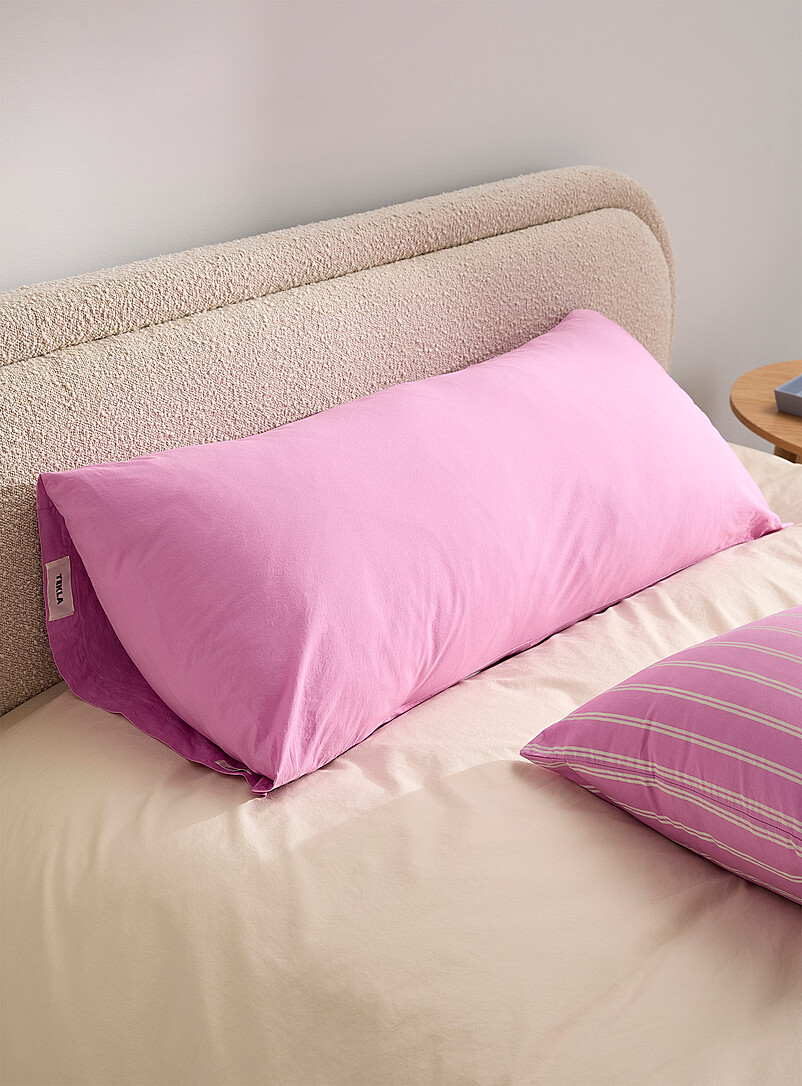
A long rectangular pillow sham with a solid bright pink front and an open envelope flap at the left side; a smaller striped pillow is partially visible at the lower right.
- Sham overall shapeLong rectangular pillow sham with soft, lightly wrinkled surface and a flap-style opening at the left end that folds under the pillow.
1 region
x 0.05 · y 0.24 · w 0.85 · h 0.46 (high) - Fabric texture and finishSmooth percale-like cotton surface with gentle creasing and matte finish; fabric appears lightweight and slightly crumpled where pressure from the pillow fills it.
1 region
x 0.08 · y 0.30 · w 0.80 · h 0.40 (medium) - Left flap and labelOpen envelope-style flap on the left side with a vertical rectangular fabric label sewn into the outer seam.
1 region
x 0.02 · y 0.38 · w 0.08 · h 0.18 (high) - Label text“TEKLA”
1 region
x 0.02 · y 0.38 · w 0.08 · h 0.18 (high) - Secondary pillow visiblePartial view of a smaller rectangular pillow at the lower right with horizontal lighter stripes on a darker pink background.
1 region
x 0.62 · y 0.66 · w 0.32 · h 0.24 (high)
Other
Bed styling and scene context including textured headboard, bedding surfaces, and small bedside table; soft directional lighting from upper left creates gentle shadows.
- HeadboardCurved-top upholstered headboard in a textured cream bouclé fabric visible behind the pillow.
1 region
x 0.00 · y 0.00 · w 0.88 · h 0.28 (high) - Bed sheet surfaceLight beige or cream flat sheet forming the visible bed surface beneath the pillow, with subtle creases and soft shadows.
1 region
x 0.03 · y 0.63 · w 0.94 · h 0.33 (high) - Bedside tableRound wooden bedside table visible at the right edge holding a small rectangular object, only the tabletop and object corner are visible.
1 region
x 0.90 · y 0.36 · w 0.10 · h 0.14 (medium) - Lighting and shadowsSoft directional lighting from the upper left producing gentle, diffuse shadows under the pillow and subtle highlight along the top edge.
Colors
bright cool pink· main sham face#D48AADsaturated pink· sham flap and inner side#B56989striped pink and cream· secondary striped pillow#BB6A8Cpale cream· secondary pillow stripe color- Sham overall shapeLong rectangular pillow sham with soft, lightly wrinkled surface and a flap-style opening at the left end that folds under the pillow.
- 02
Product
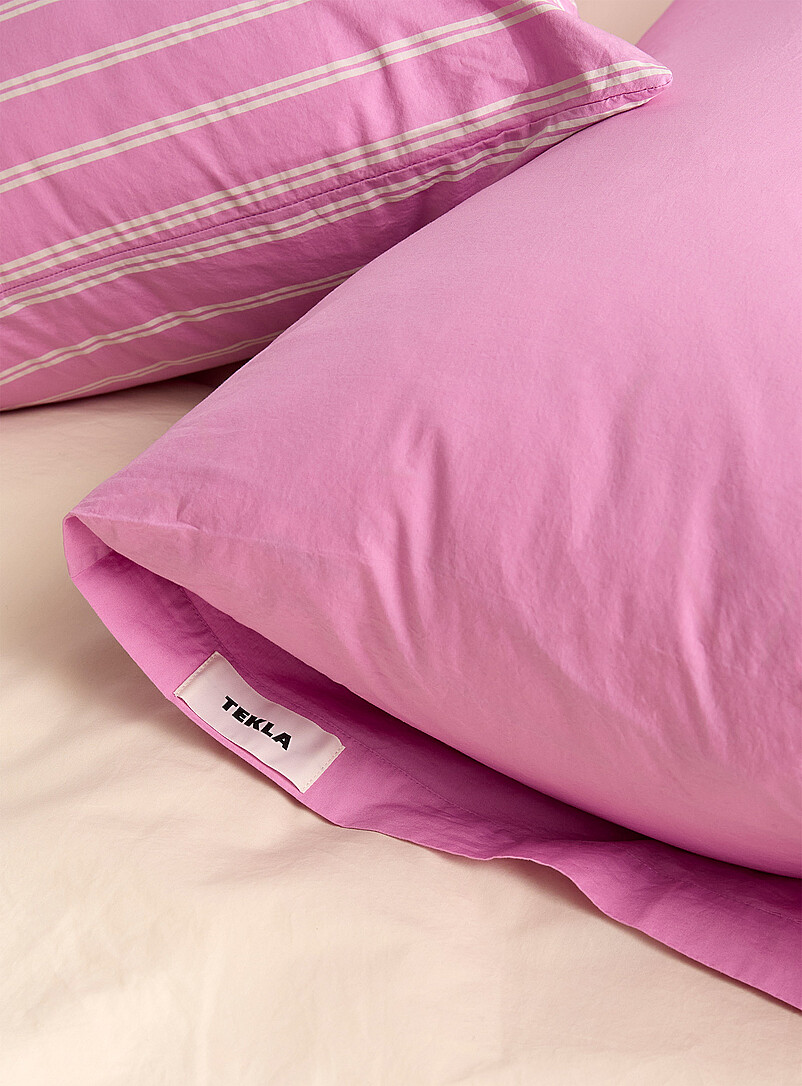
Close-up of two pillow shams: a plain solid pink sham in the foreground and a pink sham with narrow cream horizontal stripes behind it; a sewn rectangular fabric label reading TEKLA is visible on the inner hem of the foreground sham.
- Solid front shamLarge plain pink pillow sham shown in the foreground with a simple turned hem and visible soft wrinkles on the surface.
1 region
x 0.32 · y 0.15 · w 0.56 · h 0.66 (high) - Striped rear shamPartially visible pillow sham behind the foreground one with a pink base and repeating narrow horizontal cream stripes; stripes run parallel to the pillow edge.
1 region
x 0.00 · y 0.00 · w 0.70 · h 0.36 (high) - Envelope opening and hemInner envelope opening of the foreground sham is visible along the bottom edge, showing the folded hem and fabric overlap.
1 region
x 0.10 · y 0.68 · w 0.62 · h 0.22 (high) - Fabric labelRectangular sewn fabric label attached to the inner hem, partially tucked under the sham.
1 region
x 0.18 · y 0.71 · w 0.18 · h 0.10 (high) - Surface texturePercale-like tightly woven cotton appearance with small irregular wrinkles and soft matte finish visible across both shams.
1 region
x 0.30 · y 0.14 · w 0.60 · h 0.68 (medium) - Label text“TEKLA”
1 region
x 0.18 · y 0.71 · w 0.18 · h 0.10 (high)
Other
Close cropped studio shot on a neutral light background with soft even lighting and minimal shadow; image focuses on fabric detail and label.
- Shot compositionTight close-up framing showing two stacked pillow shams with foreground sham occupying most of the frame and rear sham visible at top left.
- Background surfaceLight neutral sheet or surface seen under the pillows, visible at the bottom left and lower edge of the image.
1 region
x 0.00 · y 0.80 · w 0.60 · h 0.20 (high) - Lighting and shadowsSoft diffuse lighting with gentle shadows under the pillow folds and along the envelope opening, no harsh specular highlights.
- Image cropUpper right corner of the foreground pillow is cropped by the image edge.
1 region
x 0.72 · y 0.00 · w 0.28 · h 0.20 (high)
Colors
medium pink· foreground sham fabric#D27EA2medium pink· striped sham base#D57EA9cream· striped sham stripesoff-white· fabric label- Solid front shamLarge plain pink pillow sham shown in the foreground with a simple turned hem and visible soft wrinkles on the surface.
Brand PDP Lookup
- Brand
- Tekla
Percale pillow sham – Broken White
Variants
6 SKUs| SKU | Title | Price | Avail |
|---|---|---|---|
| 4486076 | Solid Pure Organic Cotton Percale Pillow Sham See Available Sizes - White - Std P/c | CA$60.00 | Yes |
| 4486108 | Solid Pure Organic Cotton Percale Pillow Sham See Available Sizes - White - King P/c | CA$80.00 | Yes |
| 4486077 | Solid Pure Organic Cotton Percale Pillow Sham See Available Sizes - Blue - Std P/c | CA$60.00 | Yes |
| 4486109 | Solid Pure Organic Cotton Percale Pillow Sham See Available Sizes - Blue - King P/c | CA$80.00 | Yes |
| 4491468 | Solid Pure Organic Cotton Percale Pillow Sham See Available Sizes - Pink - Std P/c | CA$60.00 | Yes |
| 4491469 | Solid Pure Organic Cotton Percale Pillow Sham See Available Sizes - Pink - King P/c | CA$80.00 | Yes |
Documents & Data
Reddit Insights
1 threads · r/BeddingReddit users report negative experiences with Tekla bedding, citing poor durability and customer service, though towels are an exception.
Multiple users experienced ripping, disintegration, and poor customer service, with only towels praised.
Themes
Watch Out For
Source Threads
User reports poor durability of Tekla pillow covers
I have the pillow covers which are still the same colour as it was before but the cover has completely changed and when you see it next to each other it’s incomparable. The corners are also all ripped up this was super disappointing.
u/lostandsad88r/BeddingView thread →